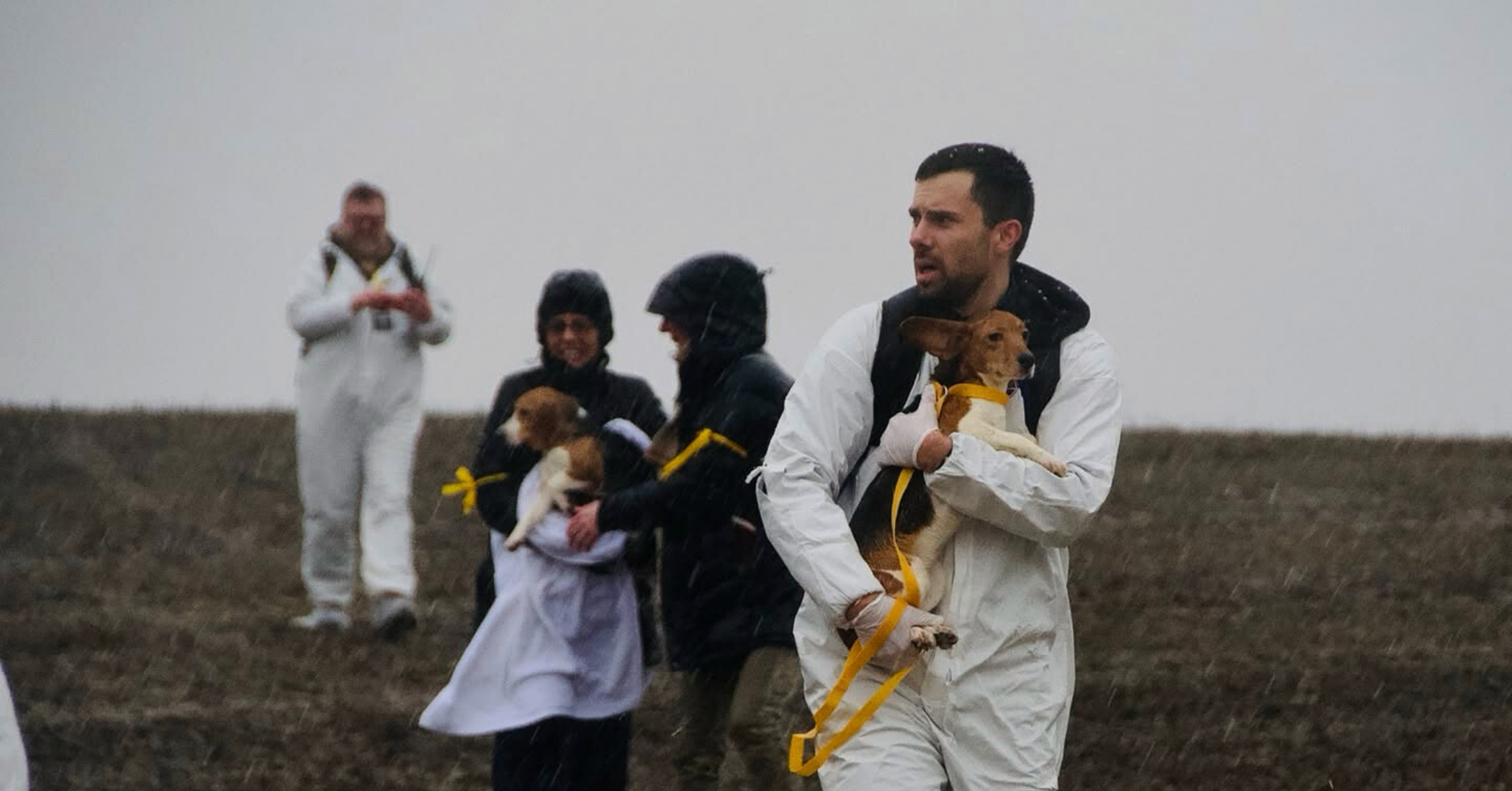
On Sunday morning, animal advocates entered Ridglan Farms—the country’s second-largest breeder of dogs for experimentation—and carried victims out.
Twenty-two dogs made it to safety and are now experiencing life outside cages for the first time.
Ridglan exists to breed, trade, and exploit the lives of dogs roundly described as docile and trusting.
Sunday’s rescue made this painfully clear, as we all watched dogs who had spent their entire lives incarcerated in Ridglan’s sheds respond to unknown humans with gentleness. They allowed themselves to be hugged, kissed, and carried by humans they had never met—even amid the urgency of the rescue operation.

Moments like these make the truth impossible to ignore.
Indeed, in their bold action, the animal rescuers further helped collapse the very myth that Ridglan, and the broader animal research industry, bank on.
The “Lab Dog” Lie
USDA Class A breeders like Ridglan want members of the public to view the dogs they harm as somehow different from the dogs who share our homes. This bogus distinction was motivated, in part, by public uproar over the use of shelter and other companion dogs in research: faced with regulations and bans on the use of shelter and other companion dogs, industry invested in “purpose-bred” dogs who would come to “occupy a second tier of concern.”
Ridglan has relied on this fake dichotomy for both its revenue and its public relations, effectively arguing that it’s acceptable for industry to breed and use Ridglan’s dogs in experiments claimed to benefit humans or other dogs. Rise for Animals has previously explained how this false logic leads to the sacrifice of some dogs for others, and career laboratory veterinarian Larry Carbone describes how this approach privileges “the dogs we really care about, the pets who need the best vaccines and antibiotics and medical care.”
This “separation of dogs into various tiers of concern,” observes Carbone, “starts with where we get the dogs in the first place.”
Breed dogs in a facility like Ridglan.
Keep them out of public view.
Label them as “research animals.”
Then their suffering becomes easier for the industry to hide—and easier for the public to ignore.

The Policies That Created Facilities Like Ridglan
The idea that some dogs matter more than others didn’t emerge by accident. It was built into the system itself—and it’s why Ridglan exists in the first place.
Ridglan Farms is a product of our animal welfare policies, or lack thereof: Ridglan was actually established in 1966, the very same year the federal government passed the first version of the Animal Welfare Act (AWA), which set some limits on the trade in dogs for research.
At the time, the law was crafted as a response to public outrage stemming from exposés of a disturbing pipeline that routed companion dogs—some believed to have been stolen from their guardians—into laboratories. The AWA purported to help regulate that pipeline in an effort to prevent still-wanted companions from finding themselves in labs, but it did not intend to stop the flow of dogs into laboratories.
Industry was inspired to invest more heavily in a new supply chain: breeding dogs specifically for experimentation.
Enter Ridglan Farms
Commercial facilities like Ridglan became the institutionalized “dog to lab” pipeline, ensuring that laboratories would have a continuous—and less controversial—supply of dogs to exploit.
Post-AWA efforts on the state level to protect shelter dogs from researchers further grew the demand for commercially-bred dogs. Pound seizure laws (which prohibit the transfer of shelter dogs to laboratories for research) “were a boon for commercial kennels breeding dogs, mostly beagles, for science,” according to Carbone.
How Ridglan Avoided Accountability
Not only has Ridglan Farms benefited from regulations claiming to protect animals, but it has also been shielded by them.
The AWA, as administered by the United States Department of Agriculture (USDA), has been interpreted in ways that allow Ridglan to escape accountability. And, while state-level violations tied to Ridglan’s treatment of animals have accumulated, federal (USDA) inspectors have failed to document similar wrongdoing—though that tide may be turning.

Earlier this year, a USDA inspector actually documented violations under both Ridglan’s Class A license and Class R registration. Notably, the inspections giving rise to these violations were the first led by an inspector different from the one Rise for Animals publicly identified as having overseen Ridgan’s USDA inspections for over a decade.
Whether Ridglan Farms will face any meaningful legal accountability remains to be seen.
But, thanks to the ongoing efforts of animal advocates—including Sunday’s brave rescuers—Ridglan is facing a continued public reckoning.
Why Sunday’s Rescue Matters
By removing dogs from Ridglan Farms, animal advocates both saved individual lives and challenged the very logic on which facilities like Ridglan depend. They refused to accept that some dogs are companions while others are commodities. They refused to accept that the difference between a family member and an acceptable laboratory subject is simply where someone is born.
For the 22 beagles carried out of Ridglan on Sunday morning, that refusal meant everything.
And for the thousands of other dogs still trapped inside facilities like Ridglan, it sends a message just as powerful: we see you, we reject the lie that you matter less, and we won’t stop fighting for your freedom.
Your Call to Action: Please take a moment right now to send a message to the Dane County Sheriff’s Office urging them to work with appropriate agencies to remove the dogs from Ridglan Farms and transfer them to rescues, fosters, and adoption programs.
Send Your Letter: Free the Dogs