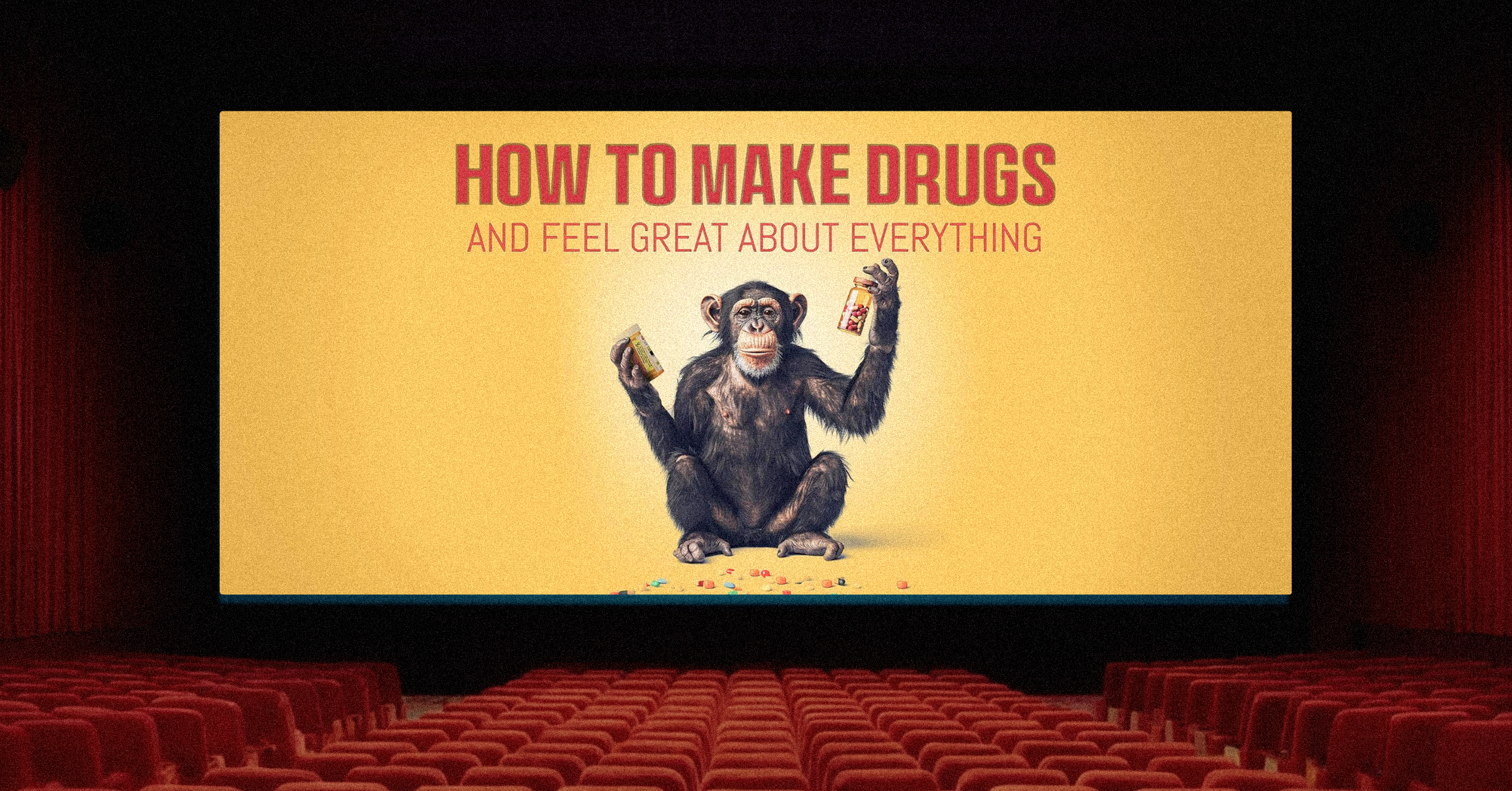
Rise for Animals is proud to have helped sponsor How to Make Drugs and Feel Great About Everything, a film that sheds light on some of the animal research industry’s most insidious lies.
Among them, the myth that experimenting on nonhuman animals is necessary to save human lives.
Spoiler alert: It’s not. And it never has been.

One Myth, Multiple Species
Dr. Aysha Akhtar—co-founder and CEO of the Center for Contemporary Science, a revolutionary initiative Rise for Animals helped launch—cuts straight through the noise. She reminds us that claims about genetic similarity between humans and other animals are nothing but red herrings.
Yes, mice and humans may share 85% of their DNA, but, as Dr. Akhtar articulates, that’s “not a good number” when you’re trying to use mice to predict human outcomes.
This is not only obvious but has practically been admitted by the U.S. government—the world’s largest funder of animal research—itself. When ending invasive research on chimpanzees (humans’ closest relatives, with whom we’re claimed to share over 98% of our DNA), the government declared their use “unnecessary” for the advancement of human health and not “supported by science.”
Yet, somehow, the animal research industry wants us to believe that the use of animals far less genetically similar to us is not only justified but essential.

We’re Using the Wrong Map
The industry’s very existence relies on getting us to believe this, in fact—to our severe detriment.
As Dr. Alka Chandna, Vice President of Laboratory Investigations at PETA, distills down clearly: relying on nonhuman animals to develop treatments for humans is like using a map of Australia to get from California to D.C. It’s a map—but it’s the wrong map for what you’re trying to do, and it leads somewhere other than where you’re trying to go.
Still, the industry keeps handing it to us—and researchers keep following it—because we’re told it’s the only map that exists. (It’s not.)

We’re Running From, Not Toward, Cures
To get us to keep following, the industry relies on various corrosive tools, including false hope—as called out by Dr. Charu Chandrasekera, formerly of the Canadian Centre for Alternatives to Animal Methods (CCAAM) (another Rise for Animals-supported initiative).
Charities raise money by promising that cures for human illnesses are “around the corner”—only, they pour these donations right into animal research, and the cures don’t materialize. In this way, and with an irony that Dr. Chandrasekera captures perfectly, those race-for-a-cure fundraisers actually have us running from cures, not toward them.
(Charities contacted by filmmakers either declined interviews or ignored the inquiry altogether.)
Fear and False Hope
The film’s critique of false hope echoes the work of Americans for Medical Advancement’s Dr. Ray Greek.
Dr. Greek has observed that human support of animal research is driven by fear of dying—that humans cling to animal research in “the hope of denying death” and for the promise “that someone somewhere is working on preventing their death.” Only, the comfort provided by animal research is just an illusion.
In fact, “[m]uch of biomedical science ends up stranded” in what researchers have taken—ironically—to calling “‘the valley of death’: the huge divide between promising preclinical studies, many of which involve testing on animals, and genuine breakthroughs in human medicine.” (As we know, an estimated 95% of drugs and therapies showing promise in animal studies fail for reasons of safety and/or efficacy in human trials.)
But it gets worse, because, as Dr. Greek observes, animal research doesn’t just fail to help—it actually “prolongs, rather than eases, human suffering by inhibiting medical progress and diverting funds from more effective research modalities.
A 95% Failure Rate—and Still Protected
Dr. Chandrasekera puts it plainly: the biomedical industry is the only industry on the planet that “protects a 95% failure rate.”
What other industry could survive such failure? What other system would be allowed to?
Science, says Dr. Chandrasekera, is supposed to be evidence- (not belief-) based, and its integrity depends on its ability to change. Not so at the hands of the animal research industry, which has traded integrity for ideology, and innovation for inertia.
Case in point: today, human biology—the most scientifically relevant model for humans—is treated as an alternative, as opposed to the gold standard. If that’s not proof that, as Dr. Chandrasekera asserts, both the system and culture of modern science need reimagining, what is?
Love, According to the Industry
Well, actually, maybe the fact that the animal research industry equates “love” with hurting animals for money and squandering limited resources on bad science?
Enter Cindy Buckmaster of animal research industry mouthpiece Americans for Medical Progress. First, Buckmaster repeats one of the industry’s most exhausted and baseless talking points: that every single medical convenience has relied on animal research. (As we’ve previously highlighted, not only is this claim unproven and unprovable, but it ignores a basic truth: using animals is not the same as needing to use animals.)
Next, she doubles down on delusion, perversely claiming that only those who “love” humans and other animals “so deeply” are capable of performing animal research for years. According to industry, then, “love” is synonymous with:
Torturing.
Killing.
Exploiting.
Manipulating.
Breaking promises.
Perpetuating false hope.
Inflicting suffering.
And, of course—at the core—chasing dollars above all else.
A Business Built on Greed, Not Good
The film reminds us of this overarching, inescapable truth: animal research is big business.
Dr. Akhtar highlights the vastness of the industry’s actors—spanning labs, breeders, equipment vendors, and transporters—all of whom are profiting from and working to protect the status quo; and who together wield incredible power, including the ability to shape laws that directly affect them (and those of us fighting for change).
Real Change Requires Us
How to Make Drugs and Feel Great About Everything is more than a documentary. It’s a call to action.
The film makes clear that animal research isn’t about helping humans (other than those making money off it). Rather, it’s about reaping profit by manufacturing public trust—and perpetuating public ignorance.
And that means that real change won’t come from within the system.
As Dr. Frances Cheng says: change will only come through political will—and that means through us.
Together, we must rise—to demand that science evolve. To reject the weaponization of hope. And to stop the exploitation of animals.
Not by reforming the industry. But by dismantling it—and throwing every last cage door wide open.
Watch the Film: How to Make Drugs…