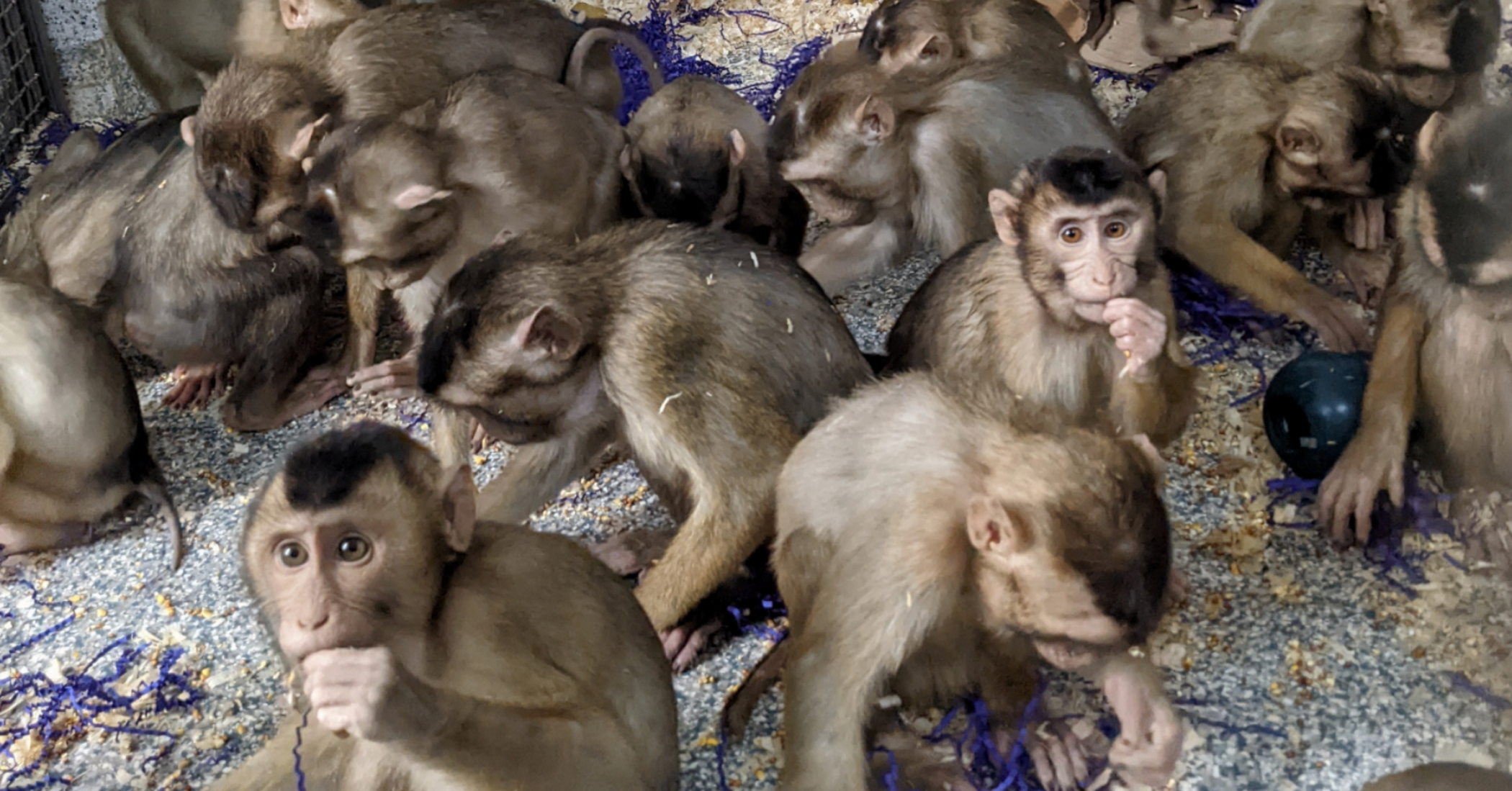
Washington State requires public health reporting when certain infectious diseases are diagnosed in humans. Yet, when those same zoonotic diseases—diseases that can pass between nonhuman animals and humans—are detected in monkeys inside research facilities, there is no reporting requirement.
At the Washington National Primate Research Center (WaNPRC), monkeys have reportedly been diagnosed with “notifiable conditions” like Shigella, Campylobacter, and Giardia—all without the facility reporting these conditions to Washington health officials.
Animal research facilities cannot be allowed to continue exploiting this loophole.
That is why Rise for Animals is joining with PETA, the Physicians Committee for Responsible Medicine, and the Northwest Animal Rights Network in asking the Washington State Board of Health to close it.
This Thursday, the Board is set to consider a petition that would require laboratories to report “notifiable conditions” detected in nonhuman primates—whether or not those pathogens have already infected human bodies.
Disease Prevention Requires Reporting
The purpose of public health reporting is prevention.
A pathogen does not become relevant only after it infects a human being. Zoonotic diseases are dangerous precisely because they can move between species, and public health rules should help authorities proactively identify and respond to the dangers posed by the exploitation of nonhuman animals.
Those dangers are real and expansive. They are not confined to some sealed-off laboratory world.
Lab Walls Do Not Contain Lab Risks
The WaNPRC, for example, is physically connected to broader university and medical infrastructure. University of Washington (UW) faculty, staff, and students have access to the WaNPRC’s monkeys, who are routinely moved into, out of, and between UW facilities and buildings—including at least one open to the general public and connected through internal hallways to a UW Medical Center that serves the broader community.

Human risk does not require direct contact with infected animals. It can involve contact with laboratory workers who handle infected monkeys before interacting with other humans both inside and outside the lab. It can involve contact with pathogens spread through the ordinary mechanics of institutional life: hands, clothing, transport carts, equipment, reusable protective gear, shared surfaces, and air-handling systems.
This lays bare one reality animal research facilities try hard to obscure: the walls around their labs do not contain all the consequences of what happens inside them.
A Loophole Enabling Secrecy
The current reporting loophole allows labs to keep critical public health information out of mandatory public health channels. It allows this even when the diseases detected in captive monkeys can infect humans, even when humans are exposed to those diseases, and even when diseased animals are moved among and between facilities accessible to the public.
That is secrecy by design—and it is indefensible as public health policy.
The Industry May Not Police Itself
Animal research facilities already control much of what the public sees. Without a mandatory reporting requirement, they also get to control whether health officials learn about disease risks created by their own operations.
In practice, that means the very laboratories creating public health risks are allowed to decide whether those risks remain hidden—the very institutions causing the danger are given control over whether anyone else learns about it.
Secrecy Protects Animal Researchers
Animals suffer first, humans are put at risk next, and the public is told to blindly trust the same industry causing the harm and benefiting from secrecy.

The monkeys at the center of this issue are individuals trapped in a system that treats their lives and bodies as tools. Their suffering matters whether or not their disease status ever impacts a human being.
But their illnesses do pose threats to humans, too.
That fact exposes another reality the animal research industry works hard to hide: Animal experimentation is defended in the name of public health, yet its practices directly threaten, if not outright harm, human wellbeing.
The petition before the Board is a direct response to that contradiction.
Close the Loophole
Board action would not end primate experimentation or free the monkeys trapped inside the WaNPRC. But it would force more transparency from a system that depends on withholding information from the very public it claims to serve—and that does matter.
Mandatory reporting should be the floor, not the ceiling.
The deeper demand remains unchanged: the use of nonhuman animals in experimentation must end. No animal should be used as a living instrument for human ambition.
But, at minimum, laboratories should not be allowed to hide public health information from public health officials simply because the first bodies affected belong to monkeys.