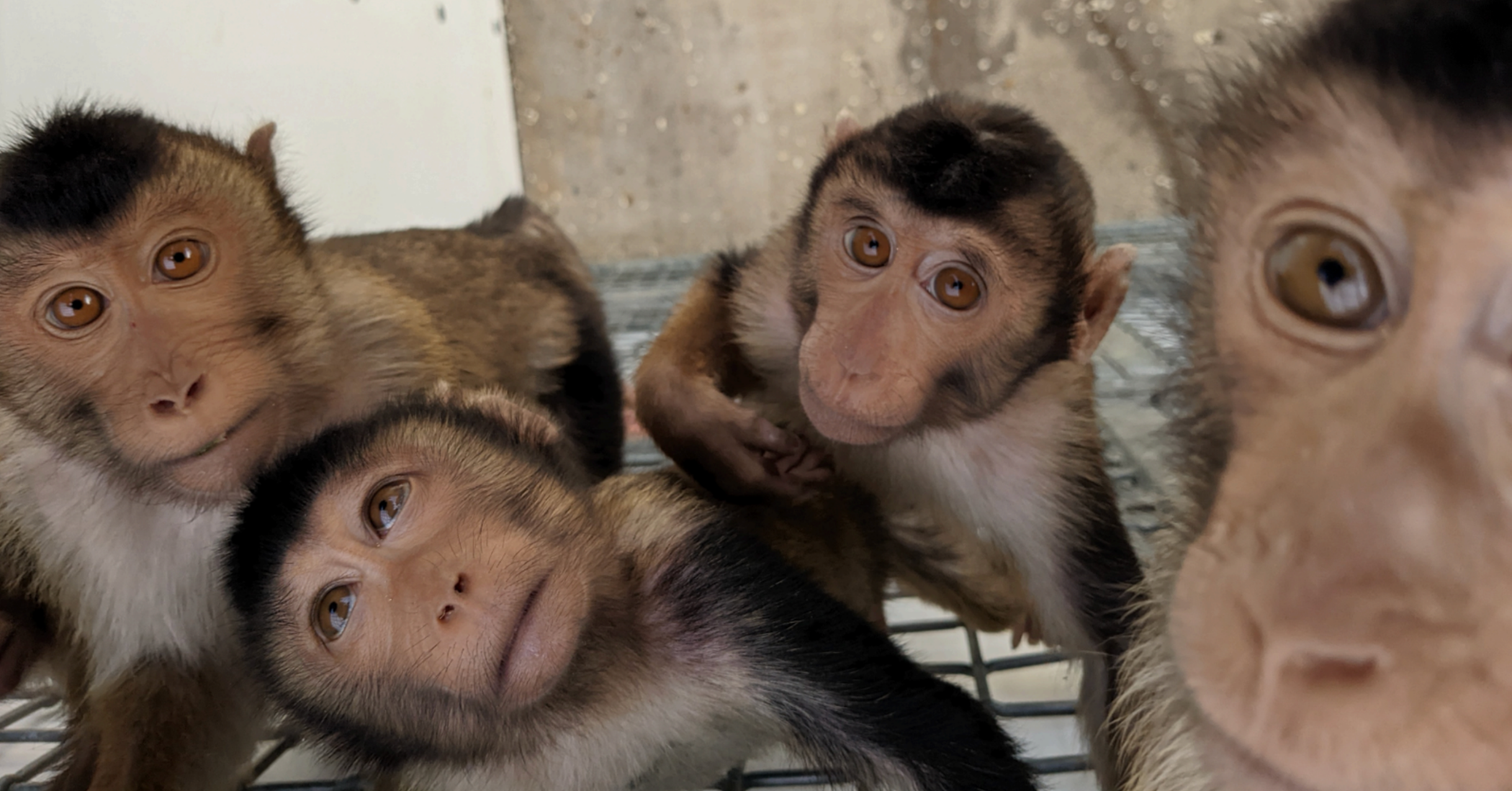
Two National Primate Research Centers (NPRCs) have changed their names: dropping “primate” and replacing it with the more palatable and less evocative “biomedical.”
A Rebrand Without Reform
The Washington National Primate Research Center (WaNPRC) and Tulane National Primate Research Center have rebranded themselves as “Biomedical Research Centers.”

The name changes offer a clear example of how the animal research industry manipulates language to influence the public’s perception of what happens inside its facilities.
Nothing but the names have changed, the Centers themselves concede.
Officials have been explicit that experimentation on monkeys will remain the labs’ core function. The difference is in how they want the public to perceive them.
Distancing Their Harm From Public Scrutiny
The NPRCs are under increasing scrutiny as federal agencies signal interest in reducing animal experimentation and as the Oregon National Primate Research Center faces the possibility of being converted into a sanctuary.
Public opposition to animal research is growing; policymakers are paying attention; and the NPRCs are responding—not by changing course, but by promoting a desperately curated distraction.
The NPRCs no longer want their torture of nonhuman primates—their self-described “work on monkeys”—to be the first thing that comes to mind for the public or, critically, for government funders.

In other words, their goal is not to end the harm they cause—their goal is to distance themselves from it at a critical time.
Saying the Quiet Part Out Loud
According to WaNPRC spokespersons, the name change is all about public relations and does not reflect a change in the Center’s “research or operations.”

So, when the WaNPRC claims its new name better reflects its work, what it really means is that its new name better reflects what it wants the public to think about its work. The reality remains the same; only the framing has changed.
Current and former animal research insiders have been blunt about what’s happening here. Some describe the move as desperation. Others as political conformity. Still others as a financial strategy designed to protect and expand funding streams at a moment of vulnerability.
The Reality They’re Trying to Obscure
A clear assessment comes from Dr. Lisa Jones-Engel, a former primatologist who spent 14 years at the WaNPRC:
Renaming UW’s primate center doesn’t alter what happens there: the same primate experiments on monkeys confined for years, pacing, rocking, or staring through bars, in facilities with a long record of animal welfare violations, in windowless rooms with restraint devices and stacked steel cages — it will just be happening under a new label.
This is the reality the NPRCs’ rebrand is designed to obscure.
It is also a reality unchanged by NPRC claims that their new names are justified because they do not only experiment on monkeys: they exploit other animals, too, and they sometimes incorporate non-animal methodologies as complements to their animal research.
The NPRCs are not describing any transition away from animal experimentation—at most, they are describing self-serving diversification.
Even top federal officials have openly acknowledged that the NPRCs are not seeking to stop, if even reduce, their use of monkeys.
Department of Health and Human Services Secretary Robert F. Kennedy Jr.—who oversees the NPRCs’ founder and primary funder (the NIH)—recently observed that the NPRCs remain resistant to adopting more ethical, human-relevant approaches because animal experimentation remains highly profitable.
Adhering to the Industry Playbook
This fits the animal research industry’s pattern to a T: when faced with scrutiny, the industry does not dismantle its practices or release its victims.
It repackages the harm it causes.
It seeks to reframe its victims.
It tries to reshape public perception just enough to preserve the status quo.

The industry depends on keeping the public disconnected from the individuals it exploits, and language plays a central role in that effort. Terms like “animal models” and “biomedical research centers” are not neutral descriptors; they are strategic choices designed to sanitize, legitimize, and—ultimately—deceive.
Because once the reality is clear—once the public sees the animals confined, controlled, and harmed for profit—the narrative becomes much harder to sustain, and their “work on monkeys” and others much harder to defend.
Beyond the Centers’ new names, the real issue remains the same: nonhuman primates continue to be confined and experimented on, just under a more sanitized label.
But while the label has changed; the suffering of animals has not. They just don’t want you—their funders—to think about it.