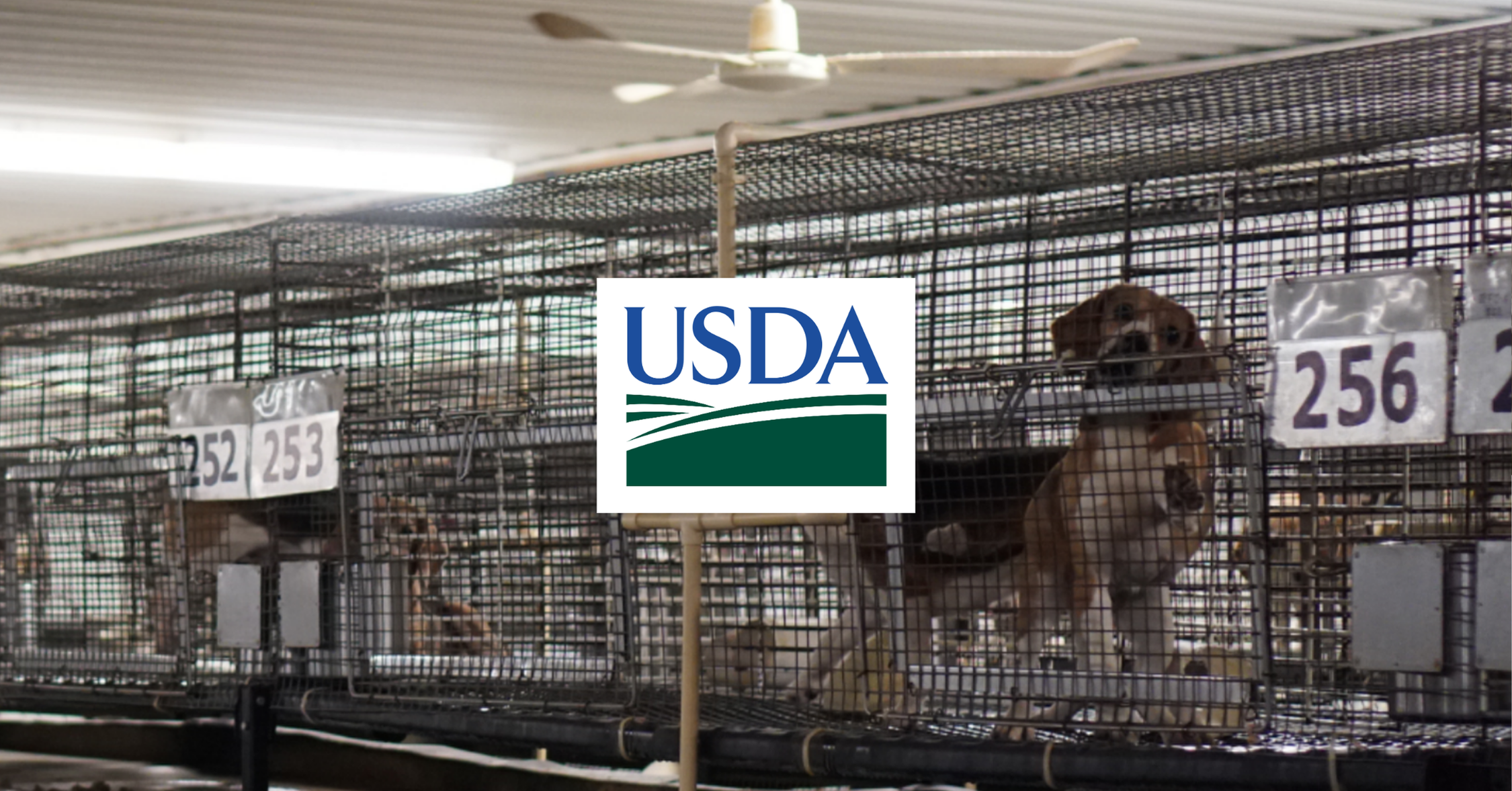
As word of Ridglan Farms’ closure hit national news, one of Ridglan’s core enablers jumped into the fray to claim credit.
The United States Department of Agriculture (USDA)—the very agency under whose purview Ridglan remained operational for decades—now wants us to believe that it is responsible for Ridglan’s downfall.
Shortly after the news broke, USDA Secretary Brooke Rollins publicly claimed not only that USDA “investigated conditions at Ridglan Farms, conducted inspections, and held the facility accountable under the law,” but also that those actions directly “led” to Ridglan’s closure and the rescue of its remaining dogs:

Those claims are stunning to those of us who have been involved in the campaign.
They are also flatly unbelievable based on the available public record.
That is why Rise for Animals has submitted a letter to Secretary Rollins asking USDA to immediately release the records substantiating her claims.
Inspections Are Not Accountability
USDA did inspect Ridglan. This is not in dispute—though aspects of those inspections raise serious and unanswered questions.
According to USDA’s posted inspection records for Ridglan’s Class A dog-breeding operation, the agency documented only four noncompliance items between 2014 and 2026. All four were designated “non-critical,” meaning USDA classified them as having no known, or only minor, impacts on animal health or well-being.
That classification is especially striking because three of those four findings involved inadequate veterinary care and inadequate animal treatment records—issues that plainly bear on animal health and well-being and also mirror the types of violations that formed the basis for serious state-level action against Ridglan.
Further, two of the four “non-critical” findings were only documented earlier this year—after public scrutiny had escalated, after state authorities had already documented hundreds of regulatory violations related to care and recordkeeping, and after USDA rotated out the single USDA inspector who had led every pre-2026 Ridglan inspection since at least 2014.
Despite these identified violations, however, USDA’s records betray no meaningful consequence for Ridglan. Ridglan was only prompted to take “corrective” action, once immediately and once within the next week.
That is nowhere near the realm of federal action that could reasonably explain the closure of a major dog-breeding and research facility.
USDA’s Records Helped Ridglan Defend Itself
Secretary Rollins’ claim is also vexing because Ridglan itself repeatedly pointed to USDA’s inspection history as evidence in its own defense.

Despite whistleblower testimony under oath, judicial and prosecutorial determinations, state findings, and more, USDA’s public inspection record has barely corroborated—much less exposed—Ridglan’s misdeeds. Instead, that record helped create the appearance that Ridglan was being adequately overseen by federal agents.
Herein lies one central contradiction screaming out from Secretary Rollins’ statement:
How can USDA seriously claim that it held Ridglan accountable when Ridglan itself used USDA’s “oversight” record to resist and stave off accountability?
USDA Had Multiple Other Chances to Act
Even if USDA inspectors did not observe or otherwise become aware of Ridglan’s illegal activity during its site visits, the agency was repeatedly put on notice and given every reason it should have needed to act.
In April 2025, Rise for Animals and The Marty Project (TMP) submitted a formal complaint raising concerns about Ridglan’s classification of dogs under the Animal Welfare Act. USDA’s response, signed by repeat Ridglan inspector Scott Welch, stated that reporting guidance was “not 100% clear” and “could be interpreted” in different ways. Ultimately, USDA “did not find that there was a non-compliance” and closed the matter.
In plain terms: when faced with the prospect of regulatory manipulation by Ridglan, USDA admitted uncertainty with its own regulations and resolved the issue in Ridglan’s favor—not in favor of accountability.

Rise for Animals and TMP submitted another formal complaint in September 2025, urging USDA to act in coordination with state authorities that intended to cite Ridglan for 311 state violations. USDA has yet to respond to our FOIA request seeking to understand how this complaint was handled.
Then, in October 2025, we submitted a third formal complaint, this time calling on USDA to intervene after Wisconsin’s Veterinary Examining Board summarily suspended Ridglan’s lead veterinarian for numerous violations of state provisions that have analogs at the federal level. USDA has yet to respond to our FOIA request about this complaint’s handling.
USDA Was Alerted, Again and Again
The public record is clear that USDA had ample information about Ridglan and ample reason to act. It received critical information through formal complaints and other public submissions. It knew about Wisconsin’s regulatory and legal findings. Journalists kept the story and new developments in public view. Advocates and community members pressed the agency and other officials to intervene for years.

The existing public record shows USDA being put on notice about Ridglan over and over again.
It does not show USDA doing the work the agency now claims credit for even once.
The available record does not evidence enforcement, pressure, or other decisive agency intervention. Nor does it reflect USDA action that could reasonably explain Ridglan’s closure.
Instead, the record documents USDA checking its usual regulatory boxes and repeatedly remaining silent—until, of course, it saw a chance to take credit for a national success story.
USDA Has Now Pointed to One Specific Action
In a separate video statement issued on June 15, 2026, Secretary Rollins pointed to one specific, threatened action that she suggested would help hold Ridglan accountable. She stated that USDA had put Ridglan “on notice about inbound accountability” by informing the facility that, unless it voluntarily canceled its federal Class A breeder license by July 1, 2026, USDA would begin termination proceedings.
Today @USDA @SecRollins and I secured a major win for animal welfare.
Ridglan Farms will transfer its remaining 475 beagles out of a research breeding facility and into the care of a no-kill rescue, where they can begin the path to adoption.
Thank you, @LaraLeaTrump, for… pic.twitter.com/gmxiZeYc7k
— Secretary Kennedy (@SecKennedy) June 15, 2026
That is more concrete, but it still raises serious questions. For one, Secretary Rollins’ reference to “inbound” or prospective accountability does not substantiate her separate claim that USDA had already “held” Ridglan accountable.
For another, timing and actual effect matter. Secretary Rollins says Ridglan was put on notice of USDA’s license termination threat “prior to” her June 15, 2025 announcement—a formulation that suggests recency. But by October 2025, Ridglan had already agreed through state proceedings to surrender, by July 1, 2026, the Wisconsin dog seller license required for its large-scale breeding-and-sale operation. USDA’s threatened federal proceedings therefore appear to have been tied to the same date as a preexisting state deadline that was already poised to shut down Ridglan’s large-scale commercial breeding operation.
That does not mean USDA’s threat was entirely meaningless. Terminating Ridglan’s Class A license could have imposed a separate federal consequence, preventing Ridglan from selling any dogs to federally regulated research facilities even if those sales fell below Wisconsin’s licensing threshold. But the available record does not yet show what, if anything, USDA’s threat of “inbound accountability” independently accomplished; nor does it show whether that threat caused, accelerated, or materially contributed to Ridglan’s closure.
If USDA Did What It Now Says, Where Are the Receipts?
Secretary Rollins has said that USDA held Ridglan accountable and that 475 dogs were saved by USDA action.
We are simply asking her to prove it.
Rise for Animals has pending FOIA requests seeking records that should exist if USDA’s public claim is true. But USDA does not need to wait for FOIA processing. If the agency did what Secretary Rollins claims it did, it can and should release the records now—and it should want to.

Ridglan’s Survivors Are Not Public Relations Assets
USDA must be willing to prove its role if it wants credit for ending Ridglan’s reign and saving its remaining victims—and we must demand that it do so.
We cannot allow USDA to use as public relations assets the very individuals who were bred, confined, and experimented on with USDA’s effective blessing.
We must not allow unverified USDA bluster to overshadow the immense tenacity and perseverance of advocates who worked for years to force Ridglan into the public eye and to overcome state and federal inaction—advocates who, if USDA acted as Secretary Rollins claims, almost certainly helped force USDA’s hand.
And we cannot allow USDA to repackage the prolonged, indefensible, and illegal suffering of dogs under its regulatory authority as agency success.
USDA wants credit for Ridglan’s closure. We want proof.
Let’s get after it.
Demand proof now!
Share this article on Facebook, X, or Bluesky.
Tag USDA and Secretary Brooke Rollins to turn up the pressure.
About the Author: Lindsey Soffes is Head of Programs at Rise for Animals. She holds a law degree from William and Mary Law School and has spent her career advocating for the rights of all animals—both human and non-human.