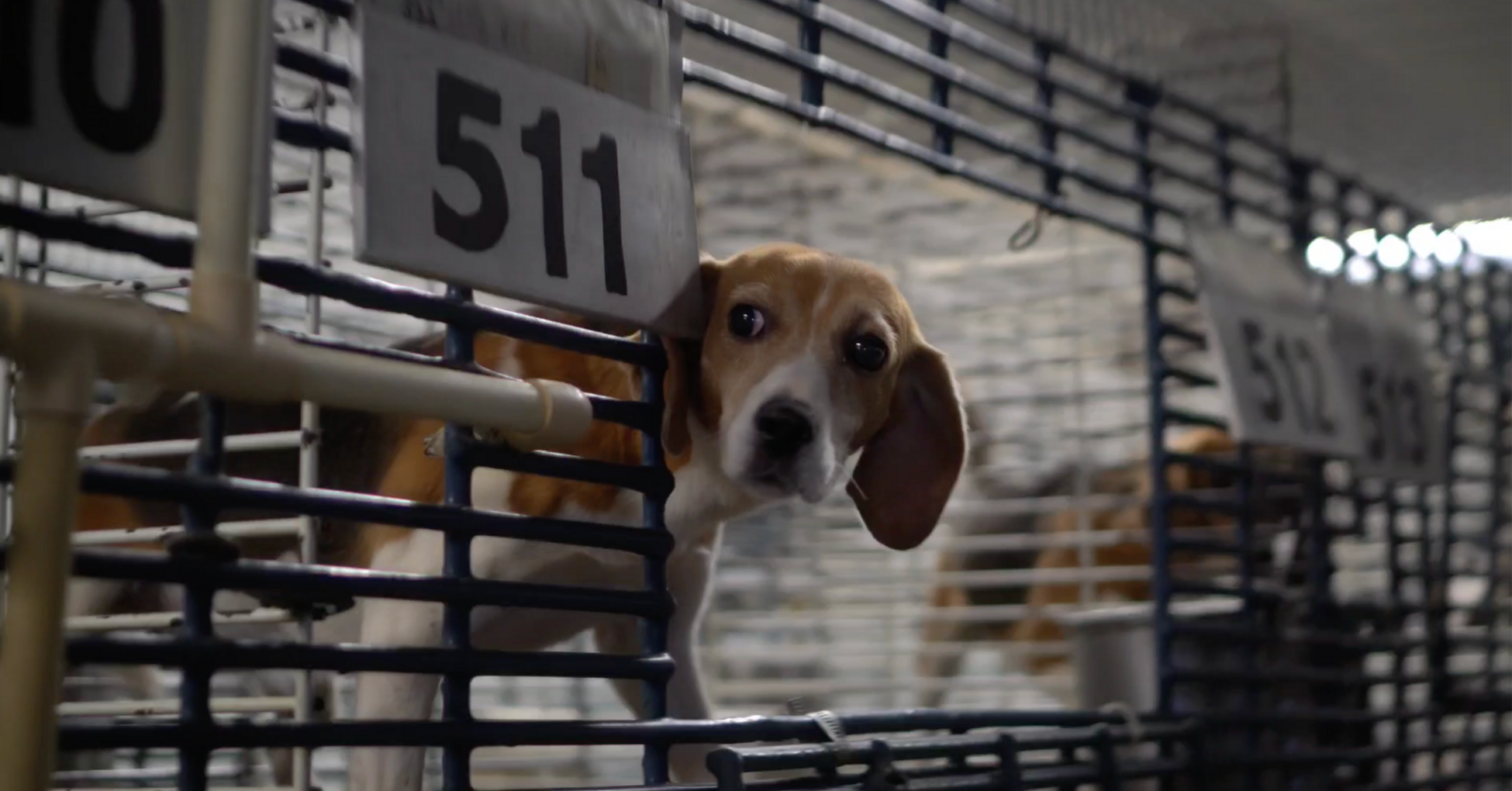
Why This Matters: In a second rescue attempt at Ridglan Farms, advocates didn’t reach the beagles—but the escalation of force used to stop them reveals just how much it takes to keep those dogs locked inside.
Advocates Blocked from Reaching the Dogs
On Saturday, hundreds of animal advocates returned to Ridglan Farms to do what the law still refuses to do: free the estimated 2,000 dogs trapped inside Ridglan’s soon-to-be-shuttered dog breeding-for-sale program.
The effort followed a rescue last month, when dozens of advocates entered Ridglan and carried out 30 dogs. This second attempt was different: advocates were stopped before they could reach a single cage.

Ridglan’s private security and local law enforcement worked together to aggressively defend the facility’s perimeter with chemical agents and blunt force.
Authorities deployed tear gas, pepper spray, and rubber bullets against the advocates. They chased, tackled, and forced them to the ground—reportedly kicking and beating some—and arrested many.
Apparently, a coordinated, militarized response is now what it takes to sustain Ridglan Farms.
Ridglan Fortified Ahead of Rescue
Ahead of the second rescue effort, Ridglan fortified its property with manure-filled trenches, barricaded its facilities behind hay bales and barbed wire, and deployed armed personnel (dressed head-to-toe in black and reportedly brandishing guns) to intimidate anyone who came near. On Saturday, Ridglan’s show of force was buttressed by representatives of 17 first responder agencies, including multiple police departments, the Dane County Sheriff’s Office, and the State Patrol.
What unfolded at Ridglan offers a clear view into how the animal research industry operates—and what it relies on to survive.
Industry Power Without Legitimacy
For decades, Ridglan has existed to profit from the exploitation of dogs: breeding them and consigning them to laboratories where their bodies are used and discarded. The facility has been linked to appalling, gratuitous, and illegal acts of animal cruelty. Now, Ridglan has crossed another threshold: openly relying on violence against humans to maintain its operations.

Ridglan’s violence betrays what happens when an industry built on systemic harm begins to lose its grip on public acceptance—or, more precisely in the case of animal research, public passivity.
Ridglan’s violence also exposes a deeper truth: The animal research industry is sustained by power, not legitimacy.
The animal research industry does not reflect democratic will. Rather, the industry persists as an undemocratic force—entrenched through economic strength, political maneuvering, and the domination of public narratives. Faced with a threat to its hegemony, the industry asserts its power through force.
The world saw extreme levels of power and oppression at play against people who want to save beagles from a life of torture for money.
—Jeff Brown, Wisconsin resident and animal rights activist
The industry’s use of force takes multiple forms, including two clearly on display in defense of Ridglan: physical repression and legal coercion.
Rescue Reframed as Terrorism?
Following last month’s rescue, the National Association for Biomedical Research (NABR) invoked the Animal Enterprise Terrorism Act (AETA), a federal law designed to protect businesses like Ridglan. NABR called on authorities to “set a precedent” by targeting those advocating against Ridglan.

Under the AETA, interfering with the operations of an animal “enterprise” (i.e., a business like Ridglan that breeds, uses, and/or sells animals for profit) can be prosecuted as terrorism. The law has been used before to investigate, prosecute, and imprison animal advocates who successfully challenged Huntingdon Life Sciences—later merged into Envigo, the parent company of what was once the largest beagle breeding operation for research in the United States.
Now the AETA may again be positioned to protect the animal research industry.
Wayne Hsiung, the principal organizer of the Ridglan rescue, was arrested at the outset of Saturday’s action. While incarcerated, Hsiung was interrogated by members of a joint state and federal terrorism task force.

Consider the glaring contrast: while thousands of animals are bred and tortured for profit, those who try to help them—not those who harm and kill them—are treated as the wrongdoers, as criminals, and even as potential terrorists.
What Ridglan’s Response Reveals
This contrast is equal parts disturbing and revealing, and it raises questions the animal research industry has long tried to avoid:
➢ If what’s happening inside places like Ridglan is broadly supported, why must industry rely on concealment, fortification, and militarized violence to survive?
➢ If its practices are ethically defensible, why must industry attempt to impose an inverted reality—recasting those who cause harm as the victims, and those trying to stop that harm as the offenders?
These questions answer themselves:
Enterprises grounded in widely held values do not need to quash dissent with violence and distortion.
When an industry resorts to such measures—especially physical and legal repression in tandem—the signal is clear: its power base is weakening, its control is declining, and a well-known historical pattern is unfolding.
Following a Historical Pattern
When entrenched institutions are put on the defensive, they do not quietly concede. Instead, they escalate.

History has documented a familiar trajectory across movements for social justice:
First they ignore you,
then they laugh at you,
then they fight you,
then you win.
Ridglan, the broader animal research industry, and the state apparatus protecting them are clearly fighting us. That alone indicates a significant shift.
If history is any guide, that shift suggests we are closer than ever to ending the industry’s violence in all of its forms—to reaching the cages, and to throwing every door wide open.
Your Call to Action: Around 2,000 dogs remain inside Ridglan Farms today—and state and federal regulators have the authority to act now to get them out. Send your message urging them to act immediately and free the dogs to safe homes.