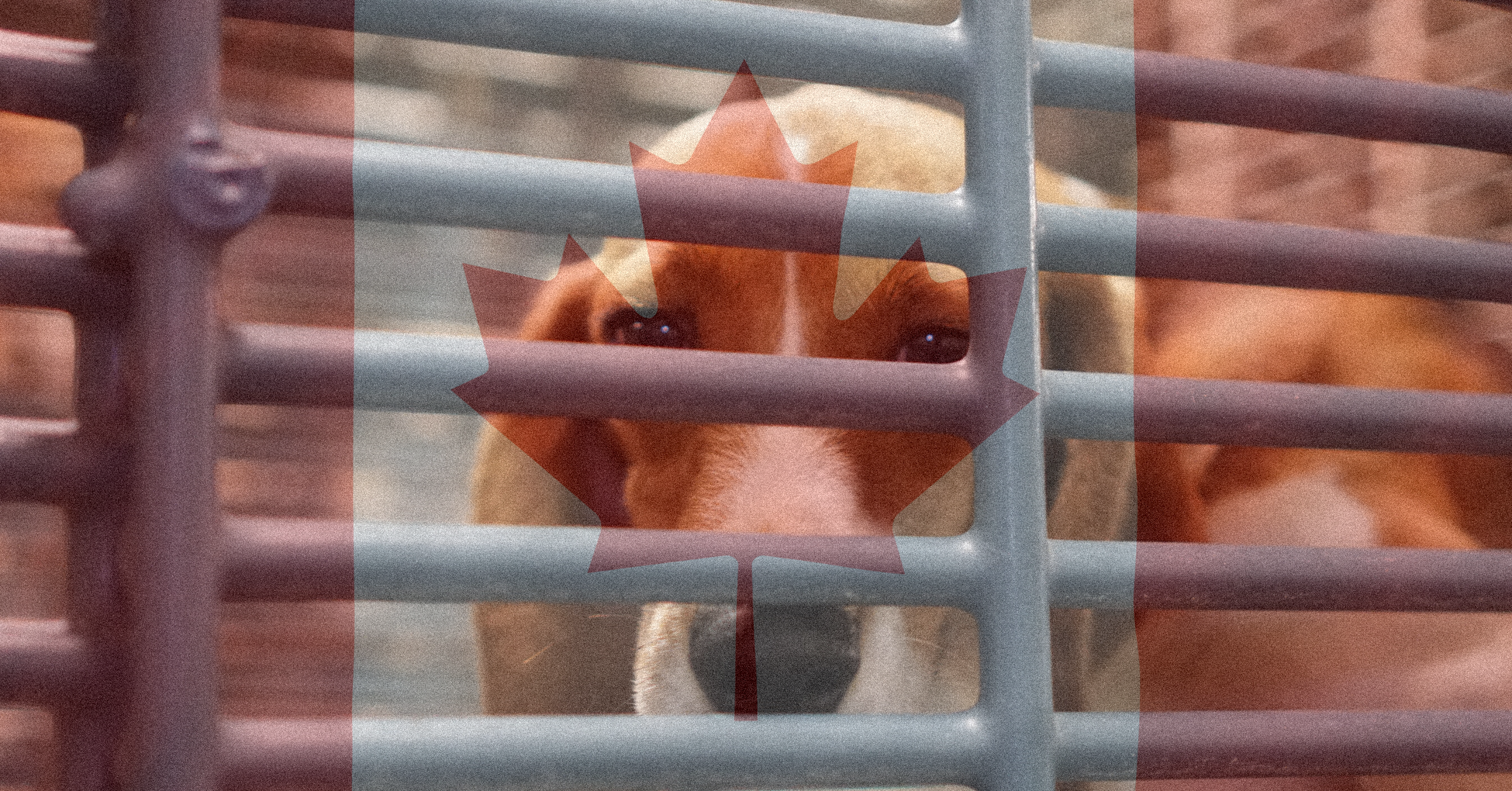
Recently released records obtained by Dane4Dogs and investigations by Canadian journalists reveal that, between 2022 and 2025, Canadian laboratories purchased dogs from embattled U.S. dog breeder Ridglan Farms.
And in so doing, these records and investigations expose a troubling irony: the very province now patting itself on the back for a bill that supposedly protects dogs and cats used in research may be Canada’s largest importer of dogs from one of the industry’s most notorious U.S. dealers.
Let’s be clear: Ontario is not seeking to ban research on any animals. It’s not moving to end the exploitation of dogs or cats in labs. And it’s not even pretending to sever ties with Ridglan Farms or others like it.
So those political pats on the back are nothing if not wildly premature.
The Bill Fails to Achieve Meaningful Change
While media coverage has framed Ontario’ s draft legislation as a ban on invasive research involving dogs and cats, the actual bill represents no such thing. In fact, it doesn’t even define what “invasive” research is.
Some media reports have claimed that the bill defines “invasive” research as altering an animal’s physical integrity, significantly impacting the animal’s physiological systems, or causing moderate to severe pain, extreme distress, or death. But, that language doesn’t appear in the bill—and it doesn’t appear in the Animals for Research Act, which the bill seeks to amend.

Instead, neither the draft bill nor existing law provides a definition of “invasive” research.
Indeed, the language invoked by commentators likely comes from guidance issued by the Canadian Council on Animal Care (CCAC)—a non-governmental body with no regulatory authority. CCAC guidelines are widely cited, but they are not law—and even they do not specifically define “invasive” research.
So what exactly is Ontario banning?
We don’t know—and neither do the lawmakers promoting the bill.
Making matters worse, the bill allows even “invasive” research under the vague exception of serving a “veterinary purpose.” Only that phrase isn’t defined either. (And nowhere does the bill require that the animals being used directly benefit from the research being conducted.)
This legal vagueness presents not as incidental, but as tactical: it opens the door for researchers to claim that any particular protocol, surgery, or procedure is either not “invasive” or permissible under the vague umbrella of “veterinary purpose.”
In other words: the bill offers no real protections—just loopholes dressed up as limits.
Moreover, even if we assume good intentions and imagine valid definitions for both “invasive research” and “veterinary purpose,” the bill still offers researchers an easy runaround.
As observed by Angela Fernandez, Professor of Law and History and Director of the Animal Law Program at the University of Toronto:
Invasive experiments can still be allowed if approved by a facility’s Animal Care Committee under the exception as currently worded, so it’s difficult to see how that is a ban on invasive experiments.
Translation: the bill doesn’t prohibit researchers from hurting dogs and cats. It merely requires that they ask for permission first—a weak procedural hoop that’s easily cleared in systems where institutional committees routinely rubber-stamp animal experiments.
But that’s not all.
Lab Breeding Is Out—But Imports Are Still In
The draft bill also fails to disrupt Ontario’s pipeline of research dogs from Ridglan Farms or other commercial breeders outside the province. It only bans the breeding of dogs and cats for research within Ontario. Nothing more.
Which means that Ontario labs can continue importing dogs, exactly as they’ve done for years.
As Professor Fernandez explains:
In addition to a ban on breeding dogs and cats in the province for research purposes, there needs to be a ban on importing them from other jurisdictions. Research facilities will continue to experiment on non-locally produced dogs and cats brought in from the U.S. and other provinces unless that loophole is closed.
So, what does this bill provision actually do? It merely outsources exploitation. It shifts the optics. It protects Ontario’s image—without protecting the animals themselves.
None of the Ontario dog imports exposed by Dane4Dogs would be barred under this bill. Not one.
And, perversely, by shutting down local breeding without addressing animal acquisition or use, the bill may actually increase Ontario’s reliance on foreign suppliers just like Ridglan Farms.

The Bill’s Strength Lies Not In Reform, But In Reputation Laundering
As written, the bill gives Ontario lawmakers the appearance of action without the burden of change. It allows politicians to make sweeping claims and media outlets to write glowing headlines. And it gives the public the dangerous illusion that the meaningful protection of animals is on the horizon.
But, in truth, the bill wouldn’t change much for the animals brutalized in Ontario’s labs.
It appears, then, that Ontario has a choice: it can revise the bill to actually curtail animal research—with clear definitions and binding prohibitions—or it can keep up a legislative charade that distracts from ongoing and unabated suffering.
What it can’t be allowed to do is continue seeking accolades from the public for its supposed care for dogs and cats, while it touts a bill amounting to nothing more than a legislative stunt—one with gaps and loopholes so wide that researchers and breeders can blow right through.
The fate of untold numbers of animals—including those whose futures may include being shipped from the U.S. to Ontario for torture and death—hang in the balance.