No Sanctuary at Oregon’s National Primate Research Center
The Oregon National Primate Research Center (ONPRC) is not becoming a primate sanctuary.
On Monday, the Oregon Health & Science University (OHSU) Board of Directors voted unanimously to adopt a resolution directing OHSU to develop a plan for ONPRC’s future. That plan will not empty the cages.
It may shrink the primate colony by an unstated amount, on an unstated timeline, while preserving an unstated amount of primate experimentation.

What the Board Actually Did
Resolution No. 2026-07-27 directs OHSU’s President to develop and present to the Board a comprehensive plan that:
- Transitions ONPRC into a national leader in research on the development of New Approach Methodologies (NAMs);
- Substantially reduces the size of the nonhuman primate colony at ONPRC;
- Continues nonhuman primate research characterized as “unique” to ONPRC’s capabilities; and
- Anticipates removal of the center’s federal National Primate Research Center designation.
The Board also recognized that implementing the resolution will require ending ONPRC’s role as a national supplier of primates for research.
If carried out, parts of this plan would matter a great deal for the animals.
A sizable, sustained reduction in the breeding colony would mean fewer individuals bred into confinement and enduring scientific slavery; and ending ONPRC’s role as a monkey supplier would close one component of the national pipeline that moves monkeys from breeding colonies into laboratories across the country. Those would be outcomes with real impacts.
But we should be precise about where things stand right now: the resolution is not a plan; it is an instruction to write one.
It remains to be seen whether the resolution’s directives will be enacted, and in what form.
The resolution also supports renaming ONPRC as part of a rebrand. We have already watched other National Primate Research Centers drop “primate” from their names in favor of “biomedical,” while conceding that nothing about their operations would change. A rebrand is not reform, and that is something that will need to be watched closely at OHSU—especially in light of a recent statement by OHSU President Shereef Elnahal.
President Elnahal reportedly told staff that “‘not much is going to change in the next couple of years, most likely….’”
A Framework Built Out of Blanks
Every question that determines what this resolution will tangibly mean for the animals inside ONPRC has been deferred to a document that does not yet exist.
The resolution directs President Elnahal to develop a plan and present it to the Board but fixes no date for delivery, no date for adoption, and no date for implementation. It requires the plan to propose timelines while not binding OHSU to any.
The resolution sets no numbers, either. It instructs the plan to estimate an appropriate colony size range—to be determined by the primate research OHSU decides to continue. In other words, reduction in colony size will be contingent on staff determinations, and President Elnahal has “declined to offer a ballpark estimate” of what a “substantial” reduction would entail. The resolution also does not commit a single animal to sanctuary. It names sanctuary placement as only one thing the reduction timeline could include, alongside limits on breeding—and a colony with reduced breeding shrinks on its own, without anyone ever leaving for sanctuary.
The resolution also rests heavily on federal government action. The Board acknowledged that the timeline for colony reduction and for the transition itself will depend on approval and financial support from the NIH; and the forthcoming plan must ensure that any changes to ONPRC’s infrastructure, programs, resources, or colony management are reviewed and approved by the NIH for consistency with grant requirements. It seems, then, that the primary federal agency paying for primate research at ONPRC holds a veto over how quickly ONPRC stops doing it.

Meanwhile, the experimentation continues. The plan’s reduction timeline must minimize disruption to research already funded, and President Elnahal clarified on Monday that every ongoing study—including work supported by grants still in flight—will run to completion.
This open-ended outline raises questions of its own: why this form, and why now? To these, OHSU has largely provided the answers.
Follow the Money—Because OHSU Did
OHSU frames this resolution as driven by scientific evolution, but its own record points elsewhere.
The resolution’s text ties the plan to money. It recites that the ONPRC’s federal funding—the NIH P51 primate center grant, two auxiliary breeding colony grants, investigator awards, and program income—has not been sufficient to cover all of ONPRC’s operating costs and proportionate institutional overhead. It also notes that no state general funds may support ONPRC’s operations. The result is that OHSU has, over time, had to increasingly cover ONPRC costs—which explains why the forthcoming plan must include a financial analysis for ONPRC to achieve “financial sustainability.”
For OHSU, then, reducing the primate colony is not primarily a matter of reducing suffering—it is a way to reduce the bill OHSU has been paying.
Core components of the transition plan also hinge directly on dollars. ONPRC would shed its federal designation as a National Primate Research Center only if satisfactory infrastructure funding arrives from the NIH and elsewhere. President Elnahal clarified on Monday that this provision is conditional on OHSU’s continued success in competing for its P51 grant, or on confirmation that some other infrastructure funding vehicle remains available to it. ONPRC gives up the label if, and only if, someone replaces the money attached to it.

Leadership was equally direct about why the sanctuary suggestion stalled. President Elnahal said the costs of running ONPRC “do not disappear when the science stops,” and he identified that as the major reason a sanctuary was ultimately not deemed feasible.
This suggests that OHSU opposed sanctuary because caring for ONPRC’s monkeys without extracting anything from them was a cost with no revenue attached.
The monkeys are affordable as exploitable subjects and unaffordable as protected residents.
Then there is the other pressure. President Elnahal also acknowledged that ONPRC faced a real risk of closure by legislative action and strongly implied that the resolution is, at least in part, a response to a political threat. A closure, he said, would have left OHSU with thousands of animals, hundreds of employees, and no financial support for them—an outcome he called “catastrophic” to the institution’s “financial outcome.” According to President Elnahal, who cited “private conversations with legislators,” approval of the resolution by OHSU’s Board would take the risk of legislative closure off the table.
Put those admissions beside one another and a reading emerges that OHSU has not offered, but has largely supplied anyway:
OHSU could not afford the outcome that advocates had been pushing for, and it could not safely ignore the political threat the campaign for that outcome had generated. What it needed was a third option—something cheap enough to sustain and responsive enough to defuse the pressure.
The resolution reads as that option.
The People Being Asked to Regulate Themselves
Each blank in the resolution’s directives will be filled by someone, and on the most consequential question of all—who does the filling—OHSU has already signaled its answer.
The analysis that closed the door on sanctuary came from ONPRC itself.
OHSU convened a Council on the Future of ONPRC drawn from OHSU’s and ONPRC’s own ranks. By President Elnahal’s own account, that Council assessed the risks of sanctuary transition, offered substantial input on the resolution, and secured changes to it. President Elnahal also stated that a proposal ONPRC submitted last fall served as the starting point for the repositioning strategy the resolution now contemplates. Looking ahead, he said an implementation team would develop and carry out the plan, and that no version of it would succeed without the people who run ONPRC and know it best.
It seems the people whose work was under direct threat wrote the assessment, shaped the resolution, supplied the starting point for the plan, and will staff its implementation.
Chief among the terms they surely helped set is the standard slated to determine what animal experimentation will continue: research “unique” to ONPRC’s capabilities. The resolution’s definition of the term is problematic. Research qualifies for continuation if it is “not robustly available or scientifically feasible at other National Primate Research Centers.” Nothing in that standard asks whether the research itself is beneficial or requires monkeys at all—only whether another primate center could run it instead.
A project may survive by being unavailable elsewhere, not by being necessary anywhere.
Researchers have already shown how easily that bar might be cleared. A neuroscientist at ONPRC recently claimed that projects do not get competitive NIH funding by describing work someone else could do.
By that interpretation, nearly every funded project at ONPRC is already, at least arguably, “unique” in the minds of researchers, who will be critical to the determination of which research continues.
That carve-out protects primate experimentation ONPRC already conducts. A second provision does something even more durable: it generates new reasons to keep primate research going indefinitely.
The resolution contemplates a population of primates at ONPRC expressly to support the development and validation of NAMs; and it describes primate research playing a critical role in validating and benchmarking those emerging methods. In that way, every NAM OHSU works to develop creates demand for the animals it claims to be reducing its use of.
This reasoning converts the new methodologies—often marketed as substitutes for animal research—into reasons to keep animal research going.
The resolution’s own framing of NAMs gives that away, describing them as opportunities to “complement, refine, replace, and reduce” animal use. We have previously warned about industry’s attempts to position NAMs as complements—or add-ons—to animal research, and here that framing appears in the founding document of a primate center’s supposed transition away from primate research.
OHSU does not appear to regard any of these issues as problems, because it treats researcher judgment as a safeguard rather than the thing requiring one.
In his closing remarks, President Elnahal said that the people best positioned to responsibly reduce animal use at ONPRC are, in his judgment, those working with—and on—the animals there.

We have heard this argument before. It is the 3Rs argument—the promise that researchers, given time and discretion, will reduce, refine, and replace their way toward fewer victims. President Elnahal explicitly framed this resolution as continuous with that tradition, which should worry anyone paying attention, because scientists themselves have described the 3Rs as “failing dismally to reduce or replace animal use”—and as actually working to “perpetuate the use of animals in science.”
What Comes Next Is TBD
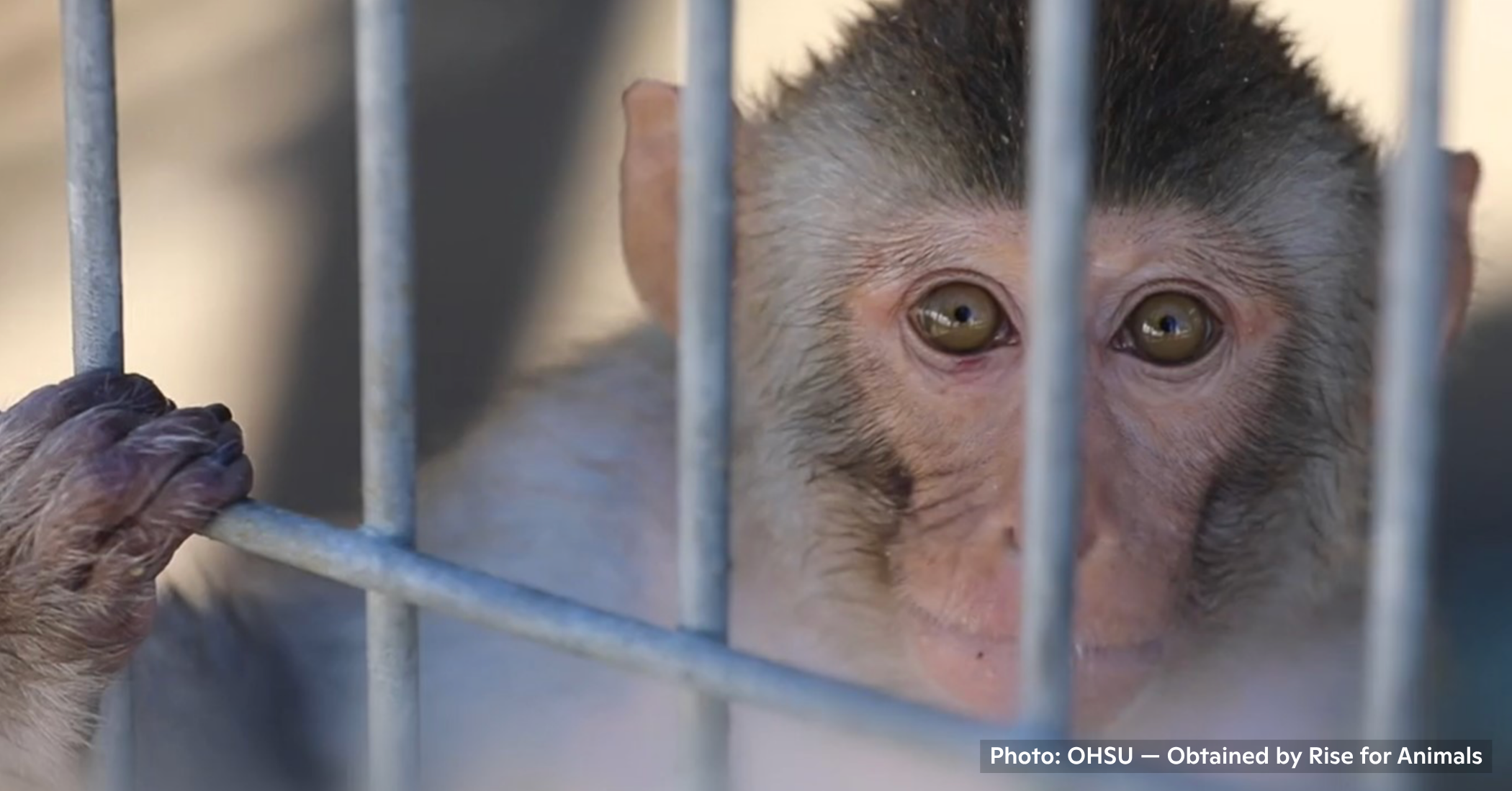
An estimated 4,000 to 5,000 nonhuman primates remain trapped at ONPRC today, and nothing in the Board’s vote changes their circumstances tomorrow. But there is hope.
Six months ago, a federally-funded primate center entering negotiations over its conversion to a primate sanctuary was unthinkable. The fact that OHSU had to construct an elaborate alternative to sanctuary—and had to cite financial and legislative threats when explaining why—is itself evidence of how much pressure the industry is now under.
The Board acted because it was made to act, and it stopped short of animal advocates’ calls because nothing has compelled it to go further—yet.
OHSU says sanctuary was unaffordable, and that it is relying on ongoing federal funding to keep primate experimentation going. That makes this all about federal money, and federal money is something we can affect.
Your Call to Action: OHSU says federal funding is helping keep primate experimentation in place. Tell Congress to support the SPARE Act and redirect that funding toward human-relevant research while ensuring animals are placed in sanctuary.
Share this article on Facebook, X, or Bluesky
About the Author: Lindsey Soffes is Head of Programs at Rise for Animals. She holds a law degree from William and Mary Law School and has spent her career advocating for the rights of all animals—both human and non-human.