Here’s a roundup of the latest, biggest news stories related to animal research—all the recent media coverage you need to know right now to be the most effective activist for animals in labs.

How to Make a Monkey Killable
Lindsey Soffes, Rise for Animals, 9/1/2026
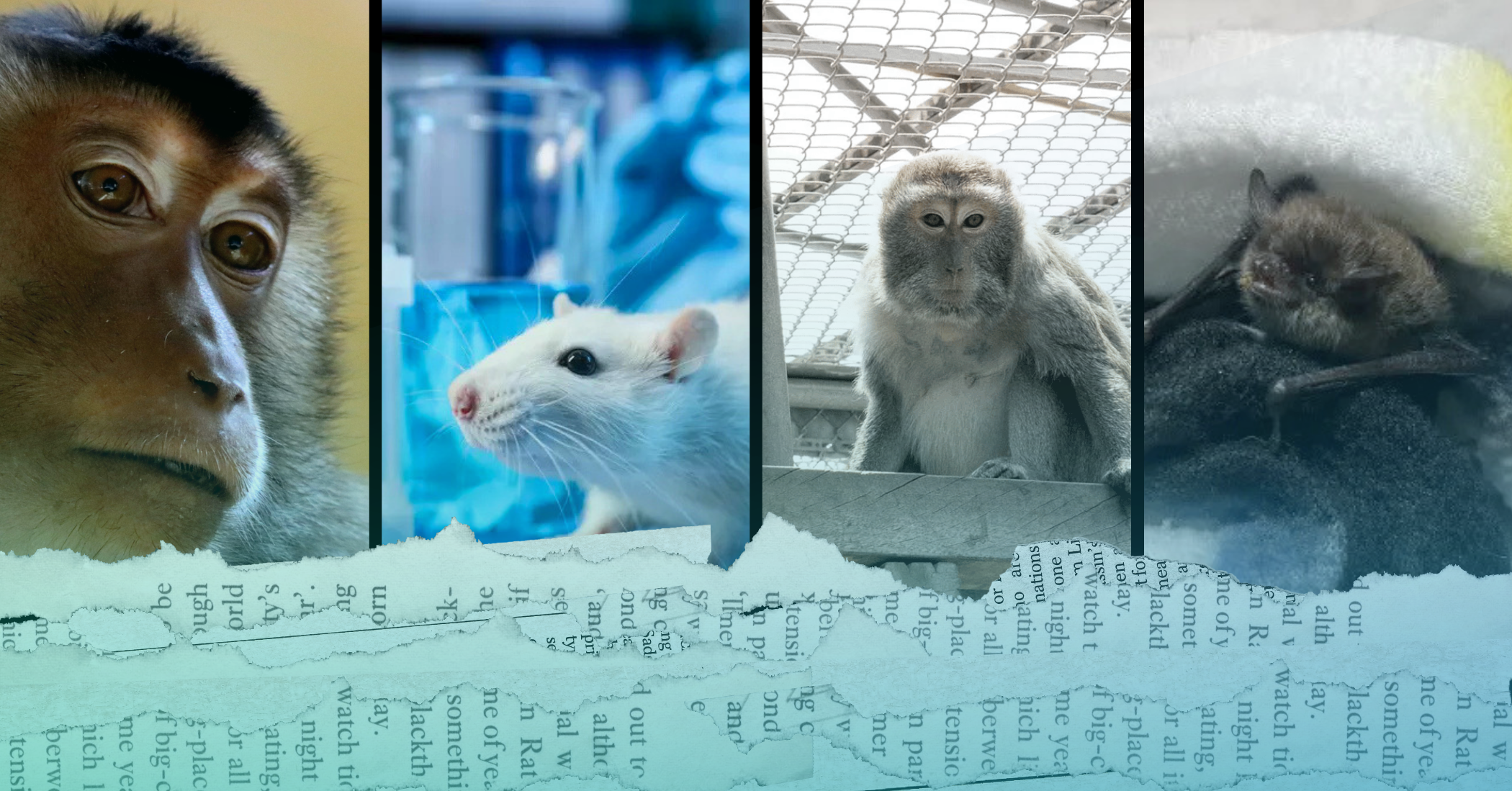
First, label the monkeys “pests.”
Then it becomes easier to justify trapping, caging, breeding, and selling wild-caught animals for use in laboratory research.
Think this sounds awful? It’s what’s happening to endangered long-tailed macaques in Indonesia and elsewhere. 📰 Full Story →

Trump’s EPA just took a step toward ending all animal testing by 2035
Stephen Dinan, The Washington Times, 8/27/2026
“The Environmental Protection Agency announced two new methods of testing chemicals’ toxicity . . . in what officials called a major step toward the goal of ending all testing on mammals by 2035. One of the advancements updates the way the EPA tests surfactants, found in cleaning products, and whether they irritate the lungs. The other advancement is to adopt a new formula-driven approach to evaluating pesticides, allowing the EPA to assess risks based on the known mixture of chemicals without having to test the final blend on animals.”
“The EPA is responsible for testing the toxicity of chemicals in products. For most of its history, that meant animal testing to ensure safety for humans. . . . EPA said the alternatives can also be faster and cheaper than animal testing, and can allow researchers to look directly at chemical impacts on cells, giving a more accurate look at health risks.”
“Animal rights organizations have been pushing for an end to animal testing, arguing it’s unconscionable to ask taxpayers to fund what are sometimes cruel-sounding experiments. They celebrated Mr. Zeldin’s announcement [] as proof the agency is back on track for the 2035 phaseout.” 📰 Full Story →

Worker Advances Religious Bias Claim Over Animal Testing
Maia Pandey, Bloomberg Law, 8/27/2026
“A former IT employee can proceed with claims the University of Pittsburgh retaliated against him because he objected to working in departments that conducted animal research due to his Native American religious beliefs, a federal judge ruled.”
“Richard Shafter plausibly alleged that his complaints over denied religious accommodations led the university to fire him and then repeatedly refuse to rehire him for other positions, Judge Robert J. Colville wrote [] for the US District Court for the Western District of Pennsylvania.” 📰 Full Story →

Science Is Learning How to Study Animals Without Killing Them. A Vermont Researcher Helped Show How
Compass Vermont, 8/28/2026
“Vermont has lost 90 percent or more of its little brown bats. To understand a collapse like that, to work out what the disease does, why a few animals survive it, and whether anything can be done, scientists need to read everything written in the animal’s DNA. Until recently, getting that meant killing one and taking it apart. A study published last week says they don’t have to anymore. And a University of Vermont researcher helped prove it.”
“The tool is a punch three millimeters across, pressed through the wing membrane, a layer of skin a fraction of a millimeter thick. The bat is weighed, measured, and let go. It flies off with a small hole that heals. The skin left behind on the punch is the whole point. Put those few cells in a dish and they multiply into far more tissue than the animal could ever have spared. From that supply, scientists can assemble the animal’s complete genetic blueprint in a matter of weeks, then keep running experiments on the cells long after the bat has gone back to its cave. The technique is not new, and it is not limited to bats. Researchers have grown the same kind of cell colonies from skin clipped off free-swimming humpback whales, and from the pulp inside a growing feather . . . What was missing was proof that the gentle version was good enough to replace the old one.”
“That proof arrived on Aug. 26 in a study published in Nature. A team assembled the complete genetic blueprints of eight related bat species . . . Most of the eight blueprints were built from wing punches. Two were built the old way, from the tissue of animals that had been killed. . . . The wing punches won. The blueprints built from living, growing cells were the higher-quality ones. That is the part that makes this more than a story about being kind to animals. Nobody had to trade accuracy for mercy. The method that leaves the animal alive produced the better result, and produced it faster.” 📰 Full Story →

The EMA launches a pilot to share data on alternative methods to animal experimentation
Agencias, Demócrata, 9/2/2026
“The European Medicines Agency (EMA, for its initials in English) has communicated the launch of a pilot program for voluntary data exchange aimed at promoting innovative methods that serve as an alternative to animal testing. Specifically, the project seeks to facilitate the flow of information on the so-called new approach methodologies (NAM, for its initials in English). Thus, pharmaceutical companies will be able to submit this data and, at the same time, receive personalized feedback on it. According to the EMA, these alternative methods ‘have the potential to provide information comparable to or even superior to that of current testing methods, while contributing to replacing or reducing the use of traditional animal studies in the preclinical development of medicines.’”
“In this scenario, the new program aims to establish a structured and non-binding framework that allows stakeholders to voluntarily present and discuss NAM data, without the need for an ongoing marketing authorization request. In return, they will receive individual feedback —non-binding and without decision-making power— from a group of operational experts made up of non-clinical professionals from the European regulatory network of medicines. With all this, the EMA aspires to ‘improve scientific dialogue, increase regulatory expertise with new study methods, promote harmonized assessment approaches across Europe, and support the development of a sustainable framework to integrate these innovative methods into the regulation of medicines.’” 📰 Full Story →

Dutch primate center awaits October animal research debate
Lauren Schenkman, The Transmitter, 9/2/2026
“One of Europe’s biggest primate research centers has escaped a budget mandate passed last October that would have phased out federal funding for animal experiments at the center by 2030. But the fate of the Biomedical Primate Research Centre (BPRC), based in Rijswijk, the Netherlands, remains vulnerable, according to center director Merel Langelaar, a veterinarian. The Dutch Parliament is set to debate animal research next month, and members are allowed to propose changes to the science budget at that time. ‘As long as this government is there, I think we’re pretty safe,’ Langelaar says. But a future parliament could easily move to phase out animal research again. ‘At this moment, we’re completely dependent on the politics and elections,’ she says.”
“The debate about animal research to be held in October is part of a larger discussion about animal welfare that happens twice a year, according to Joris Schouten, a spokesperson for Letschert. Members can propose changes to the budget then, but it’s unlikely that another funding phaseout will be put forward, says Debby Weijers, director of the Dutch Society for the Replacement of Animal Testing, a nongovernmental organization.”
“ . . . Langelaar says the center should not rely on the government’s good will. ‘We have to think of a strategy to be able to sustainably go on with the work that we have to do,’ she says.” 📰 Full Story →

Jane Goodall Institute Calls on York University to retire Nine Macaques Following Last Chance for Animals Uncover Investigation
Last Chance for Animals, PR Newswire, 9/2/2026
“Last Chance for Animals (LCA) [] applauded the Jane Goodall Institute (JGI) for calling on York University to immediately retire nine rhesus macaques subjected to neuroscience research and transfer them to an appropriate sanctuary following LCA’s undercover investigation into the university’s primate research program. In a statement issued on September 2, JGI said it was ‘deeply troubled’ by the conditions and treatment of the nine macaques documented in LCA’s investigation and said its commitment to animal welfare requires JGI ‘to speak out when animals may be experiencing unnecessary suffering.’”
“JGI also reaffirmed Dr. Jane Goodall’s lifelong opposition to invasive experimentation involving primates and her support for the development and use of alternatives to animal research. The organization called for a decisive move away from invasive animal experimentation and toward non-animal methods that can ultimately end the use of animals in research.”
“LCA released its undercover investigation in April 2026 after an LCA investigator spent nine months working inside York University’s Behavioral Sciences Building as a Laboratory Animal Attendant, caring for the nine macaques and documenting their conditions. The investigation was the first undercover investigation by an animal rights organization into animal research at a Canadian university. The nine macaques named Hannah, Liesl, Mini-Sass, Olivia, Virginia, Do, Kenny, Bento and Magneto, collectively known as the ‘York 9,’ were being used in neuroscience research. Most of the animals had spent more than 17 years inside the laboratory.” 📰 Full Story →

One Movement, An Unlikely Coalition: How a Beagle Rescue is Uniting a Divided Nation
Be Magazine, 9/3/2026
“What’s most striking about the momentum coming out of Ridglan is who is supporting it. Animal testing reform has become one of the rare policies in Washington where Republicans and Democrats are working toward the same legislation. . . . The shift is happening in the medical and scientific communities too.”
“If Ridglan Farms was the turning point for a national movement for change, organizers [of the March to End Animal Testing (MAAT)] say the real target has always been bigger. Marshall BioResources, headquartered in North Rose, New York, is the largest breeder of dogs for laboratory experimentation in the country, with additional facilities overseas, and its operations are more than 13 times the scale of Ridglan Farms.”
“Marshall BioResources has pushed back publicly, arguing that animal research remains necessary to medical progress and inviting scrutiny of its practices. Organizers counter that federal inspection records, not just activists’ accounts, show a facility operating at an industrial scale beyond anything the public reckoned with during the Ridglan rescue operation . . . a whistleblower report has been released that details felony-level animal welfare violations that have been happening behind the closed doors of Marshall BioResources. It is hard to watch and listen to these horrific accounts of what is being done to the beagles at Marshall, but there is hope as public awareness and pressure for accountability is mounting.”
“For the 2,100 beagles who left Ridglan Farms this year and moved the hearts of a nation, they are finally settling in with their adoptive families and enjoying homes, couches, grass, sunlight, fresh air, and their own names for the first time in their lives. They are free. Organizers of the march to Marshall are hoping tens of thousands more beagles and other animals will get that same chance and that by the time marchers reach North Rose on September 26, the country will be paying attention to Marshall the way it did to Ridglan. This one movement, an unlikely coalition, is set to move the hearts of the American people and unite a divided nation like nothing else.” 📰 Full Story →

After Ridglan, the fight against beagle breeding for testing turns to Marshall BioResources
Jason Collins, Species Unite, 9/3/2026
“ . . . for the activists, the fight doesn’t end with the release of thousands of beagles from Ridglan. They have now turned their eyes to the industry’s biggest player: Marshall BioResources. This September, hundreds of advocates will begin a 207-mile, 14-day march [March to Abolish Animal Testing (MAAT)] from Albany that will end at the Marshall BioResources’ gates, as part of a campaign to shine a light on animal testing. . . . ‘This march is about ordinary people coming together to do something extraordinary, and proving that when enough of us refuse to look away, we can change systems that once seemed impossible to change.’”
“The nonprofit animal rights organization Rise for Animals uncovered an experiment by a Ph.D. student at Temple University who used mixed-breed hounds from Marshall BioResources. The student sliced the spinal roots of these dogs, cut off their tails, implanted electrodes on their bladders, and then euthanized them. This is one of several documented cases involving dogs from Marshall while the company banked its profits. According to records obtained by Rise for Animals, laboratories were paying Marshall Farms upward of $1,000 per dog.”
“Part of MAAT’s campaign core goals is to ban the use of dogs in experimentation and end federal funding for animal experimentation.” 📰 Full Story →