Long before humans harm animals with their hands, they harm them with their words.
When humans call animals “pests,” they recast living beings as problems. And once animals are seen that way, trapping, caging, and killing them can begin to look less like the unethical and indefensible violence it is—and more like a necessary evil.
We have watched language do this work before: to mice, to rats, and, as recently as this year, to wax moths, whose increasing exploitation in labs was announced under the headline “From pest to useful tool.”
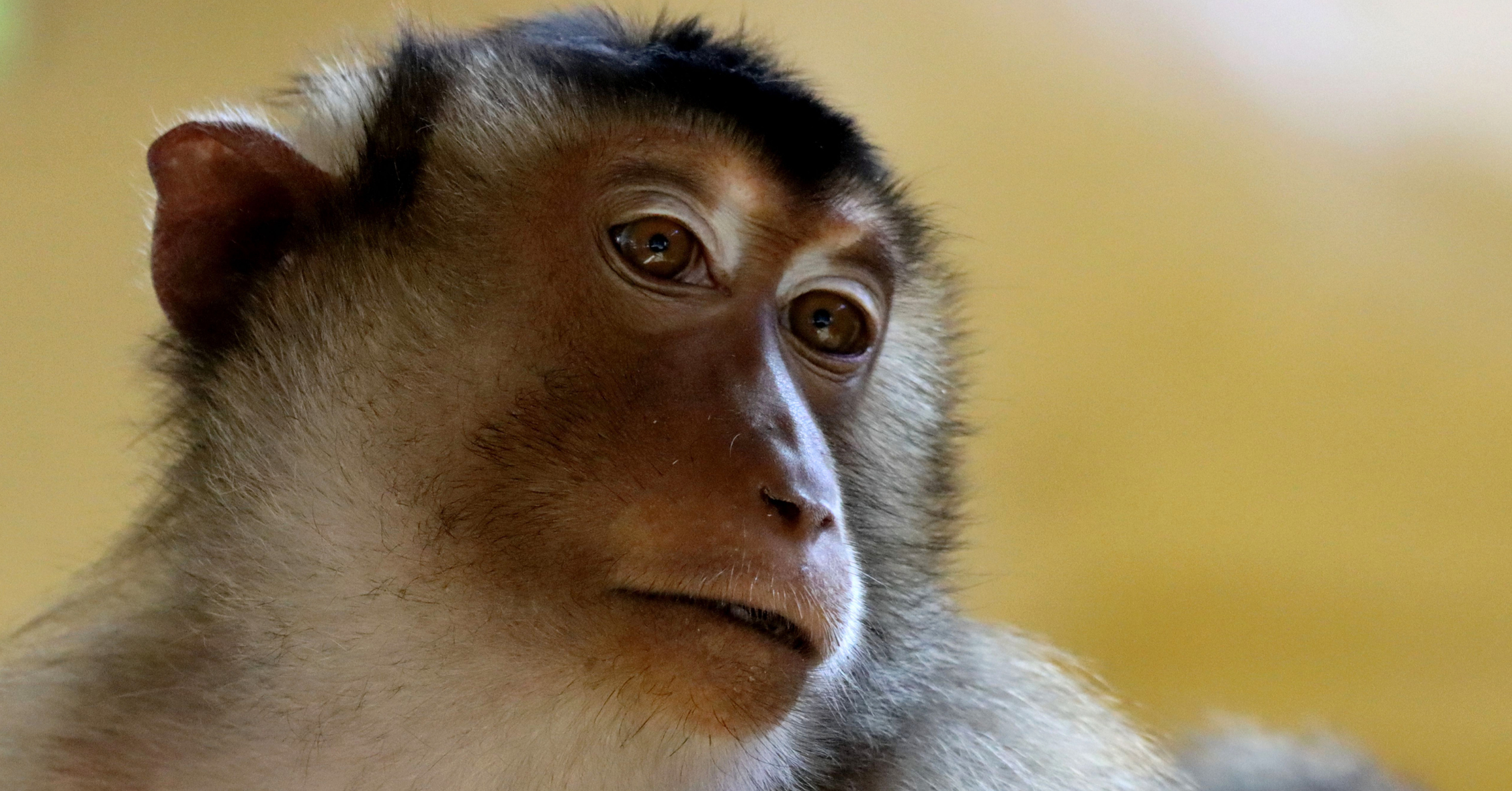
To this list, we must add long-tailed macaque monkeys, desperately trying to survive a human-dominated world closing in around them.

Long-tailed macaques in Indonesia are common: highly visible, encountered often, living at the edges of the same lands humans have cleared for farms and plantations. That presence and overlap are part of what puts them at greatest risk.
Animals who are not rare—who enter the spaces humans have claimed as theirs, and who cannot be fully controlled—are the animals most likely to be classified as “pests.” Once so classified, their wellbeing stops being a relevant consideration, and what remains—in the words of science journalist and former vivisector Bethany Brookshire—is the question of how to, at minimum, control them, and, at worst, eradicate them.
“Labeling something a pest means you can do almost anything you like to it”—and that is exactly what is unfolding for macaques in Indonesia.
A new, Indonesian primate breeding facility currently cages more than 800 long-tailed macaques, trapped from the wild to serve as breeding stock. Their planned offspring—designated “F1” in the industry’s shorthand—are intended for export to laboratories in the United States and, potentially, China. In June, Indonesia secured a fresh export quota of 1,928 monkeys from the Convention on International Trade in Endangered Species of Wild Fauna and Flora (CITES), the same body that has repeatedly failed to protect these endangered monkeys.
Facing criticism from animal protection groups, Indonesian officials and the breeding facility have reached for a familiar defense: the monkeys are “pests.”
Official statements have pointed to long-tailed macaques raiding farms, destroying crops, and injuring humans; and Indonesian media coverage has historically followed the industry’s script, favoring “negative words like ‘attack’ to describe long-tailed macaque behavior.” That framing serves an industry bent on exploiting the monkeys because, when the public comes to see a species as a danger, a nuisance, or both, local communities may become encouraged to “persecute” the animals and interest in their conservation evaporates.
Brookshire identifies exactly this mechanism in her book Pests: How Humans Create Animal Villains. Once humans frame an animal as a threat, they “can feel absolved” of whatever they do to neutralize it. Calling animals pests is, in practice, often how humans make harming them feel permissible:
It’s easy to “just call something a pest and make it killable.”
True to that logic, industry has framed its new primate breeding facility as a public service—a way to “manage” the monkey population and the “human-wildlife conflict” they are blamed for. It’s the same defense Indonesia has used in the past, and the same one the global primate trade has leaned on for decades in Mauritius, Cambodia, and Vietnam.

Mauritius Already Showed Us the Lie
Mauritius has run essentially the same operation for decades, breeding long-tailed macaques—also branded there as a “pest” species—for export to international research facilities. Just like Indonesia, Mauritius has used the “pest” label both to justify its exploitation of long-tailed macaques and to persuade local communities that the industry is acting in their interest.
As recently reported by Daily Maverick:
All across the industrial board, from breeders to pharmaceutical companies, the public messaging is the same: Mauritian long-tailed macaques are an invasive species, a threatening pest, and the industry is benefiting nature by using them. This message has become a moral justification for subjecting Mauritian macaques to regimes of painful and traumatic biomedical testing, and ultimately, death in captivity.
As is true for other industry accounts, this public benefit narrative falters under scrutiny. It is, in the words of Daily Maverick, “a lie.”
Asked directly whether its trapping operations amounted to deliberate population control, the Mauritian breeding company Bioculture told Daily Maverick that no such policy exists, and that any real effort to manage the population would require a level of coordination the industry has never attempted. In fact, the industry “needs a wild population to draw off,” because primate breeders’ captive populations are not self-sustaining.
Despite seeking public support for managing a “pest problem,” the industry has no intention of doing that. Rather, its business model requires just the opposite.
The “Good for You” Argument Is a Sales Pitch, Not a Reality
Here lies one pronounced intersection between the macaque trade and the broader animal research industry. Animal research is defended to the public on the premise that human benefit justifies animal suffering—a utilitarian trade the industry insists is worth making.
Wild macaque capture is defended on the same premise, in miniature: wild monkeys captured from the wild and confined by humans, the argument goes, to spare farmers their crops and villagers their fear and inconvenience.
In neither case do the outcomes support industry’s claims. The evidence is clear that, while the harms of animal research to animals are certain, the benefits to humans are questionable at best. And industry has admitted that, rather than seeking to quell “human-wildlife conflict,” it will continue to rely on wild populations of macaques for its business model.
In both cases, the benefits promised to the public are vague, unproven, and (seemingly if not admittedly) disingenuous, while the harms—to the animals, and in animal research’s case, to the humans it claims to serve—are extensive and guaranteed.
“Pest” Is a Label, Not a Fact
Industry is also lying to us about the wild animals it harms being “pests” in the first place.
The term conveys a subjective designation, a description of a relationship rather than a species—and, per Brookshire, that designation can “lay bare our internal hypocrisy.” Humans can support the killing of animals on the street one day and protest their torture as research subjects the next.
Brookshire actually connects this inconsistency directly to animal research itself. In her account, the laboratory is a new “niche” humans built for “pest” animals like mice—one where, instead of them “living off” humans, humans live off them.
That exploitation, she argues, became possible because mice were first devalued as “pests” outside laboratory walls.
The mouse became a “constant in the human landscape. It became both so common as to seem worthless and invasive enough to be a constant minor irritation.” The mouse became classified as a nuisance and, then, conscripted as a research tool.
What befell the mouse has now befallen the macaque.
Humans Are the Real Pests
Brookshire ultimately turns the label back on the species applying it. The animals humans call “pests” are rarely the ones causing the underlying disruption; more often, they are simply the ones left bearing the consequences of others’ choices. And, far from how industry paints them, “pest” species are often remarkable survivors—beacons of resilience and success, who are resourceful enough to adapt after humans paved over, fenced off, or otherwise commandeered the world they used to inhabit.

Long-tailed macaques didn’t choose to live at the edge of Indonesian farmland. Humans cleared the forest that used to separate macaques’ habitats from cropland, then declared the resulting contact the macaques’ fault. Brookshire’s scholarship points toward a different question than the one industry keeps asking: not how to manage a “pest problem,” but how humans might actually learn to share space with the other animals living in it.
That is a question Indonesia’s new export quota, and the industry it supplies, is built to avoid answering.
It is far more profitable to exploit “pest” animals for laboratories than to learn to live peacefully alongside them.
Brookshire’s own conclusion is blunter still: humans, not mice or monkeys, are the ones driving this—the species expanding into others’ habitats, then calling the resulting friction someone else’s fault.
Humans “are the real pest.”
The fix she calls for isn’t removing the animals we’ve decided are inconvenient. It’s building a shared world that makes room for all.
Until Indonesia, or any other government profiting from the trade in so-called “pests” is willing to do that, that label will continue functioning exactly as designed: not as an apt description, but as a permission slip for violence.
Your Call to Action: The PRIMATE Act offers Congress a clear and necessary intervention: stop the import of monkeys for research before more animals are harmed. Urge your U.S. Representative to support this bill and help shut down the pipeline that routes monkeys from their wild homes to U.S. laboratory cages.
Share this article on Facebook, X, or Bluesky
About the Author: Lindsey Soffes is Head of Programs at Rise for Animals. She holds a law degree from William and Mary Law School and has spent her career advocating for the rights of all animals—both human and non-human.