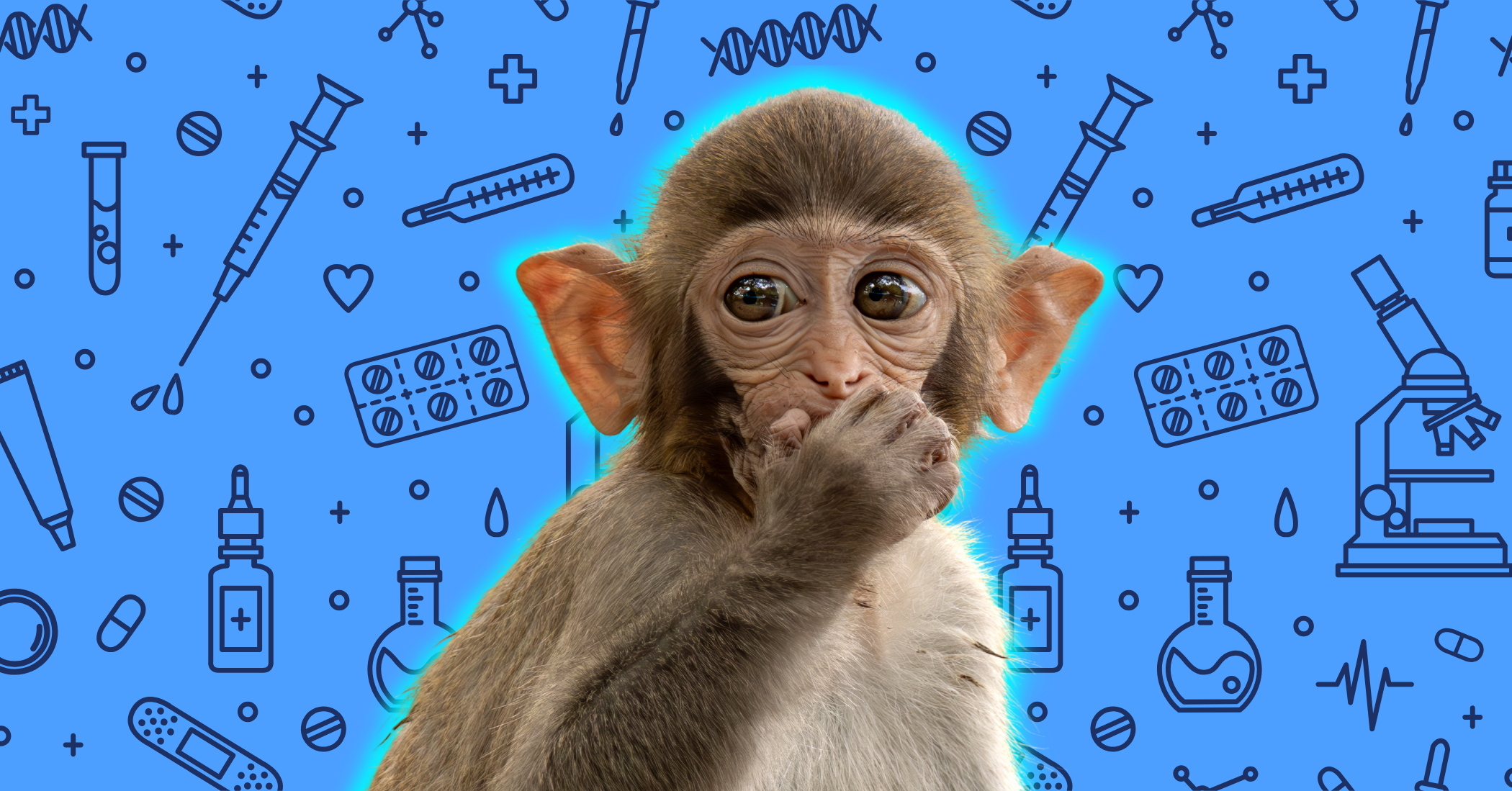
When Animal Researchers Call Their Victims Their “Kids”...
Why This Matters: The animal research industry is rewriting harm as care, hoping the public won’t notice the violence it masks with gentle words. It’s crucial we expose these narratives because they shape policy, funding, and the lives of countless animals trapped within exploitative systems.
Framing Herself as the Victim
In a recent article, STAT featured a former lab technician from the Emory National Primate Research Center who spent years making money off the exploitation and harm of infant monkeys.
But, guess what? According to STAT—and the former lab tech herself—she’s the victim.
The article paints her as a bighearted animal lover, grappling with the choice to leave her beloved career due to federal funding uncertainties.
The real tragedy, we’re seemingly told, isn’t the suffering of the monkeys—it’s that the lab tech may no longer be able to pay her bills by harming them.
Calling Harm “Kindness”
Yet the most perverse distortions don’t come from STAT—they come from the lab tech herself, who refers to the monkeys her lab exploited as her “kids” and suggests that the harms they endured are expressions of “humanity and kindness.”

This is someone who spent years “working closely with dozens of young macaques” by “taking blood samples, jotting down notes on the primates’ behavior, and using eye trackers to assess their visual acuity and interest in looking at novel objects”—all, supposedly, to determine whether repeated exposure to anesthesia affects development.
Only, these effects had already been observed—both in rhesus macaques (who were reported more likely to display signs of anxiety later in life when repeatedly exposed to anesthesia in infancy) and in human children (who have an increased risk of developing learning problems after multiple exposures to anesthesia).
So, what exactly was this lab tech doing?
Well, she was helping to repeat trauma that had already been documented, on infants commodified for science, and reframing it as an act of care. She was exploiting animals she called her “kids,” and profiting off their harm while calling it “kindness.”
This is more than denial. It’s propaganda.
The Industry’s Newer Strategy: Rebranding Harm as Care
The animal research industry appears no longer content to emphasize emotional detachment “from the animals under their control.” Now, it leans straight into emotional manipulation.
It wants to recast incarceration, enslavement, and violence as care, and it wants the public to see researchers not as technicians of harm but as reluctant caregivers—loving parental figures to the very beings they’re being paid to exploit.
This shift is, of course, strategic: by rewriting harm as nurture, the industry not only disguises the violence it has long normalized—it also distracts from the scientific illegitimacy at its core.
Bad Science Wrapped in Sentiment
The research described in the article relies on “healthy” monkeys—and, indeed, a “core assumption in biomedical studies is that animals used in experiments embody healthy biological and psychological systems.”
But, this assumption is unfounded in labs.

Primates confined to labs are not “healthy.” They are imprisoned “in unnatural, barren, or restrictive environments”—spaces that, for rhesus macaques, are “seven million times smaller” than their natural home ranges. This captivity alone causes chronic stress and anxiety, which impair their “cognitive potential and emotional capacities (anhedonia).”
So, how can repeatedly anesthetizing infant monkeys help determine if the anesthesia causes anxiety or negatively affects their cognition later in life, when researchers have already predisposed the monkeys to both? It can’t.
This isn’t valid “science.” It’s harm disguised as data and sanitized through emotional spin.
STAT includes a photograph of a bronze figurine the lab tech’s father gave her. It depicts a baby monkey clinging to an adult’s back—an image almost certainly meant to symbolize nurture, protection, and maternal love.

But, in the context of the article, it’s haunting—because, at Emory, this little one might find herself the self-proclaimed “kid” of a human benefitting from her suffering.
Would this lab tech offer up her human children for this work? Almost certainly not.
Animal researchers routinely assert that it would be unethical to do to humans what they do to animals, even though their “logic is paradoxical: other species are close enough to serve as models for human biological and psychological disease but different enough to fall beyond ethical concern….”
This contradiction is not scientific. It’s cultural
They Myth That Makes It All Possible
In reflecting on her own time working with rhesus macaques at the New York State Psychiatric Institute, Harvard primatologist and author of The Arrogant Ape Christine Webb writes that she was only able to do this work because she “had internalized a bias of human exceptionalism.”
Human exceptionalism is the belief that humans are more important—more advanced, more worthy—than other animals. Webb calls it “the most powerful unspoken belief of our time.”
It’s this belief—and not science—that animal researchers (implicitly) rely on to justify what they would otherwise see as morally indefensible. And it persists despite being directly refuted by foundational scientific theories like evolution (which, lamentably, animal researchers routinely ignore or deny).
Webb calls the process of rejecting the myth of human exceptionalism an “unlearning curve,” and that’s really what the fight for animal rights is all about: not just recognizing oppression, but recognizing and rejecting the belief systems and narratives used to justify it.
So we ask you to join us—not just in expressing empathy, but in rejecting the old lies we’ve been taught to believe, and the new ones the animal research industry is desperately trying to sell us.
Researchers’ animal subjects are not their “kids.”
The violence they inflict is not “care.”
And, the animals—not the researchers—are the victims.
Everything else is just a story they tell us to keep us from seeing the truth.
And it’s this story we must unlearn—together.
Share on X or Bluesky to spread the word and expose the truth.
Or copy, paste, and share this link anywhere else:
riseforanimals.org/news/harm-rebranded