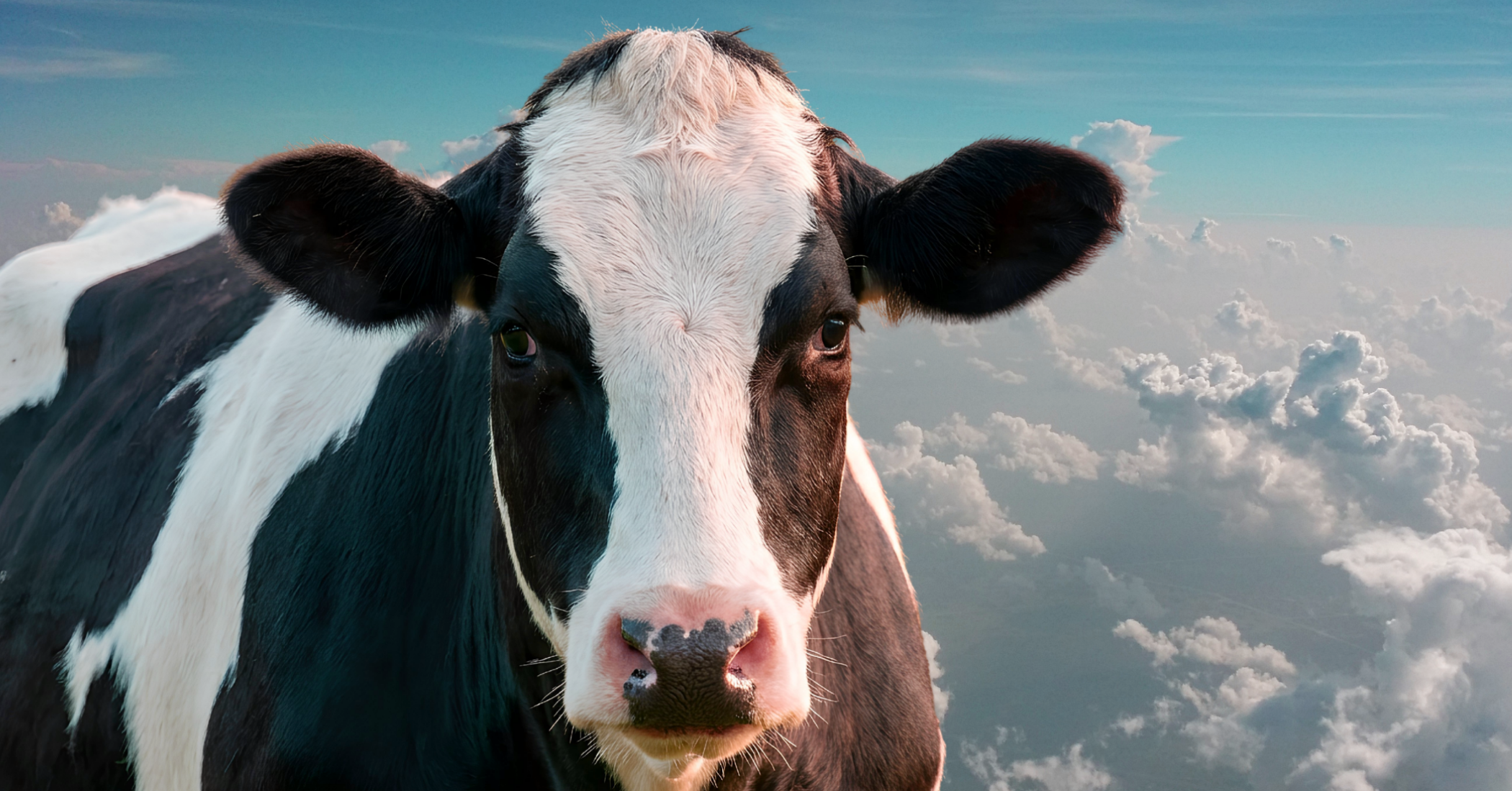
Today marks a little-known “holiday,” with a name that sounds silly but masks something far more sinister: Cow Milked While Flying in an Airplane Day.
Yes. A whole day commemorating the theft of breastmilk from a cow who was forcibly impregnated, had her baby taken from her, and was then forced aboard a tiny aircraft for spectacle.

On February 18, 1930, a cow named Elm Farm Ollie was “stuff[ed]” onto a small plane and flown from Bismarck to St. Louis, Missouri. During that flight, her so-called “caretaker” used his hands to force 24 quarts of milk from her body.
The stunt was staged as part of the International Air Exposition. Nearly a century later, it’s still memorialized as a quirky, celebratory footnote in both “dairy industry and aeronautics history.”
But strip away the media-crafted novelty, and what remains? An enslaved animal, further exploited for “a publicity stunt”—sanitized, repackaged, and sold to the public as “science.”
From the outset, the motives were commercial. Elm Farm Ollie’s mid-air violation was designed to benefit the dairy industry by promoting and boosting dairy consumption: “fluid milk consumption was [] put in the spotlight as the flight neared its final destination.”
At the very same time, organizers sought to promote the “fledging aviation industry”—to get “rural Americans more interested in flying” and “‘to blaze a trail for the transportation of livestock by air.’”
In other words, this was all about calculated marketing. And, although the stunt ultimately “failed to launch farming into the world of aeronautics the way organizers had hoped”—routine air shipment of farmed animals never truly caught on—it continues to be framed as innovation, as ingenuity, as bold experimentation in the name of progress.
That framing is not accidental.
Because when profit alone is too naked a motive, industry reaches for a shield. In this case, that shield was “science.”

Beyond its economic motivations, the stunt was cloaked in an “ostensible” scientific rationale.
We’re told that farmers and scientists “had questions” about how altitude and inertia might affect a cow’s “ability to both produce and let down milk during the flight.”
So, Elm Farm Ollie was forced into the sky to supposedly prove that “farm[ed] animals could be flown from one airfield to another and even milked en route” and that “air travel could be utilized to transport production livestock without ill effects” for humans.
The formula on display in 1930 is the same formula we see in animal laboratories across the country today:
Exploitation dressed up as inquiry.
Subjugation reframed as neutral research.
Profit motives cloaked in the language of social good.
When “science” conveniently affirms that new methods of control and commodification are viable, we must recognize it for what it really is: a tool of the animal industrial complex.
And tools require targets.
Elm Farm Ollie—now memorialized by her exploitation as “the first cow to take flight and the first cow to be milked on a plane”—wasn’t chosen at random.
Like so many victims of animal experimentation, she was selected precisely because she made for an easy target. She was described as having a “gentle demeanor,” an “easy going” and “docile and calm nature.” In other words, she didn’t lash out at those who used and hurt her.
Her temperament made her manageable.
And her body made her profitable.
Elm Farm Ollie was also selected—and, indeed, prized—for her “outstanding production” (i.e., for “her ability to give lots of milk”).
During the flight, Elm Farm Ollie was “milked” by Elsworth W. Bunce of the American Guernsey Cattle Club—an “innovative promoter” of her breed, now remembered as “the first man to milk a cow mid-flight.”
Her “fresh-squeezed” “sky milk” was packaged into “paper cartons and parachuted down to spectators,” who drank what was perversely branded “milk from heaven.”
History treats these details as charming and amusing. But there is another detail often mentioned in passing that reveals something deeper.

Elm Farm Ollie was flown in a Tri-Motor plane manufactured by Henry Ford. Today, animal research facilities bear Ford’s name.
This is more than coincidence. It’s continuity.
Ford’s legacy is synonymous with industrialization—and the same logic that revolutionized factories reshaped farms and laboratories alike. Bodies became production units. Yield and profit became the only measures of value.
Whether in a dairy barn, an animal research facility, or the cabin of a Ford aircraft, the underlying premise remains the same: nonhuman animals exist as commodities. As means to human ends—no matter how unethical, no matter how trivial.
Elm Farm Ollie’s flight sits at the intersection of animal agriculture, animal research, and industrial ambition: on that February day in 1930, she was forced onto a plane so profiteers could advertise themselves, and so exploitation could be further normalized and explored under the banner of “science.”
And that is precisely why this story matters now.

Because “science” is still strategically invoked as a distraction and a defense for obvious harm—and because we must always look closer.
We must ask who benefits.
We must ask who pays.
And we must refuse to let exploitation be rebranded as innovation.
Elm Farm Ollie deserved a life free from commodification, with solid ground beneath her feet and her young by her side.
Every animal still trapped on industrial farms and in laboratory cages deserves the same.
Let the memory of Elm Farm Ollie represent more than novelty—let it serve as a warning, and let it be a call to action.
Join us challenging the industries that weaponize “science” to justify violence, exposing the narratives that normalize exploitation, and demanding a future rooted not in profit but in justice.
Share Elm Farm Ollie’s story now on
Facebook, X, or Bluesky.