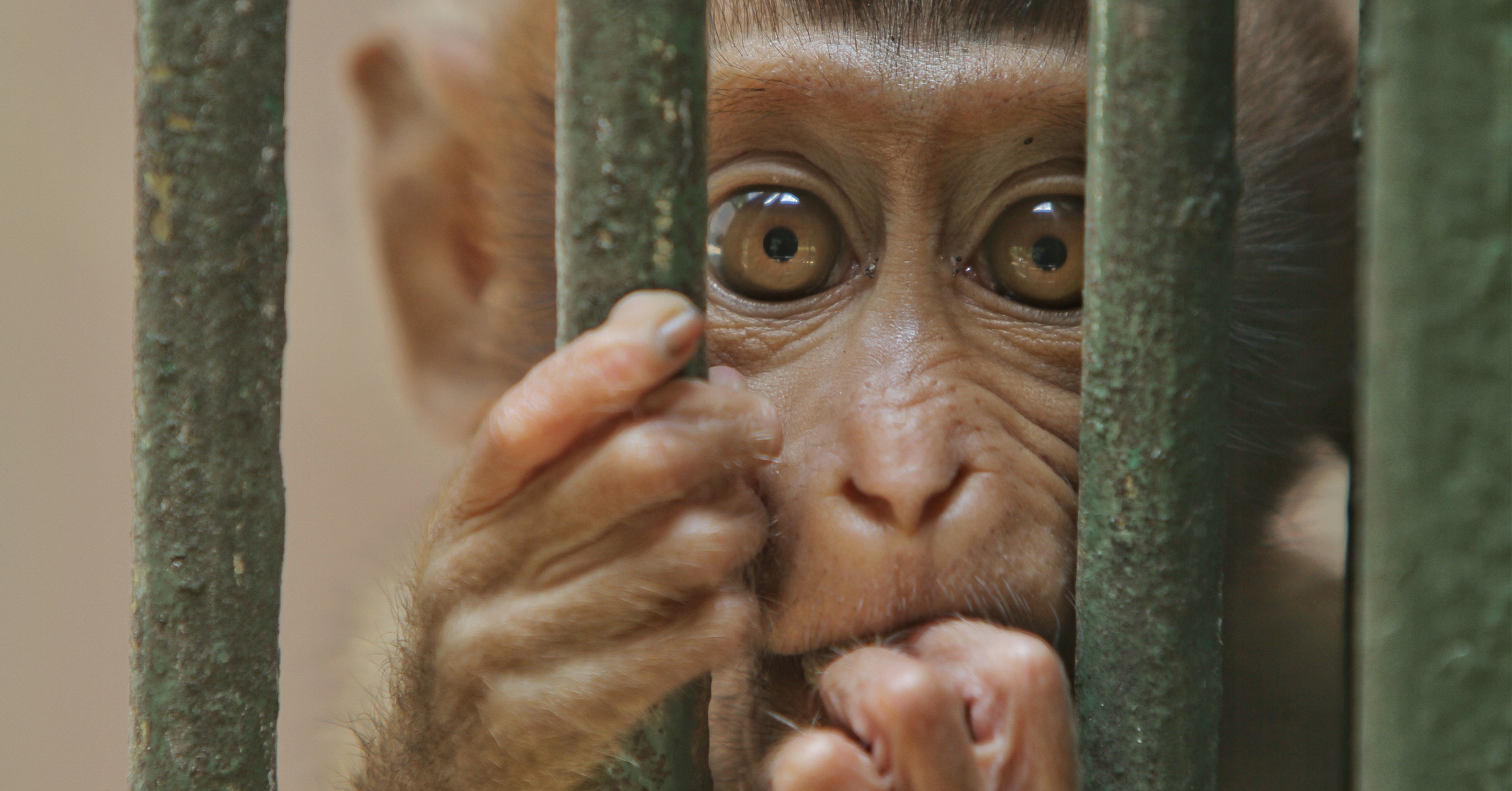
The world’s largest supplier of animals for biomedical research has expanded.
Just months after the U.S. quietly closed its investigation into Charles River Laboratories’ (CRL’s) suspected trafficking of wild, endangered monkeys into the U.S., the company has bought part of the very supply chain in question.
CRL’s purchase of an Asian monkey supplier represents a brazen move to consolidate power, avoid accountability, prevent future scrutiny, and perpetuate the import of monkeys into U.S. labs.
Buying Control of the Monkey Pipeline
CRL expects its acquisition to:
- “strengthen its supply chain after a turbulent period;”
- allow for “greater control over procurement of the animals” it uses in drug testing; and
- “help save costs.”
As summarized by CRL’s CEO:
“The demand continues to increase, so we want to have control of supply.”
That “supply”? Endangered beings victimized by a sprawling global trade built on violence, corruption, and cover-ups—a trade on which CRL is now doubling down.
CRL has announced its $510 million purchase of K.F. (Cambodia) Ltd., a company that has reportedly supplied “around 30%” of the monkeys used by CRL for drug research over the past two years.
Through this deal, CRL has taken ownership of one of its primary suppliers—described by former primatologist Dr. Lisa Jones-Engel as “a primate breeding operation . . . linked to falsified origin records, weak traceability, and documented infectious disease risks.”
Translation: a key node in the network just under federal investigation has been absorbed by one of the very companies that has most fueled—and profited from—that network all along.
Vertical Integration, Industry-Style
CRL already owns 90% of Noveprim, a primate supplier in Mauritius. With its purchase of K.F. (Cambodia) Ltd., CRL now owns and will be able to “internally source most of its future [nonhuman primate] supply requirements.”
This is textbook vertical integration, and it is all happening just as CITES—the international body charged with protecting endangered species—is once again poised to align with industry interests.

Despite overwhelming evidence of monkey laundering, the CITES Secretariat has recommended removing certain primate-exporting countries—including Cambodia—from a special review process.
And, CRL is ready to cash in.
Driven by rising demand from both biotech and pharma clients, analysts report that CRL realized its largest number of net bookings (since the end of 2022) during the last quarter of 2025.
With its purchase of K.F. (Cambodia) Ltd., CRL’s CEO anticipates further increasing profits because the company will now pay less for the monkeys themselves.
In other words: more control, less expense, more profit—and more victims.
The Industry Wants Stability, Not Scrutiny
CRL’s acquisition must be understood for what it is: an attempt to tighten control over a violent, allegedly illegal, and increasingly scrutinized supply chain of living beings.
The timing makes CRL’s move especially revealing—and not only because CRL just escaped a federal probe. At a time when federal support for primate experimentation is in marked decline, CRL is choosing not to reduce its stake in the global primate trade—but to increase it.
This exemplifies the logic of the animal research industry:
In the face of scrutiny and public opposition, the industry does not change course. Rather, it takes additional steps to shield itself from public view, insulate itself from regulatory intervention, and escape legal accountability.
Congress Has the Power to Undercut CRL’s Plan
CRL’s deal might be done, but there is still a way to fight back—and we must.
Congress can shut down the import pipeline CRL is trying to control by passing the Preventing the Risky Importation of Monkeys to Avoid Toxic Exposures (PRIMATE) Act. The PRIMATE Act would prohibit the import of monkeys for animal research purposes—exactly what CRL is banking on.
With one action, we have the rare opportunity to both stand up to the world’s largest supplier of animals for research and stand up for its victims: monkeys being trafficked to the U.S. for torture and death.
Let’s act now.
Your Call to Action: Tell Congress to pass the PRIMATE Act and help stop the animal research industry from trafficking in endangered monkeys.
Share this article on Facebook, X, or Bluesky
About the Author: Lindsey Soffes is Head of Programs at Rise for Animals. She holds a law degree from William and Mary Law School and has spent her career advocating for the rights of all animals—both human and non-human.