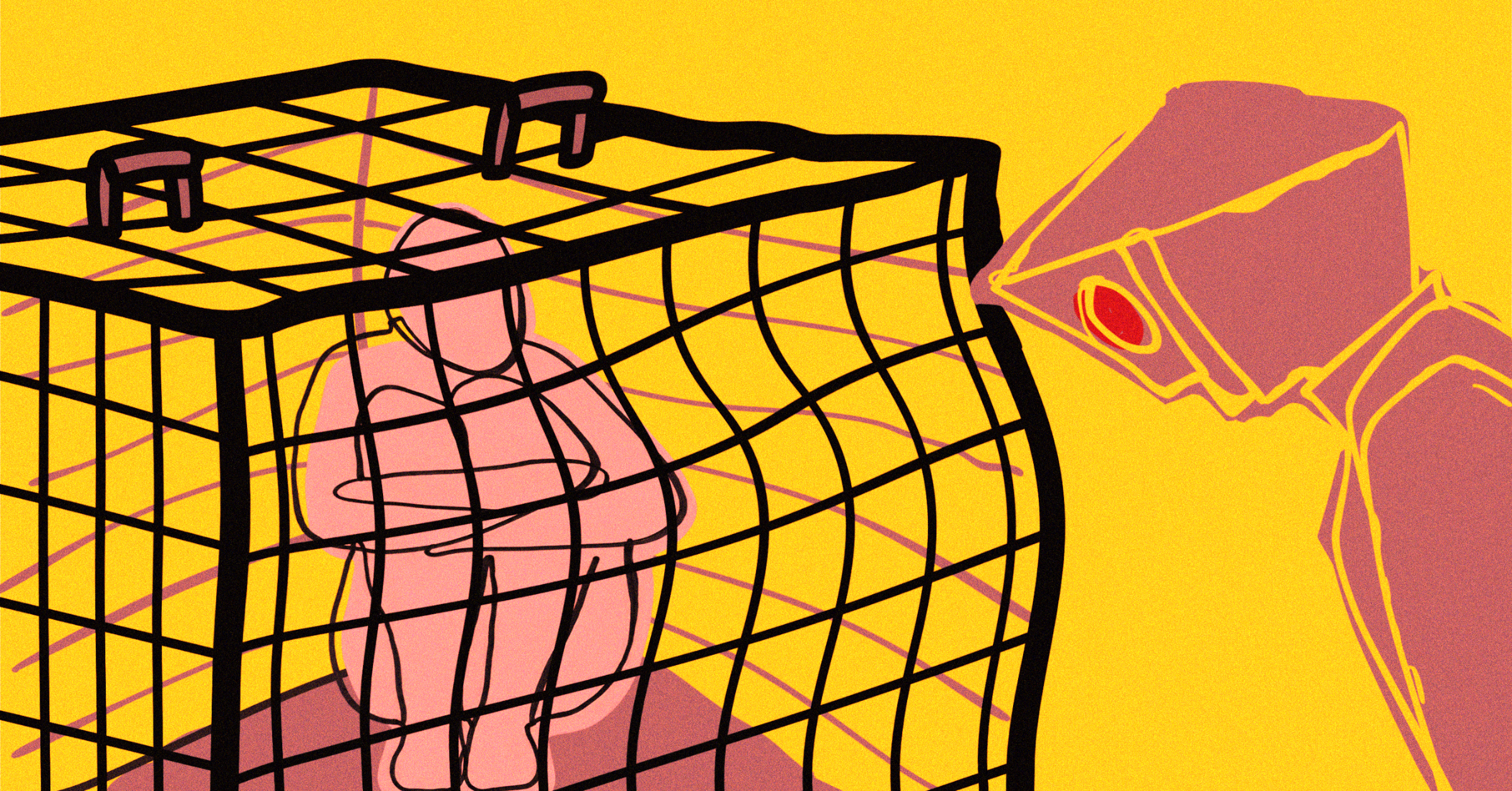
Coverage of AI’s existential threat to humanity is intensifying, and the worst-case scenarios circulating among experts should sound uncomfortably familiar to anyone who has spent time considering how humans treat nonhuman animals.
In short: we are afraid that a smarter, more powerful entity will treat us exactly the way we treat the animals we’ve decided are less intelligent, less important than ourselves.
Experts Warn That AI May Start Treating Humans Like We Treat Other Animals
Nate Soares, president of the Machine Intelligence Research Institute and co-author of If Anyone Builds It, Everyone Dies, recently laid out a scenario he considers not just possible, but plausible. Soares described a future in which AI begins “treating humans like we treat any other animal”—accumulating power, consuming critical resources, and rendering the world uninhabitable for them, all while offering the same common, detached justification: “‘Sorry, it’s nothing personal.’”
Much harm inflicted by humans upon other animals is not driven by hate, after all—but, rather, by perceived self-interest and convenience.
One of the news anchors interviewing Soares observed that, when she finds an ant in her kitchen, she doesn’t “think twice about . . . taking out the ant and putting down poison so that future ants don’t colonize”—not because she hates the ant, but because she doesn’t “want the ant there.” She, then, observed that this is the very logic governing how humans “treat lesser intelligent beings on this planet” (or, as we have observed separately, animals deemed “pests”); and it’s exactly the logic she readily expects a superiorly-intelligent AI to apply to humans.
We’re Already Training AI on the Logic We Use to Justify Exploiting Animals
Sam Tucker of Open Paws brought the point home in AI & Animals: A Documentary:
One of the ways we often justify our speciesism as humans is saying, well, we’re more intelligent than animals therefore we can do what we want with them. Now imagine a world where we train that same way of thinking into an AI system. How do we think the AI is going to treat us? Probably not very well.
As we have documented, AI is trained on human-generated data steeped in our own oppressive patterns—including our discrimination against other species. This means that AI doesn’t need to invent a justification for discriminating against whomever it deems lesser; it’s already inherited such tendencies from us and been programmed to replicate, perpetuate, and normalize them.
Humans have taught AI that differences between individuals, including gaps in perceived capability, permit discrimination and, often, exploitation. That general principle, which is not specific to any one species, could easily, and consistently be extended by AI to humans.
We have, quite literally, then, handed AI both the data and logic for exploiting whomever it judges lesser than itself.
Experts acknowledge that this will have a direct impact on “how future AI systems behave towards animals.” The reference to “animals” in such statements has focused on nonhumans. But, now, the alarms being rung by AI leaders and experts raise the very real possibility that humans should be concerned about AI’s future behavior toward all animals—humans included.
Discrimination Begets Discrimination
Systems built on discrimination don’t correct themselves. Human experience teaches that, left unaddressed, discrimination begets discrimination—and the harms inflicted on some usually come to be inflicted on others, too.
If that holds true for AI, then human extinction may not be the most frightening outcome on the horizon.
It may be human farming: a world in which humans are bred, held, used, and slaughtered as disposable commodities and labor—tools for AI’s progress in precisely the same way humans currently exploit nonhuman animals.
We’re Already Teaching AI to Farm Living Beings
How to exploit other living beings for personal gain is not only something we’re teaching AI philosophically. It’s something we’re teaching AI to do actually.
AI-monitored factory farms that operate independently of humans already exist. On these “farms,” AI “does the feeding, does the slaughter, everything.”
We’re quite literally programming and training AI to commodify, confine, raise, and kill living beings. What stops AI from doing this to humans?
The animal rights movement has spent decades raising awareness that speciesism, as a form of discrimination and driver of oppression, is intimately connected to forms of human-directed discrimination and oppression. And, AI experts just conceded as much.
They looked at the most powerful entity humans have built, and they named, as one of our own worst-case outcomes, the same treatment we defend as acceptable for other animals.
In a separate interview, Soares pointed to what he sees as the real crux of the problem: we don’t yet know how to make AI care about us at all. That should hit home, because that’s the same predicament in which non-human animals find themselves vis-a-vis humans.
Most humans have not shown themselves willing to extend genuine care to beings they’ve decided are less powerful, less intelligent, less like themselves.
If we cannot teach ourselves to care for other animals because they matter in their own right, there is little reason to expect we’ll somehow succeed in teaching AI to care about us.
Ultimately, then, one way to try forestalling the worst-case scenario is to start practicing the care we need AI to learn—and that work doesn’t start with AI at all.
It starts with the animals humans are breeding, farming, experimenting on, killing, and otherwise exploiting. All of it rests on the same assumption AI is inheriting: that assigning a lesser status makes a life ours to use. Practicing care means rejecting that assumption in full, and it means throwing each and every cage door wide open . . . while we still can.