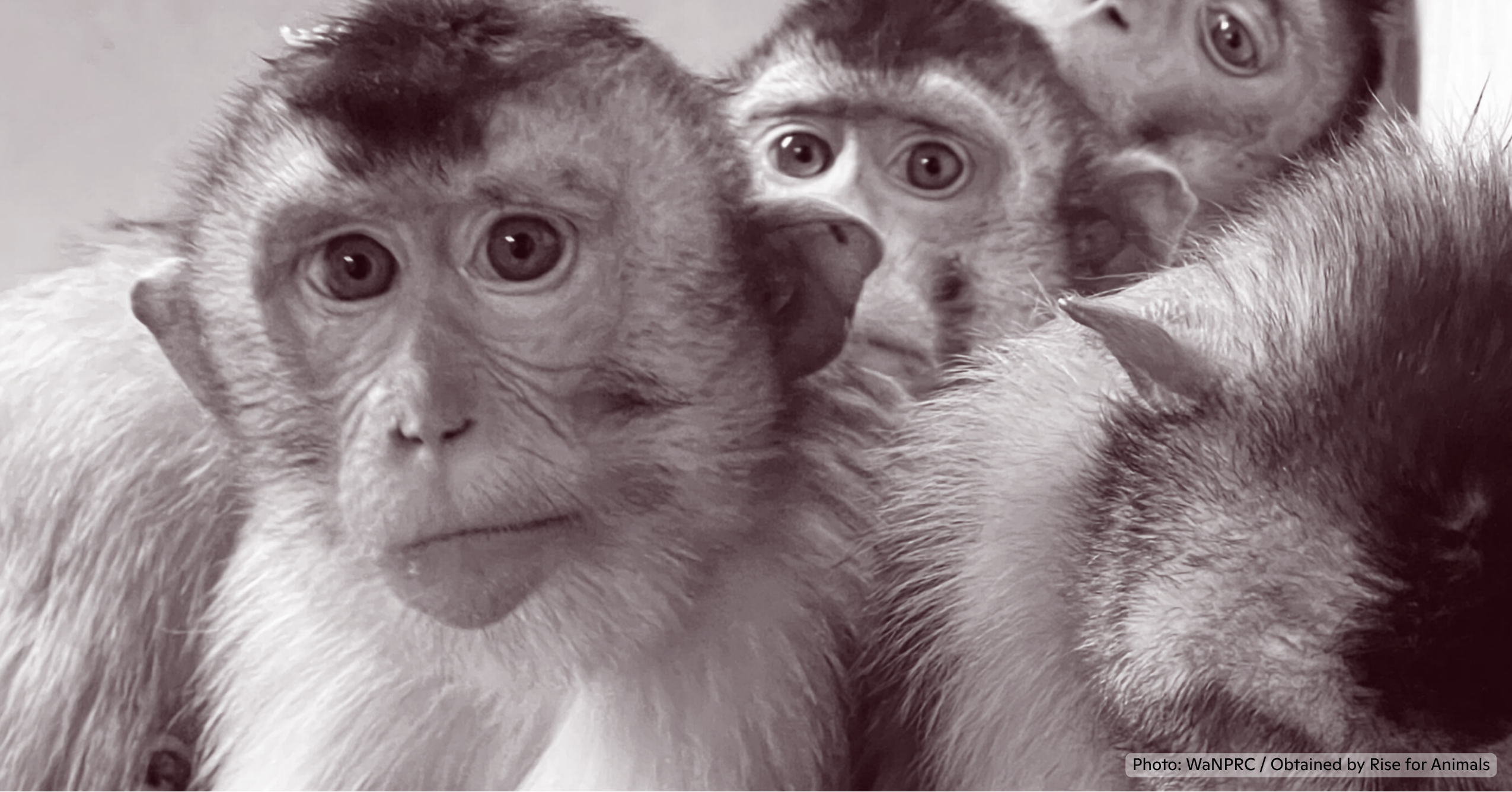
No More Monkey Labs: NIH Must Stop Funding Primate Research
When it comes to experimenting on monkeys, the federal government is trying to have it both ways.
The National Institutes of Health (NIH) says it wants to move science beyond animal research, but its funding decisions tell a different story.
NIH has acknowledged that animal research is both ethically and scientifically fraught, as well as profit-motivated. It has backed and financially invested in human-relevant science. It has even considered sanctuary transition for the primate center at Oregon Health & Science University.
Yet, at the very same time, NIH has continued directing billions of taxpayer dollars to the animal research industry.
Nowhere is this contradiction more apparent than in nonhuman primate experimentation.
The Federal Infrastructure Behind U.S. Monkey Research
In the 1960s, animal researchers convinced Congress to fund a network of “primate research centers” for the purpose of conducting and supporting U.S. research on nonhuman primates. Federal dollars molded these institutions into engines of U.S. primate experimentation that “have knit themselves into the fabric of biomedical research and facilitated the growth of the primate model.” They are places where:
- monkeys are bred, warehoused, experimented on, traded in, and supplied to others;
- animals are made to suffer physically, psychologically, and emotionally; and
- researchers are trained and encouraged to hurt sentient beings for money.
Today, this network consists of seven centers, collectively known as “National Primate Research Centers” (NPRCs), though four have recently dropped “primate” from their names:
- The National Biomedical Research Institute at the University of California, Davis.
- The Emory National Biomedical Research Center at Emory University.
- The Oregon National Primate Research Center at Oregon Health & Science University.
- The Southwest National Primate Research Center at the Texas Biomedical Research Institute.
- The Tulane National Biomedical Research Center at Tulane University.
- The Washington National Biomedical Research Center at the University of Washington.
- The Wisconsin National Primate Research Center at the University of Wisconsin–Madison.
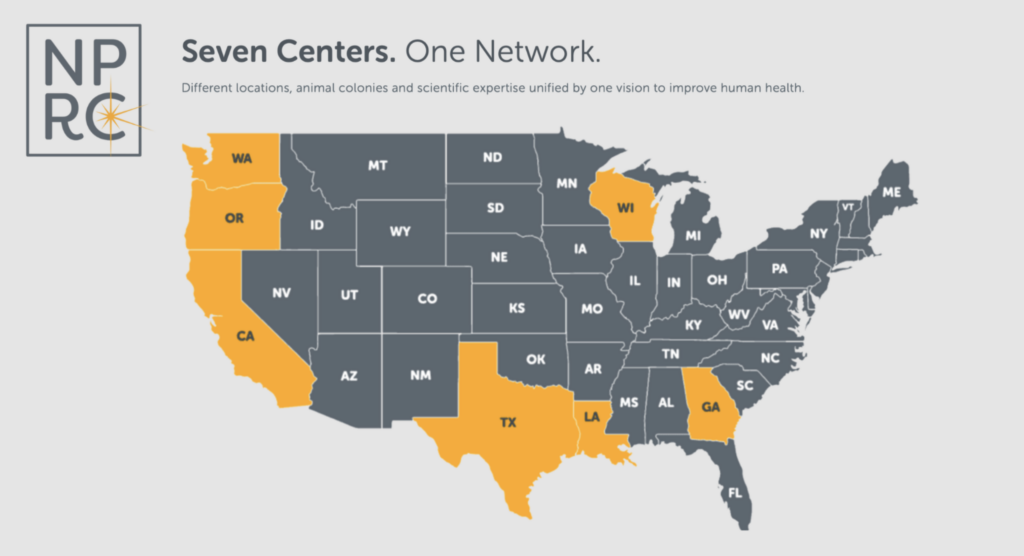
Together, these NPRCs’ parent institutions reported 24,055 nonhuman primates* in fiscal year 2025, the most recent year for which USDA has released data. That’s more than one-in-five nonhuman primates reported by all U.S. animal research facilities—24,055 individuals bred, incarcerated, and exploited for research ranging from fetal development to infectious disease.**
NIH underwrites this exploitation. In fiscal year 2025 alone, NIH awarded the NPRCs’ parent institutions an estimated $248 million for primate research or related activities.
Public records also suggest that, since 2001, NIH has awarded the NPRCs’ parent institutions around $3 billion for primate research or related activities—a figure that excludes the first 40 years of the NPRCs’ existence.
The NPRCs openly admit that federal money is their lifeline. They describe government funding as essential to their existence, down to their day-to-day operations.
That is why the NPRCs matter to any serious effort to end federally-funded animal research. They are not only places where animal experiments take place; they are the machinery that makes federally-backed primate experimentation scalable.
The Federal System Built to Breed, Cage, and Kill Monkeys Runs on NIH Dollars
NIH supports the NPRCs through several funding streams. Some grants fund their operations, including facilities, personnel, day-to-day infrastructure, and primate breeding colonies. Other grants fund primate experiments themselves.
Together, that federal support undergirds and reinforces the primate research pipeline: the breeding of test subjects, the cages in which they are locked, the buildings that hold those cages, and the researchers who open the doors only to harm those inside.
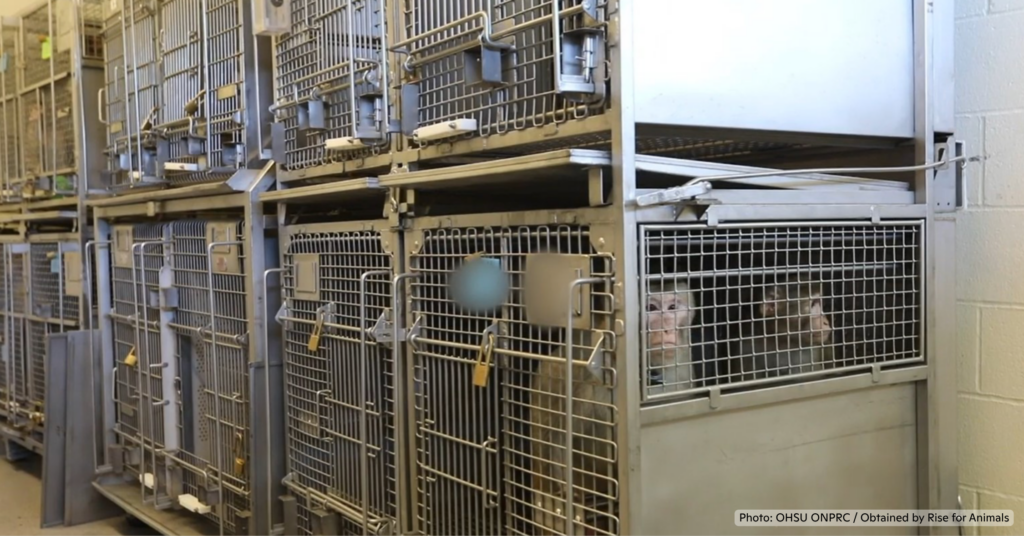
NIH is not only enabling experiments happening right now. It is also ensuring that future experimentation can, and will, continue.
How NIH Keeps Primate Research Locked In
The federal government’s ongoing support of the NPRCs has been identified as a key driver of animal research—and as a primary barrier to leaving the practice behind.
Through the NPRCs, NIH helps normalize, facilitate, perpetuate, and entrench the torture of monkeys in the name of science. Then, when advocates call for a transition away from animal exploitation, the industry points back to the very infrastructure public money sustains as evidence of legitimacy and supposed necessity.
But the status quo is neither legitimate nor necessary—nor inevitable.
It is merely the predictable result of government choices, and those choices can be changed.
It’s Time to Dismantle the System
There is a danger, in this moment, that “transition” becomes another industry slogan—useful in public statements, meaningless in practice. Any real transition away from primate experimentation would end the breeding of monkeys for research. It would shift funding from primate research to non-animal, human-relevant methods. And it would stop treating animal research infrastructure as something worth preserving while science and ethics supposedly move beyond it.
Adding new money for non-animal methods is not enough if NIH continues to fund primate breeding and experiments. That dual approach lets the agency claim progress without dismantling any of the machinery that perpetuates animal research and continues creating new victims.
If NIH is serious about moving beyond animal research, it must fund transition instead of, not alongside, vivisection.
NIH has the power to do just that. As the largest public funder of biomedical research in the world, the agency decides which institutions and what kinds of research receive public support. Through these decisions, NIH helps set the trajectory for science the world over.
For decades, NIH has used its power to sustain primate and other animal experimentation. But it doesn’t have to—and it never did.
Every renewal of existing funding is a choice.
Every new grant is a choice.
Every animal harmed with federal dollars is a choice.
No More Money for Monkey Labs
NIH now finds itself at a crossroads: it cannot credibly claim to be ushering in a new era while preserving the very infrastructure that a real transition would require it to dismantle.
More than sixty years ago, the federal government chose to help build the U.S. primate research apparatus. Today, NIH is choosing to keep it alive.
Together, we can push NIH to choose differently:
- To stop funding monkey labs;
- To start funding transition and sanctuary; and
- To build a future where science is ethical—and cages are empty.
Tell NIH: Stop investing in primate experimentation and start building the human-based research system everyone—human and nonhuman—deserves.
Share:
Facebook | X | Bluesky
*These numbers do not include the primates held or used for research at the Southwest National Primate Research Center (SNPRC), because its parent—the Texas Biomedical Research Institute—reported “0” nonhuman primates on its FY2025 Annual Report to APHIS. SNPRC’s FY2025 APHIS inspection reports, however, record primates held under SNPRC’s Class R research registration, strongly suggesting that the Annual Report is in error and that the combined total above is an undercount.
**The actual number of monkeys supplied by the NPRCs, or experimented on with NIH dollars outside the NPRCs, is unknown.