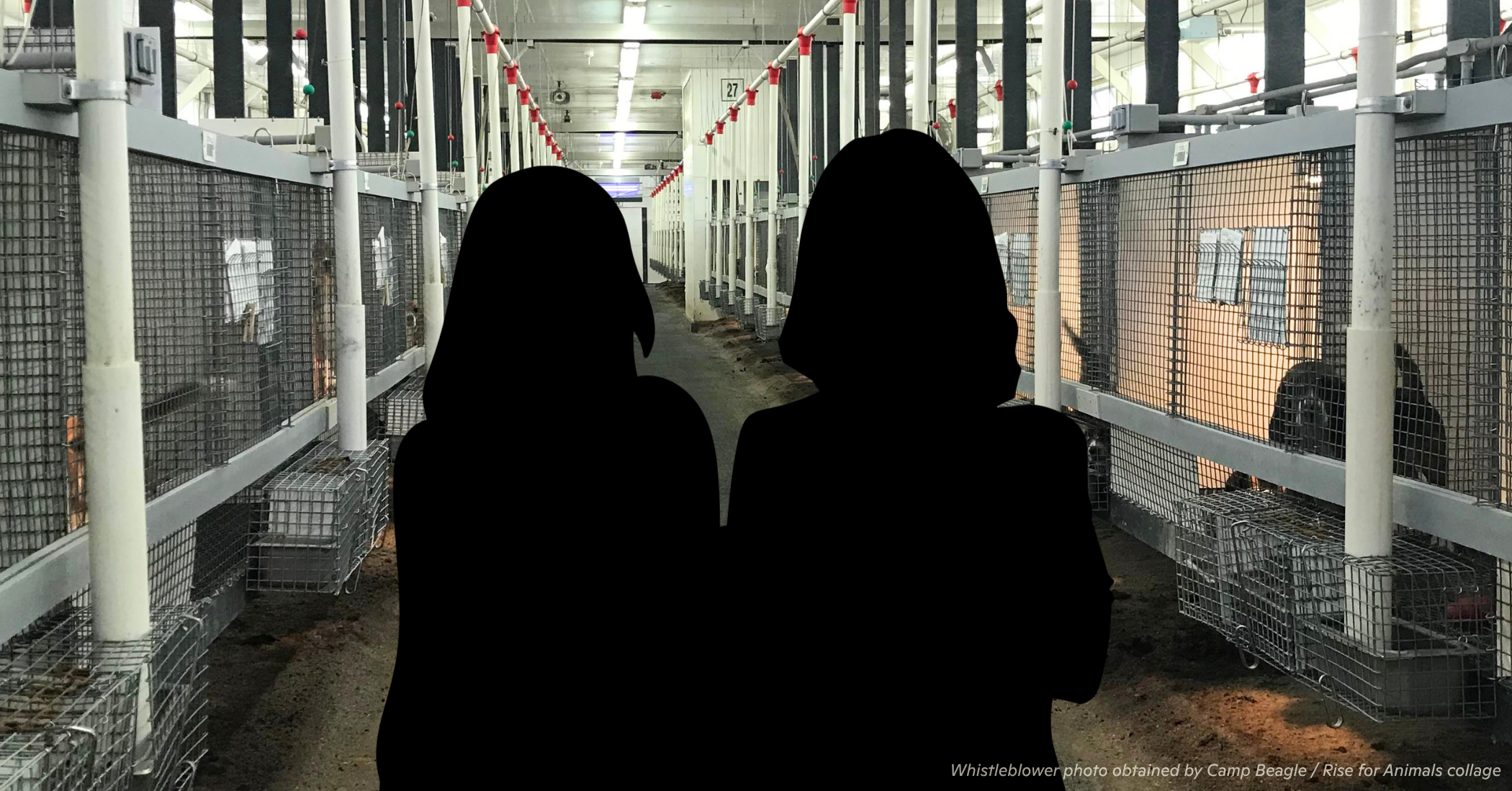
The Two Inspectors Behind Marshall’s “Clean” Record
When we examined the federal inspection history of the notorious breeder of dogs for research Ridglan Farms, we found that a single USDA Veterinary Medical Officer had prepared every available inspection report for more than a decade. We also found that the rare occasions on which he documented violations were often the very same rare occasions when other inspectors joined him.
Ridglan used its federal inspection record as a shield.
Now, Marshall BioResources—targeted by the same advocates who had Ridglan in their sights—is trying to do the same.
Marshall recently told media that breeding animals for medical research is “highly regulated and subject to ongoing oversight,” that its facilities are regularly inspected by USDA, and that its most recent, unannounced, May 2026 inspections produced a “clean report.”
But here’s the thing: when Marshall’s federal inspection history is examined, it tells a story very similar to Ridglan’s.
Marshall BioResources, or Marshall Farms, houses its U.S. operations in New York state, where it recently reported incarcerating more than 32,000 animals across just three of its sites. Based on the latest animal counts recorded by USDA, that figure reflects over 15,000 dogs and puppies, almost 14,000 ferrets, over 2,100 pigs, and almost 1,200 cats and kittens.

Marshall holds three separate federal certificates through USDA, and federal regulations require inspections of all three:
(1) a Class A license to breed and sell animals;
(2) a Class R registration to conduct animal research itself; and
(3) a Class T registration to transport animals commercially.
USDA Has Sent the Same Two Inspectors Since At Least 2014
Across 12 years and 48 publicly-available inspection reports, USDA inspections of Marshall have been led almost exclusively by two people.
➔ Veterinary Medical Officer Keri Lupo is named on 45 of the 48 reports, and she prepared all but one of the Class R reports.
➔ Animal Care Inspector Andrea D’Ambrosio is named on 35 of the same 48 reports, and she prepared 27 of 29 of the Class A reports and every Class T report.
Together, Lupo and D’Ambrosio led 46 of the 48 inspections, and they appeared together for 33 of them.
Nothing required USDA to staff Marshall inspections this way. It chose to make the same assignments over and over again.
Ten inspectors are named across the full record, but the eight other than Lupo and D’Ambrosio are almost all transient: seven of the eight surface only within a single calendar year and never again.

Every Documented Violation Falls Under One Certificate
Across the 48 reports, USDA documented 13 non-compliance items at Marshall. Every one of them attached to Marshall’s Class A breeding license.
USDA sorts its findings by severity. A finding is “critical” if it had a serious or severe adverse effect on an animal’s health or well-being; and it is “direct” if the serious or severe adverse effect is occurring at the moment the inspector is standing there. Everything else is considered “non-critical,” and it’s up to the inspector as to whether to record it.
When an inspector identifies a non-critical issue, USDA’s Animal Welfare Inspection Guide empowers the inspector to decide whether it should appear on the inspection report. This means that inspection reports are less a complete record of what inspectors found—and more a record of what they elected to write down.
Marshall’s 13 documented non-compliances break down into 12 non-critical findings and one critical finding, spread across 8 inspection reports:
➔ Eleven of the 13 were documented between 2021 and 2024.
➔ Nine of the 13 concerned facility conditions, including sanitation, food storage, and flaking paint.
➔ Only four of the 13 concerned individual animals.
USDA Documented More Violations When It Sent More Inspectors

Assessing Marshall’s 29 Class A inspection reports, we find an association we have seen before: The more inspectors listed on a report, the more likely that report documented a violation.
➔ Eighteen reports listed two inspectors, and four of those—22 percent—documented non-compliance.
➔ Six reports listed three inspectors, and two of those—33 percent—documented non-compliance.
➔ Four reports listed four inspectors, and two of those—50 percent—documented non-compliance.
(A single report, from 2018, lists one inspector, no animal count, and no non-compliance.)
Sixteen of Marshall’s Class A inspection reports show the regulars—Lupo and D’Ambrosio—working alone. Those 16 inspections resulted in four violations.
The other 13 reports included at least one inspector other than Lupo and D’Ambrosio. Those inspections produced nine violations.
That brings us to Marshall’s recent record, which it has highlighted for the media. USDA has posted only three Class A inspection reports for Marshall so far in 2026, and it produced only three in total in 2025. All six of those involved only Lupo and D’Ambrosio, and not one documented any non-compliance.
That stands in stark contrast to the two preceding years: USDA generated five Marshall Class A inspection reports in 2023 and eight in 2024, and those 13 reports documented the majority of Marshall’s total non-compliance findings over the past 12 years. Nine of those 13 reports listed inspectors other than Lupo and D’Ambrosio, and those nine reports account for five of the seven non-compliance findings made during that period.
This should trouble anyone who assumes a clean inspection report is a statement about conditions, rather than a statement about who was standing there with the clipboard.
USDA Limits What—Or Really, Who—Inspectors Examine
It should also trouble anyone who does the math. Marshall regularly reports tens of thousands of animals, yet USDA sends only two to four inspectors—and sharply limits what they are expected, or allowed, to do.
USDA’s 2025 Animal Welfare Inspection Guide directs inspectors to “observe” animals “for their health and well-being,” while avoiding unnecessary handling and any diagnostic procedures.
For Marshall’s thousands of ferrets, pigs, cats and kittens, that’s the whole of it. USDA does not require a hands-on examination of a single one of them.
USDA’s Guide sets a hands-on standard for exactly one species: for dogs, inspectors of licensed facilities like Marshall are generally directed to:
- Ask to have “any dog showing signs of a medical issue” pulled from their enclosure if they “need . . . a closer look”;
- Ask to have “any dogs that were previously identified as having a medical issue” removed from their enclosures for rechecks if they “need a closer look”; and
- “Select 10 percent of the remaining dogs (up to maximum [sic] of 10 dogs)” to be pulled from their enclosures and checked “for medical issues associated with their mouths, ears, eyes, skin, general condition, etc.”
The first two prongs are conditional, concerning only dogs with readily identifiable or previously documented concerns. All other dogs fall to the third prong, and the third prong carries a cap.
The only examinations capable of surfacing physical health issues nobody has yet noticed or documented are limited to ten dogs.
That cap of ten dogs does not scale. It’s ten dogs at a facility housing 100 dogs, and it’s ten dogs at Marshall’s North Rose site, which reported 14,565 dogs in May 2026—at the time of the “clean” inspections Marshall is advertising. Ten percent of that population would be about 1,450 dogs. The USDA Inspection Guide sets the maximum number to be examined at 10—or roughly 1 in every 1,500 dogs.
So Marshall’s clean 2026 inspection record certifies far less than Marshall suggests.
➔ All three 2026 reports were generated in a single day by the same two, regular inspectors.
➔ Across the three sites inspected, Lupo and D’Ambrosio reported 32,315 animals, but USDA’s Animal Welfare Inspection Guide directed them to put hands on no more than 20—ten dogs at North Rose, drawn from a population of 14,565, and ten dogs at a second site, drawn from a population of 513.

Twelve Years of Inspections Produced Just Four Findings About Animals
Of the 13 non-compliance items in Marshall’s federal file, nine concern the facilities themselves: sanitation, flooring, paint, food storage, an accumulation of flies, hair and debris in fans and vents. That leaves four findings about individual animals.
The first is from August 2021, when an inspection for which Lupo and D’Ambrosio were accompanied by a third inspector documented nine individual dogs at Marshall’s North Rose site with untreated conditions.
The report identifies five dogs with interdigital cysts, one with an injury to the left rear hock, one with a growth on the side of the chest, one missing a toenail from a reddened wound that was not recent, and one with a puncture wound to her left mammary gland.
All nine dogs were subsumed within a single citation.
USDA records non-compliance by regulatory provision, not by animal. So nine dogs with specific, documented welfare issues enter Marshall’s federal record as one line item—and are given the same weight as flaking paint.
The second and third, from May 2023, concerned a kitten who was found by staff missing half his tail.
According to Marshall’s own records, its staff neither handled the injury as the facility’s protocol required nor contacted the attending veterinarian. A note estimated the tail would take four to six weeks to heal, but days later a new entry declared it healed, and the kitten was moved into an enclosure with unfamiliar kittens. He was euthanized the same day, after—as Marshall’s own records documented—his still-injured tail had been chewed to the bone.

It bears noting that Marshall’s failure to treat this kitten’s injury was graded by Lupo and D’Ambrosio as “non-critical,” meaning they deemed it to have had at most a minor impact on the kitten’s health. USDA’s own criteria places untreated open wounds that expose underlying tissue, muscle, or bone in its highest severity tiers—and where the harm has already occurred, rather than being observed in progress, that tier is “critical.” Given that half of the kitten’s appendage was missing and that Marshall’s own records estimated a four-to-six week healing period, it is hard to imagine how tissue, muscle, or bone could not have been exposed.
The “critical” citation Lupo and D’Ambrosio did issue with regard to this kitten was specific to Marshall’s decision to move him into a group of unfamiliar kittens. The citation says nothing about the absence of veterinary care—meaning that, across both citations, USDA chose not to categorize Marshall’s failure to treat the kitten’s injury as having a serious effect on him.
The fourth involved a ferret who was left behind in a cage “designated empty” after his group was moved.
And that is all they wrote: four findings identifying individual animals, across 12 years, at a facility housing tens of thousands of animals under factory farm conditions.
The Only Critical Finding Came From Marshall’s Own Records
There are two ways to read a record this thin, and only one of them can be right.
Marshall’s reading is the obvious and self-serving one: few findings, few problems. Ours is the one the analysis—and repeated whistleblower reporting—supports:
USDA’s inspection process, which treats facilities like Marshall as “customers,” is not designed to expose wrongdoing.
The only critical violation Marshall has ever received concerned the kitten who was euthanized after his injured tail was chewed down to the bone. Inspectors only learned of him through a review of Marshall’s paperwork, after the kitten had already been dead for weeks.
That means that the single “critical” finding recorded by USDA was found only because two things happened to line up: Marshall wrote the self-incriminating facts down, and an inspector flagged those particular records.
Remove either condition, and the most serious animal welfare violation in Marshall’s federal file does not exist for purposes of federal documentation.

That is the actual reach of federal “regulation” and “oversight” at a facility confining tens of thousands of animals:
a few dogs examined by hand,
a glance at some of the others,
whatever the facility wrote down and an inspector happened to read,
and, in the end, only what that inspector chose to record.
When Marshall points to its federal inspection record, it’s not telling us that its animals are well. It’s just telling us that nobody has written down otherwise.
Share this investigation on Facebook, X, or Bluesky now.
About the Author: Lindsey Soffes is Head of Programs at Rise for Animals. She holds a law degree from William and Mary Law School and has spent her career advocating for the rights of all animals—both human and non-human.