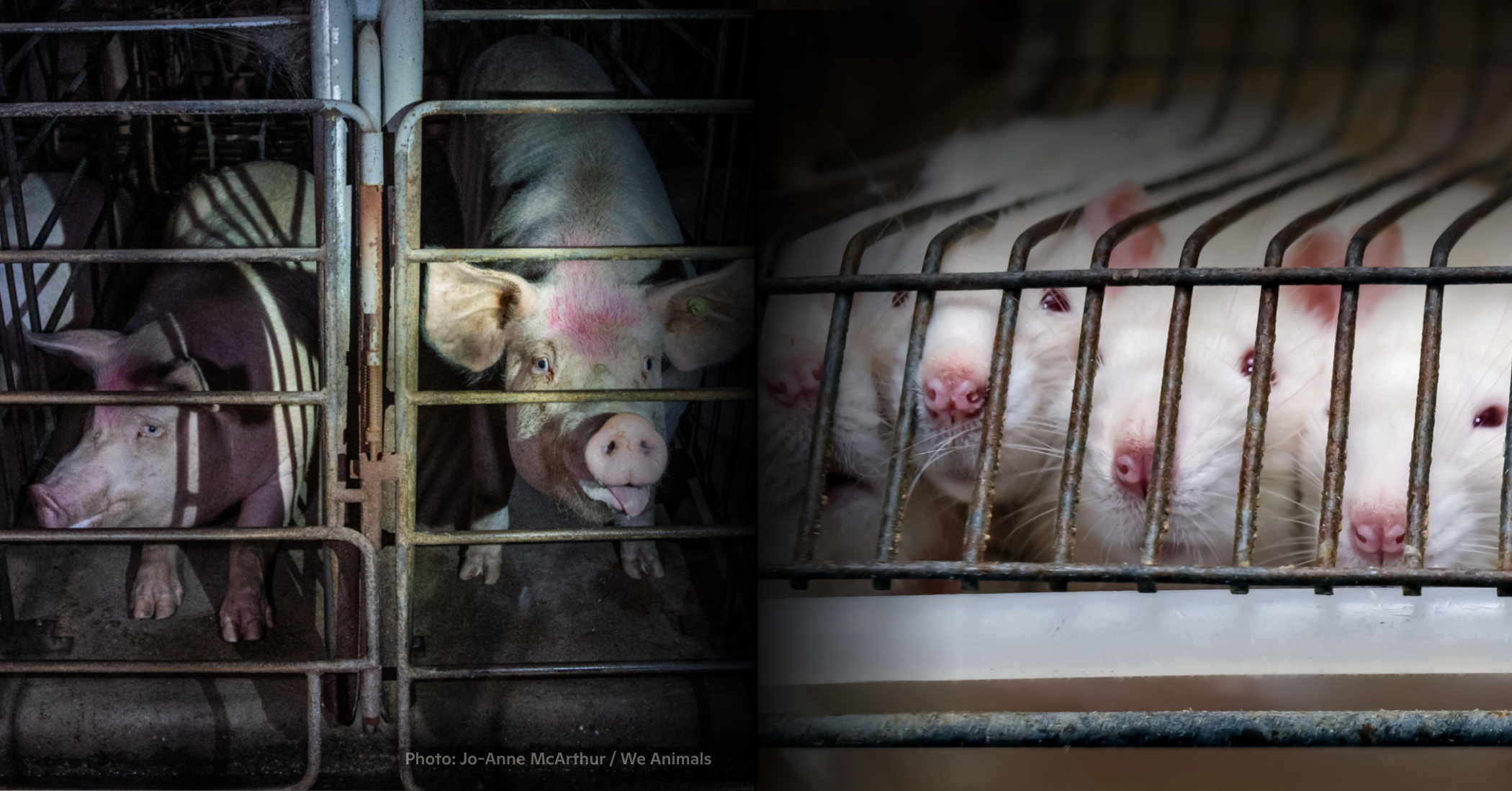
For decades, animal exploiters have taught us to see separation where there is connection:
To look at a cow and see food.
To look at a mouse and see a test tube.
To sort victims, and ourselves as advocates, into categories.
But the divisions are artificial. The system is one. And “farmed” animals are “research” animals.

The System Is One
- Cows’ babies are cut from their bodies at slaughterhouses—only for those babies to be bled out for a laboratory “serum.
- Pigs are forced to bear unnaturally huge litters, raised as “spare parts” for humans, and genetically modified to better survive their agonizing confinement.
- Chickens are trademarked and used in heat-stress research.
- Sheep are routed from a farm into artificial womb experiments.
- Fish are genetically altered to grow bigger and faster.
Rise for Animals has long worked to expose the interconnectedness of animal agriculture and animal research.
- We have unveiled the shared playbook used by those who treat animals as “food” and those who treat animals as “research tools.”
- We have explained how animal exploiters rely on and enable one another’s practices.
- We have demonstrated that “farmed” animals are “research” animals.
This all remains true, but it goes even deeper.
“Research” Animals Are “Farmed” Animals, Too
They are bred to order. Confined out of sight. Standardized, priced, sold, used, and killed as means to human ends. Their bodies are treated as production units—regardless of whether the product is “meat,” “milk,” body parts, grant funding, data, or publications. The desired output may change, but the rationale, economics, and politics do not.

The Labels Shape How We Think
The labels “farmed” and “research” frame our thinking. They tell us where to look, where not to look, and which atrocities belong to which “issue.”
Labels allow exploiters to manufacture artificial divisions. Meanwhile, the victims, regardless of label, remain trapped by the same industry and move through the same commercial pipeline.
Labels prompt us to think of farms and laboratories as distinct evils that require separate movements, separate strategies, and separate advocates. They train us to think of “farmed” and “research” animals as separate victims, each with their own advocates and their own fights.
Industry Depends on Division
Too often, we animal advocates carry labels of separation into our own work.
We organize around the very divisions created by industry, fragmenting our movement and diluting our collective power.
Rejecting the false divisions created by industry does not erase the specific realities faced by different animals. It does not minimize the distinct horrors of farms and laboratories. It does not diminish the nuances of our campaigns.
Rejecting industry’s divisions does, however, help close the distance between those of us fighting to end all animal exploitation. It helps us see that we are fighting a common enemy and that we are often fighting in protection of the very same victims.
One Fight
At the upcoming Animal & Vegan Advocacy (AVA) Conference, Rise for Animals will explore this shared system of exploitation and make the case for a unified movement—one that refuses the divisions industry depends upon.
The animals we’re fighting for are the same in all ways that matter—and so are we.

We need to stop seeing through the industry’s eyes and start looking toward one another.
Farmed animals are research animals, and research animals are farmed animals. They are all victims of the same powerful industry, one we can only dismantle together.
We hope you will join us in envisioning what our movement could become if we stopped labeling the victims and ourselves and, instead, joined together in one fight.