Ridglan Shocked the Public. Marshall Should Too.
Marshall BioResources, the United States’ largest breeder of dogs for experiments, wants you to see clean cages and animals treated with care.
A promotional video put out by the industrial-scale breeder shows beagles in pristine enclosures, newborn puppies nursing beside their mothers, ferrets nestled into fresh white bedding, and workers gently handling animals in white coats and blue gloves. The facilities look orderly and carefully maintained.
Whistleblowers’ cameras show a different picture.

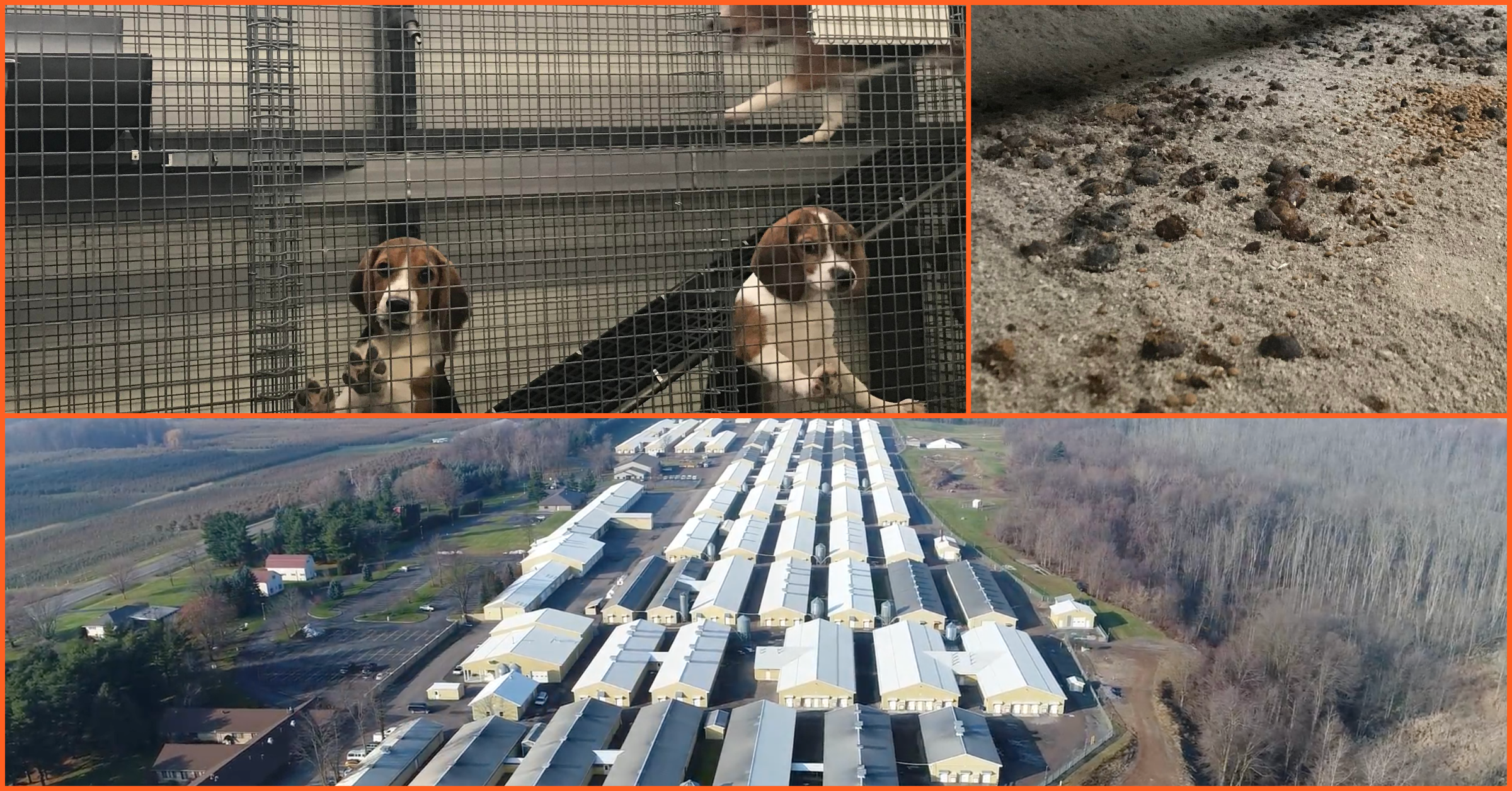
Whistleblowers who worked in Marshall’s upstate New York facilities have documented ferrets and their babies housed in filth, dogs confined in wire cages over feces-strewn floors, and beagles tethered on short leashes with masks covering their faces.
Both sets of images purport to document Marshall. Only one set was created to promote the company.
What Marshall Shows and What Whistleblowers Documented
In one promotional scene, a Marshall employee sprays down a long row of clean, empty cages.

A whistleblower captured another view of a similar spot: a worker standing among captive beagles near a large pile of feces, with shovels and a wheelbarrow nearby. They also captured accumulated waste on the floors beneath the animals’ cages.

Marshall’s marketing also emphasizes care. Their website says that “raising happy and healthy animals has been our top priority.” Their promo video shows staff cuddling and tending to animals.

But whistleblower evidence shows more of what Marshall’s sleek, choreographed messaging leaves out. One whistleblower photographed a dead puppy in a dirty metal bin. Another former worker reported that puppies sometimes died overnight and alleged that so-called “non-standard” dogs could be deemed unsellable and killed.

Whistleblower footage obtained by Camp Beagle shows tethered, masked dogs frantic to escape their restraints while purportedly forced to acclimate to equipment they could later encounter in experiments.
Ridglan Farms Was Only the Beginning
In recent months, national attention focused on Ridglan Farms, another mega-breeder like Marshall, that for decades supplied beagles to laboratories.
The Wisconsin business became the subject of protests, legal proceedings, a court-ordered investigation, rescues, and extensive media coverage. More than 2,000 dogs were reported inside Ridglan earlier this year. By June, following mounting public pressure, the company announced that it would permanently close and all its dogs would be freed.
Before its closure, Ridglan was the second-largest supplier profiting from the sale of dogs to laboratories.
Marshall BioResources is far larger.
More Than 26,000 Animals at Marshall BioResources in North Rose, NY

During a May 19, 2026 USDA inspection of Marshall BioResources’ sprawling North Rose site, federal officials counted 9,171 adult dogs, 5,394 puppies, and 11,706 ferrets: an astonishing 26,271 animals across those three categories alone.
That’s more than 13 times the roughly 2,000 dogs reported at Ridglan.

In 2019, Rise for Animals documented the North Rose location from above by drone, helping make its vastness tangible. The aerial view shows a sprawling industrial complex of long buildings filled with animals bred for laboratories and largely hidden from public view.
Marshall BioResources also runs three other locations in New York state. Per the most recent available USDA inspection records, these three other sites confined an additional 241 puppies, 272 adult dogs, 839 kittens, 1,219 adult cats, 2,253 ferrets, and 2,108 pigs.
That makes 33,203 animals total exploited across Marshall’s four New York sites.

Marshall’s promotional video features curated imagery that doesn’t convey the full scale of an operation housing thousands of animals at a single site.
Whistleblower documentation fills in another part of that picture.

After Ridglan, Marshall Is Next
The closure of Ridglan Farms demonstrates what can happen when an animal-breeding operation long hidden from public view becomes the focus of sustained scrutiny.
Advocates organized, exposed the operation, and conducted open rescues. People saw the dogs, witnessed where they came from, and learned their cruel fates. Journalists investigated. The public demanded the dogs’ freedom. Under mourning pressure, Ridglan announced that it would close forever.
The public is now turning their attention to Marshall BioResources.

This September, advocates will march 207 miles from Albany to Marshall BioResources in North Rose to demand an end to the breeding and sale of animals for experimentation.
Rise for Animals is proud to be a coalition partner of the march.
It’s time to make sure the animals at Marshall are seen and saved.
Your Call to Action: Take one minute to urge the District Attorney of Wayne County, NY to launch an official investigation into animal cruelty at Marshall BioResources.