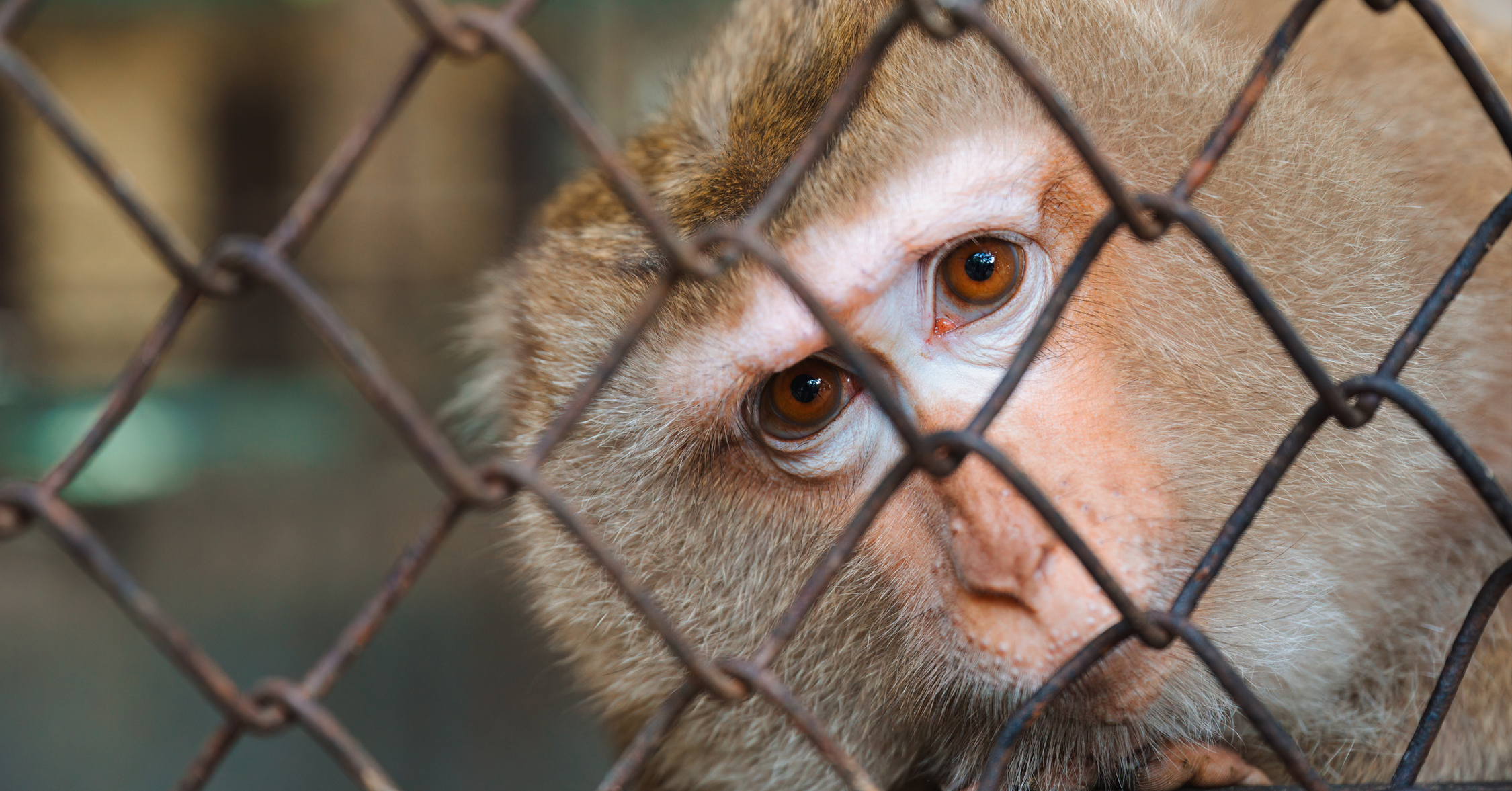
For animals exploited in laboratories, retirement is supposed to mean sanctuary.
It is supposed to mean the end of experimentation, permanent removal from the research pipeline, and the beginning of whatever peace is still possible after years of suffering.
But one of the country’s most notorious primate suppliers appears to have something else in mind.
Retirement Should Mean Sanctuary
Alpha Genesis—the South Carolina company locally known as “the Monkey Farm”—is pitching itself as a provider of “retirement” services for monkeys no longer wanted by labs.
On paper, the proposal borrows the language of care, compassion, and responsibility. In practice, it points to something sinister and underhanded: a plan to keep supposedly retired monkeys under the control and at the mercy of the very industry that exploited them in the first place.
That is not retirement. That is warehousing.
A New Revenue Stream for Alpha Genesis
If Alpha Genesis gets its way, “retired” monkeys may be held not as survivors owed protection, but as “biological resources” to be preserved for possible future use.
The timing is no accident. The National Institutes of Health (NIH)—the world’s largest funder of animal research—has changed its policy to allow animal research grants to cover the expenses associated with preparing monkeys for retirement. (As of 2019, that cost was between $10,000-$25,000 per monkey.)
That shift, combined with other federal signals about reducing nonhuman primate research and retiring at least some monkeys from laboratories, could mark meaningful progress for some victims of animal research—something the animal research industry would rather not accept.
Industry players are already working to reshape these developments to serve their own interests.
Case in point: according to Alpha Genesis, primate “retirement” presents an exciting, new business opportunity.
Alpha Genesis engages in primate research, breeds and sells monkeys for research by others, and contracts with the federal government to manage a NIH monkey breeding colony on a neighboring island.
Recently, it made national headlines after 43 monkeys escaped from its compound and 22 others were killed by a gas leak. Former employees went public with grim details about life—and death—inside Alpha Genesis. And, the facility was the subject of a devastating exposé by The New Yorker.
Now, this same company wants to expand the ways it profits from harming primates by offering long-term custody of monkeys “no longer needed for scientific or medical research.”

“Retired” Monkeys as Future Research Stock
Alpha Genesis presents its plan as a thoughtful solution for animal researchers struggling with the costs of maintaining their monkey colonies. But a closer look reveals a business strategy built around two streams of funding.
The first is immediate: revenue from taking custody of and holding monkeys deemed no longer useful by laboratories.
The second lies in the future:
Alpha Genesis predicts that the political environment surrounding animal research may soon change—and that the monkeys who are supposedly “retired” today may become useful to researchers again tomorrow.
Its proposal refers to retired monkeys as “biological resources” and argues that housing them within the research system would “serve[] the national interest” by “preserv[ing] critical United States research capacity” that “may be essential during future public health or biodefense emergencies.”
In plain terms, Alpha Genesis wants to keep “retired” monkeys within the “research ecosystem”—available, accessible, and stockpiled in case someone wants to experiment on them again in the future.
A Transfer Isn’t Freedom
This is the fundamental bait-and-switch at the heart of the plan. Retirement should mean permanent release from the machinery of animal research. It should not mean transfer from one industry cage to another.
The disingenuousness becomes even clearer when Alpha Genesis’s proposal is considered alongside the company’s long and troubling track record. Alpha Genesis may be able to offer cheaper housing than true sanctuaries—something it is pitching to researchers and other stakeholders—but that highlights a core problem:
Alpha Genesis is not selling sanctuary in any sense of the word.

Alpha Genesis has been repeatedly cited by the USDA for animal welfare violations involving animal escapes, injuries, and deaths. Documented incidents include an infant monkey strangled with gauze and a female monkey found with her head trapped in a chain-link fence and her body soaking wet—reportedly after staff may have hosed down her cage “without noticing she was dangling from it.”
These federally-documented incidents align with accounts from former employees, who have described a workplace culture marked by negligence and disregard—a far cry from Alpha Genesis’s description of its staff as “deeply experienced” and “professional.”
A former Alpha Genesis veterinarian reported that many of the medical issues she treated stemmed from staff negligence, including frostbite caused by staff forgetting to fix a heater and bone fractures caused by staff slamming netted monkeys to the ground.
Another former veterinarian described insufficiently trained staff who failed to even feed the monkeys properly, leaving them with minimal, no, or mold-covered food.
The facility has been described as smelling like “feces shot through with ammonia,” with “swarms of cockroaches hiding between the metal cages.”
Even outside its walls, the reported chaos continues.
- Employees reportedly drink alcohol, get high, play games, and have sex behind animal enclosures.
- They allegedly steal equipment and controlled drugs.
- And they purportedly even stole and traded a baby monkey for a dog and an ATV.
This is the company now invoking ethics and responsibility to promote its new monkey “retirement” program.
The Sanctuary Shortage Is Real—But This Isn’t the Answer
To be clear, Alpha Genesis is exploiting a real problem: there are far too few sanctuary spaces for monkeys who could survive and be released from labs. As efforts to retire monkeys from research grow, the shortage of placements will become an increasingly significant challenge. Alpha Genesis understands this reality, and it appears to be trying to capitalize on it.
But a shortage of sanctuary space cannot justify redefining “retirement” to the animals’ detriment. As university professor Stacy Lopresti-Goodman put it, describing Alpha Genesis as a “retirement home for monkeys” is like describing New York’s Rikers Island jail complex as a vacation destination for humans.

A cage does not become a sanctuary because the industry says so.
Industrial confinement does not become compassion because it is the cheaper option.
And a monkey held for possible future exploitation is not “retired.”
If the government and research institutions are serious about retiring monkeys from labs, then retirement must retain its traditional meaning: freedom from experimentation in a place of refuge and protection. True sanctuary.
Anything less is just another industry lie: another revenue stream built on exploitation, another rebrand of the same cruelty, and—for the monkeys themselves—another experiment in disguise.
Your Call to Action: If we want monkeys to be truly safe from companies like Alpha Genesis, we cannot settle for industry-controlled “retirement” schemes that keep them caged, stockpiled, and available for future use. We must reduce—and ultimately end—the demand for monkeys in laboratories altogether.
The SPARE Act would help do exactly that by directing federal agencies to replace primate experiments with superior, human-relevant research methods. Tell your members of Congress to support the SPARE Act: