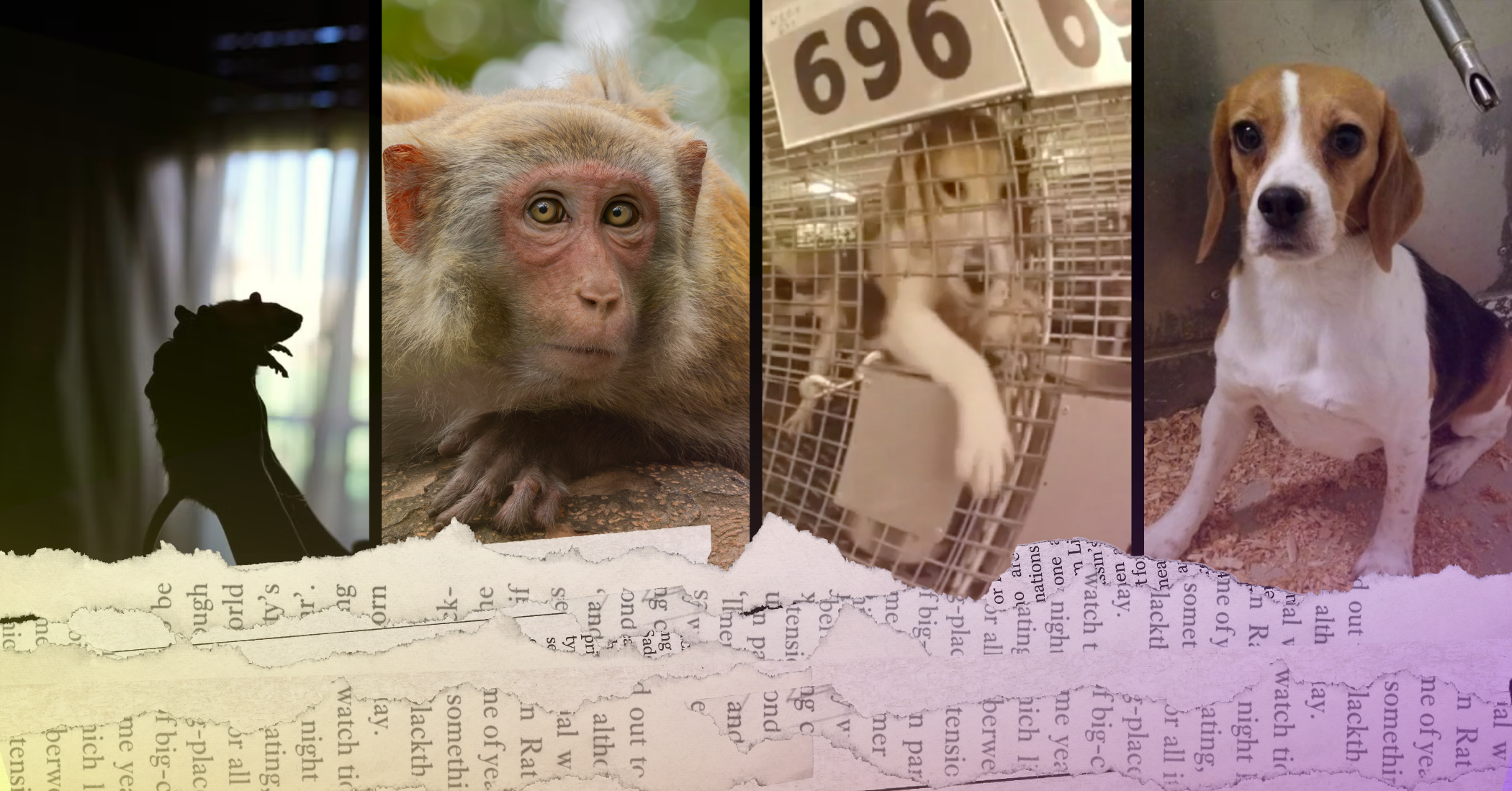
Here’s a roundup of the latest, biggest news stories related to animal research—all the recent media coverage you need to know right now to be the most effective activist for animals in labs.

Research Animals Are Farmed Animals, Too
Rise for Animals, 5/19/2026
From pigs and cows to mice and fish, animals exploited in farms and laboratories are trapped in the same industrial pipeline. We’re calling for one unified fight against animal exploitation. 📰 Full Story →

Cows Are Exploited on Farms and in Labs
Rise for Animals, 5/20/2026
Federal records reveal how cows are exploited by both animal agriculture and animal research—used for milk, meat, serum, teaching, and experimentation. 📰 Full Story →

Carter bill reducing animal testing passes House committee
United States Representative Buddy Carter, 5/21/2026
“Rep. Earl L. ‘Buddy’ Carter (R-GA) today celebrated the House Committee on Energy and Commerce’s passage of the FDA Modernization Act 3.0, a bill directing the U.S. Food and Drug Administration (FDA) to fully implement provisions to reduce unnecessary animal testing for drug development.”
“‘The advancement of the FDA Modernization Act 3.0 out of the House Energy and Commerce Committee marks another major step toward a more modern, effective, and humane system for evaluating medicines,’ said Rep. Carter. ‘Congress already acted in 2022 to remove unnecessary barriers to innovative non-animal testing methods, and this bill helps ensure FDA implementation fully reflects both the law and today’s scientific capabilities.’” 📰 Full Story →
⚠️ Tell your members of Congress to support the FDA Modernization Act 3.0! Send your letter here.

Ontario Passes Bill Restricting Research on Cats and Dogs
The Brooks Institute, 5/14/2026
“Ontario’s Bill 75: the Keeping Criminals Behind Bars Act, 2025, has passed third reading. Once it receives royal assent, the bill will amend the Animals for Research Act to restrict invasive medical research on cats and dogs, subject to certain exceptions, and prohibit their breeding for research purposes.”
“Following review by the Standing Committee on Justice Policy, the bill was reported back without amendment. This is despite calls from animal advocacy groups and experts to strengthen the bill by banning all invasive research, not just ‘invasive medical research,’ and by prohibiting the transfer of animals from municipal pounds to research facilities, as well as their importation from other jurisdictions, including the U.S., where they are often purpose-bred as test subjects.” 📰 Full Story →

Ridglan Farms beagles: Hundreds of dogs remain inside, what’s next?
Bryan Polcyn, FOX6 Milwaukee, 5/15/2026
“Rescue groups have removed all 1,500 beagles they bought from Ridglan Farms. Now, they say they intend to ‘kick-start’ discussions with the Wisconsin breeding facility about the estimated hundreds of dogs still inside.”
“In a statement, Ridglan Farms said it is ‘finalizing arrangements’ for the remaining beagles but would not say what those arrangements are or how many dogs it still has.”
“Wayne Hsiung, the animal rights activist charged with orchestrating raids on Ridglan Farms in March and April, has announced his next move. ‘We saved 1,000-plus dogs already at Ridglan Farms. We’re trying to get the last few hundred out,’ he said. ‘It’s time to think about what the next stage is, and the next stage I propose is Marshall Bioresources in upstate New York.’ Marshall Bioresources is the nation’s largest breeder of laboratory beagles – eight times the size of Ridglan Farms. Hsiung called it the ‘Death Star’ of animal research.” 📰 Full Story →

CDC plan to retire lab monkeys to Texas sanctuary draws ire
David Grimm, Science, 5/15/2026
“Biomedical experts and a leading primate sanctuary are blasting a plan by the U.S. Centers for Disease Control and Prevention (CDC) to retire more than 160 of its research monkeys to Born Free USA, a primate sanctuary in southern Texas.”
“CDC decided to phase out all its monkey research in November 2025—the first time a U.S. agency had ended its in-house nonhuman primate program. The scientists who worked with the animals—largely used in HIV-prevention studies—hoped they could be either transferred to other biomedical facilities, where the research could continue, or retired at one of the seven National Primate Research Centers, which have extensive experience with lab monkeys. But from the beginning, CDC seemed set on sending the animals to a more naturalistic setting not affiliated with scientific research.”
“‘Born Free is the largest GFAS-accredited sanctuary in the U.S. that houses monkeys,’ [Valerie Taylor, executive director of the Global Federation of Animal Sanctuaries (GFAS)] says. ‘I feel very confident in the care they can offer.’” 📰 Full Story →

Teen’s skydive charity fundraiser to end animal testing
Miranda Norris, Evesham Journal, 5/16/2026
“Aleksandra Strojeva, from Evesham, will complete a skydive in Brackley on August 14 to raise funds for Replacing Animal Research, a charity working to end the use of animals in scientific testing. Ms Strojeva said: ‘The scale of animal suffering is overwhelming. I’m terrified of heights, but I had to do something. Every leap, every step, is about giving animals a voice.’ . . . ‘Every donation supports alternatives to animal research and empowers future generations to build a more compassionate world.’” 📰 Full Story →

MP slams government’s slow progress on animal testing
Saeed Ibrahim, South Wales Argus, 5/17/2026
“The reduction of unnecessary animal testing in the UK is ‘far too slow’ according to Newport and Islwyn MP Ruth Jones, as she urged the government to introduce new reforms.”
“The UK government has pledged to phase out animal testing, backed by a £75 million investment in alternative methods, despite continued high usage of nearly 3 million animals annually as of 2024, with only ~10% required for regulation. Campaigner’s [sic] now want the government to go further and faster to reduce the number of unnecessary animal testing in the UK.”
“Speaking at the committee hall debate in Westminster Mrs Jones said: ‘I want to thank the 211 constituents in Newport and Islwyn for signing the petition to end animal testing and the fact that the public gallery is packed shows how important this is the [sic] whole of the UK. . . . Britain as we heard is a country of animal lovers and also a world leader in animal welfare. It is critical however we don’t rest on our laurels. Continued leadership requires urgent commitment and further reforms to regulatory licencing [sic] and inspection regime governing the use of animals and science in the UK.’” 📰 Full Story →

NIH Worker Bitten by Virus-Infected Monkey at Montana BioLab as Federal Facility Continues Operations
yourNEWS Media Newsroom, [your]NEWS, 5/18/2026
“New disclosures surrounding a federally operated infectious disease laboratory in Montana have renewed concerns about biosafety oversight at U.S. government research facilities after an employee was allegedly bitten by a monkey infected with a dangerous African hemorrhagic fever virus. According to a report published this week, two biosafety incidents occurred within the past year at the National Institutes of Health’s Rocky Mountain Laboratories in Hamilton, Montana, a Biosafety Level 4 facility that handles some of the world’s most dangerous pathogens.”
“Following public disclosure of the incident, NIH later acknowledged that a laboratory worker had been exposed to Crimean-Congo hemorrhagic fever virus [“a highly infectious disease capable of causing severe bleeding, organ failure, shock, and death”] but did not specify how the exposure occurred. White Coat Waste Project officials later said they received an anonymous whistleblower letter claiming the exposure resulted from a monkey bite during a live-virus experiment. . . . ‘The NIH did not admit the full truth about what happened, that the exposure that happened in the lab was because a monkey who was being used in painful experiments with this virus, bit a staffer,” [Justin Goodman, senior vice president of White Coat Waste] said.’” 📰 Full Story →

Unwanted lab rats find new homes and are adopted thanks to an Argentine organization
Almudena Calatrava & Natacha Pisarenko, Independent, 5/18/2026
“‘People don’t really know, or they have a very specific perception of, what a pet is,’ . . . ‘Rats are very intelligent and sweet.’”
“Team Ratas [which organizes Ratapalooza, “an annual Buenos Aires event that promotes the adoption of rodents raised in animal facilities or used for research in science labs – once the animals are no longer useful, have outlived their purpose or are just surplus stock”] is a leader in Argentina and Latin America for rehoming lab rats and mice that — without a foster home — would otherwise be euthanized.”
“The initiative started in 2016, when [Dominique Verdier, who represents Team Ratas] adopted two rats after a friend told her the university where they were used for research no longer needed them. She set up a rodent rescue network with 90 foster homes in Buenos Aires and nearby towns, housing hundreds of animals from 11 animal facilities and labs. In the last 10 years, she has rescued more than 8,000 animals and found homes for approximately 3,000. . . . ‘If people see a dog shelter, they might admire it, but when I mention Ratapalooza they say, “What you’re doing is silly”,’ she said. ‘And I say that I’ve been doing this for 10 years and it keeps growing.’” 📰 Full Story →

Federal agency spends $1.3M on lab animals amid ongoing debate over testing rules
Western Standard News Service, 5/18/2026
“Canada’s federal research agency has approved a multi-year contract worth more than $1.3 million for the supply of laboratory animals, renewing attention on the country’s use of live animals in scientific testing despite years of political pressure to restrict the practice. The National Research Council of Canada issued an advance contract award notice confirming a five-year agreement to purchase rabbits, mice, rats and hamsters for federally supported research programs. The contract, valued at about $1.25 million, was awarded to Charles River Laboratories in Saint-Constant, Que.”
“The Research Council did not respond to requests for comment. The purchase comes against a backdrop of sustained advocacy efforts aimed at reducing or eliminating animal testing in Canada….” 📰 Full Story →

Arthouse Fashion Meets Animal RIghts Activism in Chilling PETA Campaign
newsroom, Marking Communication News, 5/19/2026
“Animal testing is often hidden behind closed laboratory doors, making it difficult for the public to truly grasp the suffering endured by millions of animals every year. A haunting new campaign for animal rights organisation PETA aims to change that by substituting abused creatures for human beings – forcing the viewer to confront the brutality of invasive testing with a chilling twist.”
“Creatively conceived and directed by Favio Vinson through Flavour on the Rocks and co-produced by Papaya Films, End Animal Abuse transforms the experience of laboratory animal testing into a deeply unsettling visual statement. Is it an avant-garde fashion campaign? An arthouse film? Or something else entirely?”
“Launching online on 18 May 2026, the campaign centres around a 60-second film in which human actors take the place of animals during laboratory testing procedures, enduring the same forms of treatment inflicted on animals every day. Throughout the film, subjects are caged, restrained and immobilised under harsh spotlights; gassed; showered with chemicals; injected with viruses; and put through invasive surgery and sensory deprivation. . . . It culminates in a chilling final reveal: a trembling woman huddles on a metal gurney as a blanket is draped around her shoulders, before the words: ‘Relax, these are professional actors. But in reality, animals get treated like this every day,’ appear on screen.” 📰 Full Story →

Fort Collins Dog and Cat Lab Shuts Down Following USDA Citations, PETA Investigation
Steve Middendorp, Longmont Leader, 5/19/2026
“People for the Ethical Treatment of Animals (PETA) announced last week that Red Beast Enterprises, also known as High Quality Research, in Fort Collins has shut down following a dozen USDA citations and an independent investigation by PETA that revealed neglected treatment of dogs and cats. The Animal and Plant Health Inspection Service (APHIS) registrant data confirms that the laboratory certificate status was cancelled on May 18, 2026.”
“Elena T. Contreras, DVM, MS, PhD, conducted her research training at the laboratory over a decade ago and she wrote some reflections on Substack following the lab’s closure. Contreras said it was ‘one of the most distressing professional experiences’ in her career and she is ‘relieved’ that the facility has closed down. ‘I will always remember the day that staff at HQR told me that a motionless, trembling beagle who was in pain was being “good because this was his job and he knew he worked for a living,”’ Contreras wrote. ‘Experiences like that permanently shaped how I think about fear, learned helplessness, and the dangers of normalizing compromised welfare in institutional settings.’”
“Contreras said one of the most important lessons from her time at Red Beast Enterprises (High Quality Research) is that Institutional Animal Care and Use Committee (IACUC) approval is not synonymous with ‘good animal welfare.’” 📰 Full Story →

France’s research-primate project goes against its own ethics panel
Cédric Sueur, Roland Cash, & Virginie Courtier, nature, 5/19/2026
“In February, France’s National Centre for Scientific Research (CNRS) confirmed that it would be proceeding with a €31-million (US$36 million) expansion of a primate-breeding facility in Rousset. The aim is to house 1,800 non-human primates (mostly Macaca fascicularis) and to produce 250–300 animals a year for biomedical research from 2032. The expansion was originally approved in 2022 for reasons of national autonomy, citing a need for the animals in fields such as immunology and neuroscience. We argue that it is scientifically, ethically and institutionally indefensible.”
“A public consultation last year found that 93% of respondents opposed the French project. And in January, the CNRS’s own ethics committee stated the need for the project to undergo independent scientific assessment and adhere to a road map aiming to reduce the animals’ use. But neither of those condition [sic] has been met.” 📰 Full Story →

Diseased Monkeys At Laboratories Causing Concerns
Southwest Florida Online News, 5/20/2026
“PETA today released a new report showing that Shigella, a highly contagious, often drug-resistant pathogen spread through fecal contamination, for which humans and other primates are the only natural hosts, is widespread and often un- or underreported among monkeys in the U.S. experimentation industry. . . . The findings raise serious public health concerns as infected monkeys are transported among importers, quarantine facilities, breeders, contract laboratories, and universities across the country.”
“PETA’s report comes on the heels of a recent CDC warning about rising cases of extensively drug-resistant Shigella infections in humans. Yet the agency failed to acknowledge that primates, long recognized as a natural reservoir for Shigella, are a documented source of infection, even though the CDC acknowledges that imported monkeys can carry pathogens ‘that may be a public health concern such as clinical signs consistent with filovirus infection, confirmed Shigella and Campylobacter infection, and malaria.’” 📰 Full Story →

Wayne State says dogs in heart research are euthanized at end of studies
Faud Shalhout, mLIVE, 5/21/2026
“Wayne State says dogs in its heart research are euthanized at the end of studies as lawmakers weigh a ban. The testimony came during a Wednesday hearing on ‘Queenie’s Law,’ a bill that would ban painful dog experiments at public institutions, including controversial research at Wayne State University.”
“Dr. Michael Bradley, Wayne State’s senior director of the Division of Laboratory Animal Resources and attending veterinarian, defended the university’s research . . . Bradley said no dogs used in the research have been adopted out under Michigan’s Teddy’s Law, which requires certain research facilities to offer dogs and cats for adoption if they are deemed suitable for placement after research. . . . ‘There have not been dogs that were deemed adoptable according to our determination.’ That drew questions from Sen. Kevin Hertel, D-St. Clair Shores, who pressed Bradley on how the law is being applied after testimony about a specific dog. . . . Bradley declined to discuss individual cases publicly, saying Wayne State had been investigated by the state and cleared of wrongdoing.” 📰 Full Story →