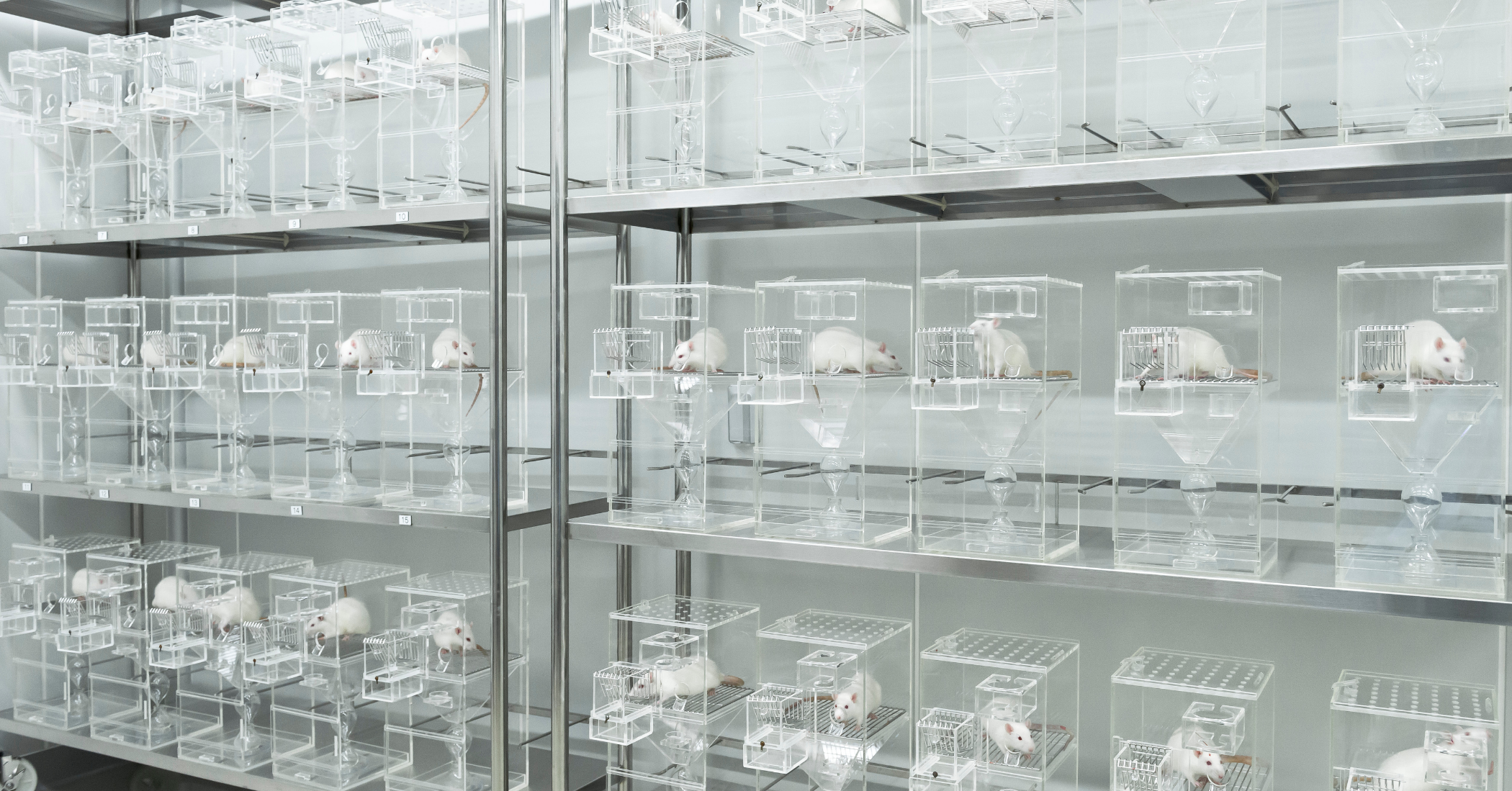
Why This Matters: While federal agencies increasingly speak about reducing animal experimentation, the animal research industry itself is preparing for a very different future—one in which more animals are engineered, confined, and exploited for decades to come.
As the government continues signaling a shift away from animal research, the animal research industry is openly planning for decades more of it.
Recently, the National Academies of Sciences, Engineering, and Medicine (NASEM)—a key industry-aligned institution, whose U.S. members include AAALAC International and Charles River Laboratories—hosted the first webinar in its new Global Dialogues on Laboratory Animal Science series. The featured speaker was Marcel Frajblat, a professor and animal researcher affiliated with the International Council for Lab Animal Science (ICLAS). His presentation centered on the future of animal research.
Animal Research on Earth and in Space
Frajblat wasted little time making the industry’s intentions clear. After opening with imagery meant to evoke the future of “laboratory animal science”—a space station—he asked: Will animals still be used for research in 2050?
88% of respondents said yes.

This was not a neutral audience. NASEM caters to elite scientific stakeholders, meaning the webinar was almost certainly attended by people whose careers, funding, and institutional power are tied to animal experimentation.
Their collective response was more than a passive prediction—it was a declaration of intent.
What Frajblat laid out next was the animal research industry’s vision for 2050: more engineered animals, more species captive in labs, and more streamlined systems for exploiting them.
Creating and Considering New Victims
Though Frajblat stated that the beauty of science is that everything is “questionable,” he never meaningfully questioned the most fundamental issue of all: whether animals should be used as test subjects in the first place.
Instead, he treated animal use as a given and moved directly to questions of who will be victimized and in what numbers. Fewer rats are being exploited, Frajblat noted, but more mice and zebrafish are being harmed—often in their place.
Nearly half (49%) of polled attendees predicted that more than 50,000 genetically distinct mouse strains will exist for “research use” by 2050. On an accompanying slide appeared a telling Science headline: ‘Any idiot can do it.’ Genome editor CRISPR could put mutant mice in everyone’s reach.

The implication was unmistakable: to the industry, progress is the increasing ease, speed, and scale with which animals can be engineered, controlled, and exploited. All kinds of animals.
Frajblat encouraged the use of “unconventional lab animals,” gesturing toward a future in which species ranging from flamingoes to koala bears are normalized as laboratory commodities. In this vision, animal research expands its reach—not only by creating more genetically engineered victims, but also by pulling less commonly exploited species further into the experimental pipeline.

From there, Frajblat turned to some practical considerations that follow from that ambition. Discussion centered on how to standardize the production of animals for use (“Are we going to maximize standardization in the future?”), how to confine animals in labs (How much cage space? What about disposable cages?), and how to streamline the mechanics of their use (“Can cage washers replace autoclaves in the future?”).
Cracks in the Scientific Foundation
Frajblat championed a future of expanded animal exploitation even while openly acknowledging some of the deepest cracks in the scientific foundation on which animal research depends.
He admitted that animal research suffers from serious problems of translatability and reproducibility—that it is both “natural” and “normal” for translation between animals and humans “not to be efficient,” and that there is a “crisis of reproducibility.” In other words, results from animal studies do not (and cannot be expected to) reliably predict human outcomes. Often, they cannot even be reliably replicated in the same animals.
On screen, Frajblat displayed a rodent version of Leonardo da Vinci’s Vitruvian Man beside the original, inviting the familiar and dishonest suggestion that animals are sufficiently like humans to justify their use as stand-ins. But the Vitruvian Man supports no such leap.

The Vitruvian Man represents idealized proportion and symmetry within a single species. Animal research, by contrast, asks us to accept something very different: that one species can reliably stand in for another. This is where Frajblat’s implicit suggestion breaks down: Surface-level similarities often mask profound differences in factors like gene expression, protein interactions, and biological pathways. Those differences determine bodily function, disease development, and response to drugs and other interventions—and, in turn, they drive the well-documented failures in translatability and reproducibility that Frajblat himself acknowledged.
Treating Opposition as a PR Problem
Even principled opposition to animal research was framed not as a substantive ethical or scientific challenge, but as a public relations problem.
Frajblat asked whether the animal research industry will improve its “transparency and outreach” or change its strategies for justifying animal research. Missing entirely was serious engagement with the core concerns raised by those who oppose it.
That omission speaks for itself: Industry’s concern has never been whether animal experimentation is defensible—only how best to market it.

Public Promises, Private Plans
Frajblat’s presentation laid bare the widening gap between political messaging and industry activity.
While federal agencies like the NIH and EPA publicly posture about moving away from animal research, the institutions most invested in the current system are actively preparing for a future in which animal experimentation remains firmly entrenched—if not outright expanded.
That became especially clear when Frajblat asked whether, if animal use were banned today, alternative methods for all areas of biomedical research would be realized within 20 to 30 years, as some industry insiders have projected. The context he added exposed the industry’s position: in this scenario, he said, “[w]e need to develop alternative methods because it’s not anymore allowed to use animals.”
Frajblat’s framing is striking in its honesty: it makes clear that the animal research industry has little interest in replacing animals as long as it is still permitted to harm them.
As long as the cages remain legal, the industry will keep filling them.
2050 Is Being Built Right Now
The animal research industry is planning for a long future, and it wants us to accept its vision as a foregone conclusion: new victims, more experimentation, the same unimaginable suffering—all repackaged as progress.
But this version of 2050 is not inevitable. It is being shaped right now by government policies, industry pressure, research funding, and laws that permit animals to be bred, confined, tortured, and killed.
That means we still hold the power to help force a different future than the one industry is already building—but only if we stand together and act now.
Take action to help animals in labs! With every petition you sign and every letter you send, you’re building momentum in the fight to save animals from experimentation.