Here’s a roundup of the latest, biggest news stories related to animal research—all the recent media coverage you need to know right now to be the most effective activist for animals in labs.
Primate Labs Rebrand as Monkey Experiments Continue
Rise for Animals, 4/16/2026
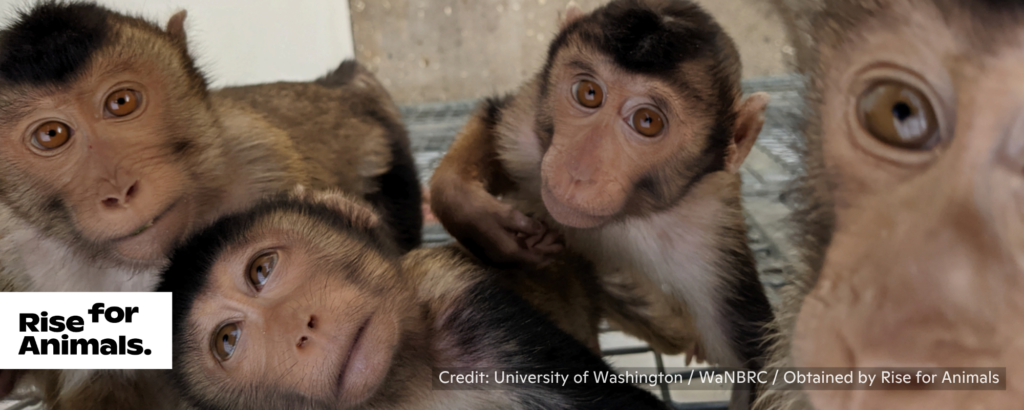
Two of the National Primate Research Centers have dropped “primate” from their names. But they haven’t stopped experimenting on monkeys. This is a rebrand—not reform.
Here’s why the name changes are about manipulating public perception: 📰 Full Story →
Industry in Tailspin, Compares Animal Labs to Daycares
Rise for Animals, 4/15/2026
The animal research industry is in damage-control mode. One of its most vocal defenders is attacking advocates for exposing what government records already document. She even compares animal laboratories to children’s daycare centers.
Here, we unpack the industry’s latest attempt to control the narrative: 📰 Full Story →

University of Minnesota professor suspended from monkey research after decade of serious problems
Erin Adler, The Minnesota Star Tribune, 4/11/2026
“A University of Minnesota neuroscience professor who studies brain activity in small monkeys has been suspended from research involving animals after a decade of repeated problems related to lab animal care and a blatant failure to follow the rules. Geoff Ghose, a researcher whose work can involve surgically implanting devices into monkeys’ skulls, has brought in millions of dollars in research grants during his two decades at the university — even as colleagues and the university itself documented numerous animal welfare issues.”
“The U’s animal research ethics committee suspended Ghose from working with animals in May 2025 after federal inspectors cited the U for problems related to animal care, surgical practices and recordkeeping. The ethics committee also noted a 2025 incident in which a post implanted in a monkey’s skull fell off. This suspension isn’t the first time Ghose has faced scrutiny over his research activities. Internal U documents show that in 2016, he was suspended after a monkey died during an MRI. In recent years, Ghose has had at least three devices fall off or ‘shear off’ monkeys’ heads despite being initially affixed with screws, including last year’s incident. And in 2024, a senior resident had such serious concerns with Ghose as a surgeon that he ‘requested [Ghose] not scrub in.’”
“It’s not clear when or if the suspension will end. Ghose still works at the U and teaches classes but no longer does animal research, said Joanne Billings, the U’s interim Vice President of Research and Innovation. Ghose’s salary is $189,928.” 📰 Full Story →
Hong Kong animal groups urge HKTVmall boycott over life science experiments
Theodora Yu, South China Morning Post, 4/10/2026
“An international animal rights group and a veterinary organisation have called for a public boycott of Hong Kong’s major online retailer, HKTVmall, after its parent company revealed a life science project testing the viability of detached animal heads and limbs. The two groups staged an hour-long protest on Friday outside the HKTVmall building in Tseung Kwan O, demanding the company disclose more details of the experiments and stop animal testing.”
“Dressed in bloodstained clothing and standing on red paper designed to resemble a pool of blood, four advocates wearing pig and sheep masks held banners that called for an end to ‘cruel decapitation tests’on animals. The visual concept was intended to illustrate the ‘blood involved’ in the testing of animals, which were sentient beings capable of feeling horror and pain….” 📰 Full Story →
Hundreds of activists plan to raid, take dogs from embattled breeder
Quinn Clark & Jeanine Santucci, USA Today, 4/15/2026
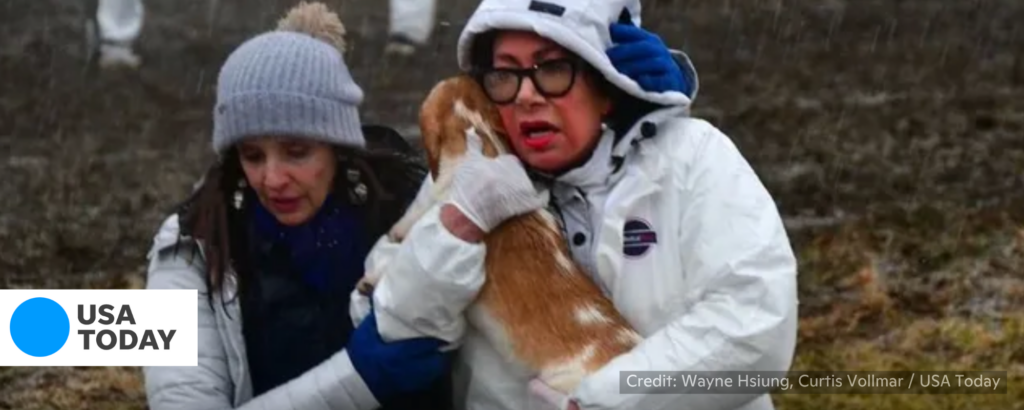
“Animal rights activists are preparing to attempt a controversial raid at a beagle breeding facility, breaking in and taking thousands of dogs they say are being abused. The operation won’t be in the dead of night, but in the broad daylight, and is being planned out in the open for all to see.”
“The planned April 19 mission at Ridglan Farms comes after a much smaller action in March that prompted the Wisconsin facility to ramp up its security measures: Wire fencing, hay bales and trenches now line the property….”
“‘On April 19, the 2,000 rescuers will descend on Ridglan Farms from all directions and use every nonviolent means to breach the facility walls and rescue the dogs. If the police illegally attempt to stop us, we will shield one another from their attempts to hurt the dogs, and pressure them to enforce the law and protect the dogs,’ wrote organizer attorney Wayne Hsiung in a blog post. ‘Nothing will stop us from getting all 2,000 beagles out of cages….’” 📰 Full Story →

EXCLUSIVE: Ricky Gervais backs plan to rescue 2,000 dogs used in lab tests
Christopher Bucktin, Mirror, 4/11/2026
“Ricky Gervais has thrown his support behind plans by up to 2,000 activists to carry out the largest ‘open rescue’ in animal welfare history. Campaigners in the US hope to remove 2,000 beagles from Ridglan Farms, a breeding facility. After Life star and animal rights activist Ricky, 64, backed the action planned for next Sunday.”
“He said: ‘ . . . I’m appalled that beagles are bred for laboratory experiments. It’s time to release the dogs at Ridglan Farms, so they can live out their days surrounded by the love and freedom they so desperately need and deserve.’” 📰 Full Story →
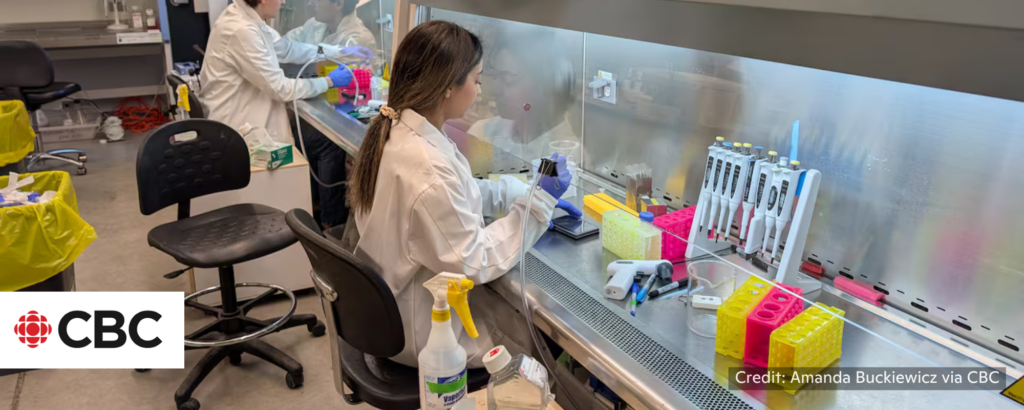
Other countries are looking to end animal testing. In Canada, there’s a holdup
Amanda Buckiewicz, CBC Radio, 4/11/026
“Other countries, like the U.K, the United States and the European Union have all dedicated funding and detailed roadmaps to replace animal testing in research settings. And while Canada has a strategy to replace animals used in chemical and toxicity testing, there is still no plan for those used in biomedical testing, which account for between 40 to 60 per cent of the up to five million animals used in Canadian research settings, every year — one of the highest figures among the G7.”
“‘It is not about taking one animal test and replacing it with one human test,’ said [Charu Chandrasekera, founder of the former Canadian Centre for Alternatives to Animal Methods at Ontario’s University of Windsor]. ‘It’s really about taking the best possible technologies we have at our disposal, asking questions that are relevant to our biology and answering them using very creative methods.’”
“Here in Canada, no money has been proposed to help fund these shifts. . . . Without that funding, Chandrasekera says she and researchers like her will be forced to leave Canada to develop their technologies elsewhere. ‘Canada needs to take a leadership role and not just watch from the sidelines,’ she said. ‘I just don’t understand why we can’t collectively come together and just say, “OK, this is what’s broken. Let’s fix it.”’” 📰 Full Story →
New stats on animals used in science reveal a modest decline but persistent challenges
Eurogroup for Animals, 4/14/2026
“The latest EU statistics on the use of animals for scientific purposes in 2023 have been published. While the data shows a slight drop in numbers, deeper analysis reveals ongoing challenges and areas of concern.”
“In 2023, nearly 8 million animals were used for the first time in scientific procedures across the EU and Norway. This represents a 4.9% decrease compared to 2022. While this brings numbers back to COVID-19 levels, almost 1 million additional animals were used for the creation and maintenance of genetically altered lines. . . . Animal use for regulatory testing continues to decline in several areas, driven by the increasing adoption of non-animal methods, and the use of non-human primates decreased by 24.1%. On the other hand, the use of animals for industrial chemical testing has increased significantly.”
“Mice and fish remain the most commonly used animals, although some alarming increases were recorded, including sharp rises in the use of hamsters, sea bass, cephalopods and other carnivores.” 📰 Full Story →

Watchdog complaint targets Johns Hopkins University’s animal research
Natalie Jones & Brian Carlton, The Baltimore Sun, 4/13/2026
“A watchdog group has filed a federal complaint alleging that the Johns Hopkins University repeatedly violated animal welfare protocols in its research studies, according to USDA inspection records and internal documents cited in a filing to the U.S. Department of Agriculture.”
“According to the watchdog, a February 2026 USDA inspection found that lab staff failed to follow required care protocols for a marmoset, allowing an infection to develop beneath a cranial implant. The animal’s condition worsened, and it was euthanized days later. A necropsy found a brain abscess. Additional university records describe other alleged protocol failures. In one case, a marmoset escaped from a handler during a research session, raising concerns about improper handling. In another, veterinarians found a rhesus macaque with irritation around a head implant after required maintenance checks were missed. A separate report detailed the euthanasia of a newborn rabbit after staff failed to provide a required nesting box.” 📰 Full Story →
NIH Signals Shift Away from Animal Testing With $150M Investment
Sneha Khedkar, The Scientist, 4/14/2026
“‘For many years, the pharmaceutical industry, the Food and Drug Administration, and many scientists have known that animal models are not accurate at predicting results in humans, particularly when it gets to clinical trials,’ said Donald Ingber, a bioengineer and pioneer in organs-on-chips research at Harvard University. ‘In fact, they’re usually wrong more often than they’re correct.’ Indeed, only about five percent of animal-tested therapies obtain regulatory approval for humans.”
“Recognizing these gaps, the National Institutes of Health (NIH) announced last year that it will no longer develop new funding opportunities focused exclusively on animal models of human disease. Last month, building on this further, the NIH announced funding of more than $150 million to develop research methods that reduce reliance on animal models. As part of this, a few researchers across the US received grants to create models that capture essential aspects of human biology such as organoids, organs-on-chips, and in silico approaches, often called New Approach Methodologies (NAMs).”
“‘It’s a turning point,’ said Ingber, who hopes this motivates scientists to explore experimental systems other than animals. ‘It will make them begin to think about not just continuing to go by reflex and do what they [have] always done,’ he said.” 📰 Full Story →
Help spread the word. Share this news compilation on Facebook, X, or Bluesky.