Today, 47 people charged in connection with the March open rescue at Ridglan Farms are due in court. Their cases are putting renewed attention on what happened behind the walls of the now-shuttered Wisconsin facility, which bred thousands of beagles for use in research for over 60 years.
The legal cases are one part of Ridglan’s story. The dogs who came out of the facility tell another.
Following the release of hundreds of beagles from Ridglan, veterinarians conducted individual triage examinations of each dog.

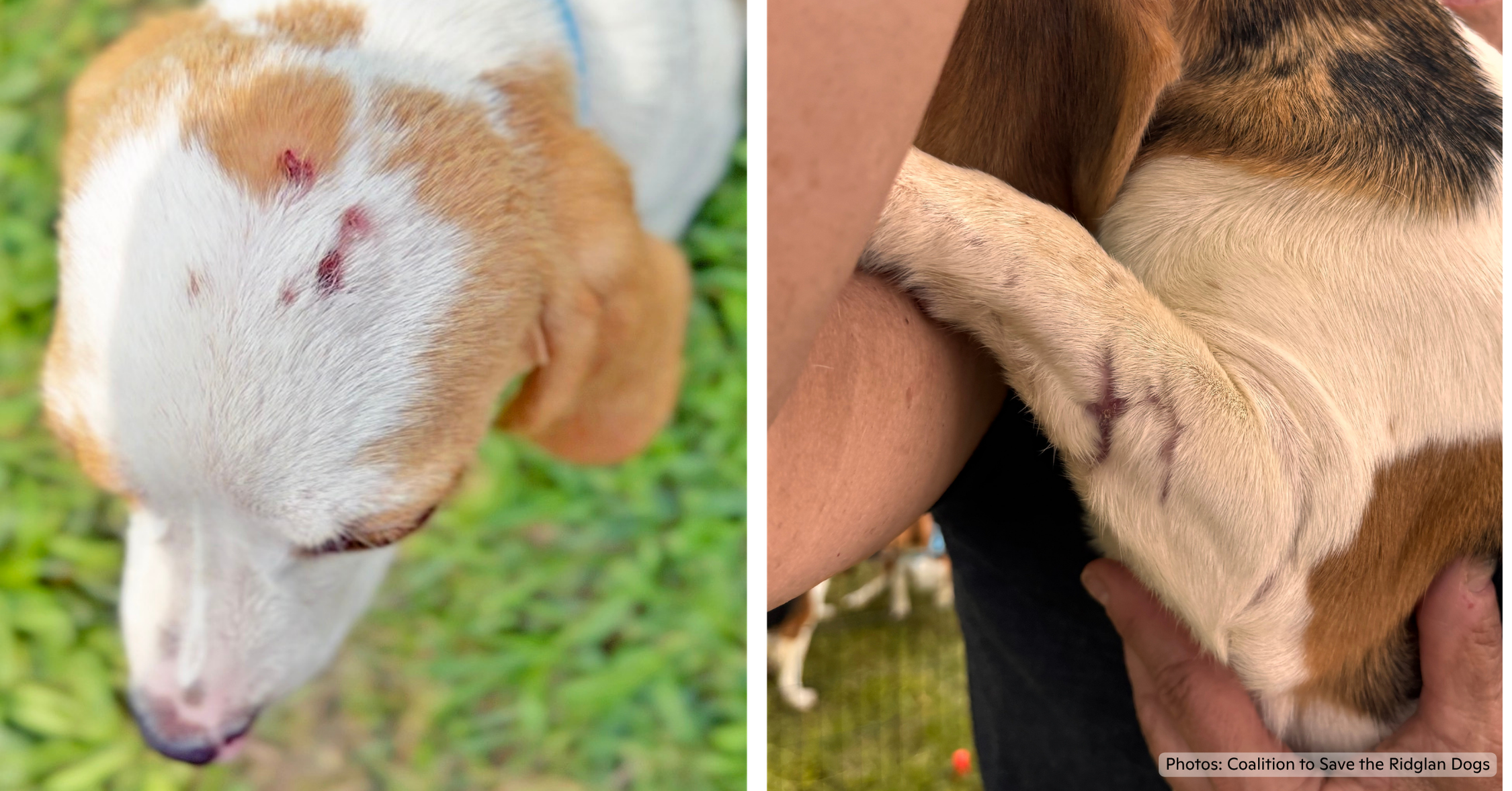
Photos and videos document what some of the dogs carried out with them: wounds and scars, hair loss and skin problems, injured paws, dental issues, and other medical concerns.

The pictures and footage—courtesy of the Coalition to Save the Ridglan Dogs—are difficult to reconcile with a statement Ridglan issued in April.
“The dogs at Ridglan Farms are
happy, healthy and well cared for.”
—Statement from Ridglan Farms
Ridglan added that publicly available USDA documentation showed this had “been the case for many years.”
The business made essentially the same claim again in June, calling the remaining beagles “happy, healthy animals” and pointing to inspections during which, Ridglan said, USDA and Wisconsin officials identified “no animal care issues whatsoever.”
But once the dogs were freed, they were examined one by one.
What Veterinarians Saw

Cameras captured beagles with wounds, hair loss, skin lesions, injured paws, interdigital cysts, and excessive dental plaque. Some dogs had fresh or healing injuries. Others bore older scars.
And physical ailments weren’t the only concerns. Many of the dogs appeared profoundly fearful and submissive, shrinking from touch, freezing in place, or cowering during examination.
The number of beagles documented with apparent health concerns undercuts the assurances Ridglan repeatedly offered to the public: a government inspection history can’t prove that every animal inside a facility is healthy and well.

These images and clips offer something most inspection reports can’t—a look at the physical and psychological conditions of individual dogs shortly after they left their facility.
What Does a “Clean” Inspection Actually Tell Us? Not Much.
Animal breeders routinely invoke USDA inspection reports as evidence of good animal care. But USDA inspections are not comprehensive veterinary examinations of every animal inside a facility.
Inspections are mere snapshots limited by time, sampling, and what inspectors happen to observe and record during any particular visit.
USDA guidance also limits how many dogs inspectors examine closely. Inspectors may pull dogs with identified or visible concerns, then select 10 percent of the remaining population for closer examination—capped at just 10 dogs.
Consider Marshall BioResources (shown below)—it’s by far the largest breeder of dogs for experiments in the United States. In July, Marshall reported 14,440 dogs—9,177 adult dogs and 5,263 puppies—at its North Rose facility. In other words, a “clean” inspection of Marshall may rest on the close examinations of roughly just 1 dog out of every 1,450.

We’re Hearing the Same Argument From Marshall
Ridglan Farms is now closed. Its final beagles left the facility in August.
But the defense Ridglan used hasn’t disappeared.
Marshall BioResources currently advertises on its website that “raising happy and healthy animals” is its highest priority.
And when questioned about conditions at Marshall earlier this year, CEO Scott Marshall pointed to USDA inspections in May, July, and September.
“We’re really proud all of those
[USDA inspections] have been clean
with no findings.”
—Scott Marshall, CEO, Marshall BioResources
Sound familiar?
Ridglan said its dogs were “happy” and “healthy.” It cited government inspections as evidence.
Then the dogs came out, their bodies and behaviors revealing myriad maladies undocumented by inspectors.

“No Findings” Doesn’t Mean No Suffering
That may be the most important lesson Ridglan leaves behind. Specifically:
- A facility can pass an inspection while animals inside it suffer medical problems.
- An inspector can record zero violations without certifying that every animal is healthy.
- And a breeder can point to its inspection reports that reveal almost nothing about what life is actually like for the animals behind its walls.
Those bullet points matter, especially as Marshall’s CEO asks the public to take its own “clean” USDA record as reassurance about the ~33,000 dogs, cats, pigs, and ferrets caged within the North Rose site.
Ridglan showed us how little those assurances can mean.

Because Ridglan’s inspection reports said one thing. Then the dogs came out bearing the literal and figurative scars of their untold story.
Your Call to Action: Marshall is the country’s largest breeder of dogs for research, but it’s not the only one. See the facilities supplying dogs to labs nationwide.