Why This Matters: Animal experiments built on fear, pain, and forced trauma consume resources and line the pockets of researchers—while producing no meaningful breakthroughs for people.
An estimated 13 million Americans—5% of adults—suffer from Post Traumatic Stress Disorder (PTSD) each year. That’s thirteen million human beings, each grappling with trauma, pain, and need.
And yet, instead of studying, learning from, or helping these human sufferers, the animal research industry is laser-focused on something else entirely: traumatizing nonhuman animals.

Even Researchers Admit: It Doesn’t Translate
Nonhuman animals can’t help us understand human PTSD because they can’t “model” human mental health. Even PTSD researchers themselves admit:
➤ The “distinct differences” between humans and other animals “invariably” obstruct meaningful translation of PTSD research.
➤ “PTSD is a complex phenotype that is difficult to model in rodents because it is diagnosed by patient interview and influenced by both environmental and genetic factors.”
➤ Animal models do not “represent coverage of human PTSD variability” and, at best, “only partially reproduce PTSD neurobiology.”
Yet, none of this has stopped vivisectors from inflicting “significant trauma” on animals—by electroshocking, drowning, isolating, and terrorizing them.

Researchers are even “fear conditioning” animals by playing a sound and, then, delivering an electric shock.
The animals—captive, cornered, and at the researchers’ mercy—start to “freeze with fear” at the sound alone. And the researchers? They sit back and call this obscene spectacle “science.”
Only it’s not science. It’s a sadistic sideshow. And it’s not some outlier.
“Fear conditioning” is described as “one of the leading animal models in PTSD research,” spawning around 100 published papers per year . . . while producing zero breakthroughs.
Even industry insiders confess that there’s still “conceptual confusion over what exactly is being modeled.”
But there’s no confusion over what isn’t being modeled: human PTSD.
PTSD Defies Simplification
PTSD is deeply personal, shaped by a kaleidoscope of factors from trauma type, to individual biology, social support, and environment. Experts explain that PTSD manifests in “exceptionally heterogenous” ways, making research, diagnosis, and treatment complex even among human populations.
Even the cause of PTSD is still a giant question mark—with 8.3% of Americans who report trauma developing PTSD.
This tells researchers something critical: it’s not just trauma that causes PTSD. It’s how individual humans process and experience it.
PTSD, it is known, “affects individuals uniquely. While some people thrive despite trauma, others may experience debilitating symptoms that persist for years.”
And, of course, the same is true of nonhuman animals. Research has found that the percentage of animals who experience PTSD-like symptoms post-trauma “varies with the species of animal used and even with particular breeds of animals within a species”:
In one strain of rats, known as Sprague-Dawley rats, [researchers] report[ed] that 30 to 50 percent of the animals could be considered as vulnerable, a figure significantly higher than in humans subjected to trauma ….”
Yet, vivisectors keep traumatizing nonhuman animals to line their pockets.
A Playbook of Suffering
In their twisted efforts to manufacture PTSD-like symptoms in nonhuman animals, researchers employ a grim arsenal of torture tactics, including:
⇢ Electric shocks. Researchers zap animals’ feet and tails with “high intensity currents” that they cannot escape for “long durations”. Researchers praise this brutality for its “procedural simplicity” and its ability to “induce lasting symptoms”—even as they admit it causes unintentional physical injuries, has no relevance to real-world conditions, and lacks any standardized protocol.
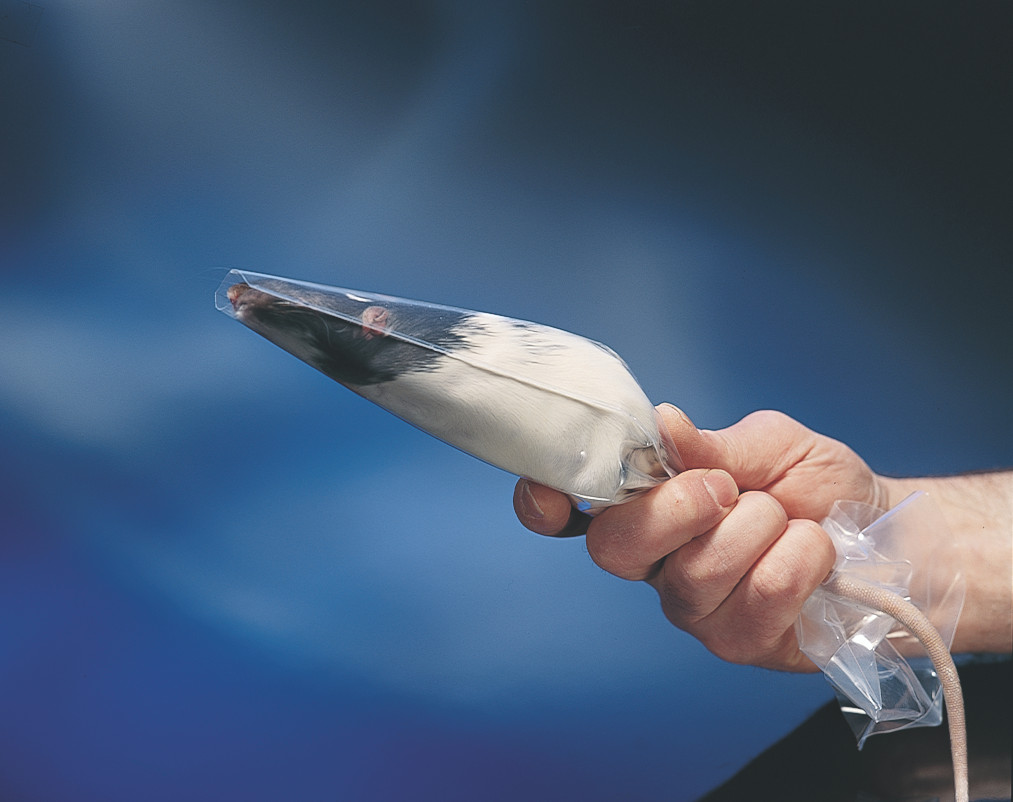
⇢ Restraint and immobilization. Researchers stuff animals into tight bags or tubes, or strap them down to boards with their limbs and heads pinned, for hours. Researchers again acknowledge the “disadvantage” of unintended physical injuries and the absence of “ethological relevance.”

⇢ Social isolation. Researchers force animals to endure weeks of solitary confinement—a cruelty so devastating it’s often illegal for imprisoned humans.
⇢ Underwater trauma (submersion stress). Researchers drop animals into water, watch them swim to exhaustion, and, then, forcefully submerge them underwater to simulate drowning.

⇢ “Single prolonged stress (SPS). “Researchers combine three or more of their “favorites” for this one: for example, first restraining animals for extended periods; then, forcing them to swim to exhaustion; then, exposing them to an anesthetic until they pass out; and then forcing them to endure inescapable electric shocks. Researchers, again, admit that this approach may result in unintentional physical injuries and is ethologically irrelevant.
⇢ “Social defeat stress (SDS). “Researchers force animals into inescapable contact with an aggressive peer or force them to watch another animal being socially defeated.
⇢ Predator stress. Researchers expose animals to predators (like cats and ferrets) while immobilized or otherwise unable to escape. Researchers tout this “method” as combining multiple “stressors,” even as they admit that it often causes physical injuries and chronic stress. Oh yeah, and it, too, lacks real-world relevance.
The pay-off for all this torment? Only paychecks for the tormentors.
All Pain, No Progress
By researchers’ own admissions:
➤ “Despite the large financial investment and the thousands of papers published annually, no treatments have been approved for PTSD since Paxil in 2000.”
➤ “Currently, there are no specific medications that reduce PTSD symptoms or biomarkers that facilitate diagnosis, inform treatment selection or allow monitoring drug efficacy.”
➤ “PTSD remains a neuropathology with no specific pharmacological treatments, no established and reliable biomarkers.”
In other words, despite decades of grotesque animal torture and uncountable victims, researchers are no closer to real solutions for the millions of humans who need them.
Yet, that never stops animal researchers. At the same time that they “acknowledge that their predecessors have failed to produce a useful animal model:”
“They want to try again, with more stress for more animals and over a longer period. They suggest this despite having themselves given an account of the likely causes of PTSD in humans that should have led them to question the very possibility of achieving a useful animal model.”
Indeed, “despite all the suffering and the doubts about the applicability of creating animal models of PTSD, this seems to be a booming field.”
Violence for Profit—Not Science

What we’re witnessing here is nothing more than yet another glaring example of the ugly truth: The animal research industry exists not to help humans, but to help researchers churn out papers, rake in grant money, and keep exploitation profitable.
Researchers get paid.
Animals get tortured and killed.
Humans get nothing.
This is violence-for-profit—not science. And it has to be stopped.