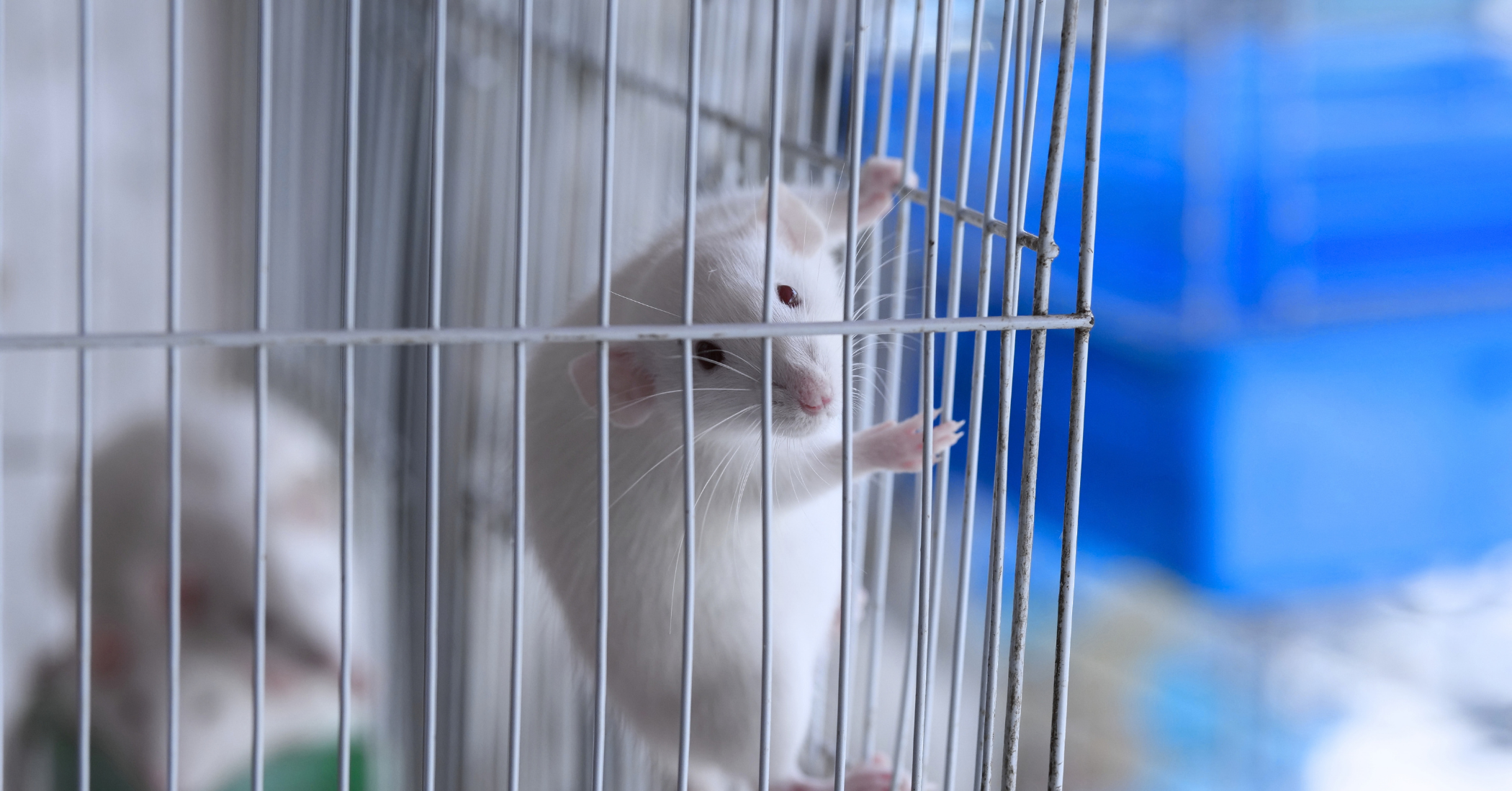
NIH Is Investing in NAMs, But Will Animals Be Spared?
On September 21, 2026, the same day the FDA moved to drop the term “animal” from its drug-safety regulations, the National Institutes of Health (NIH) announced what it called its “biggest push yet to move biomedical research beyond animal model use.”
NIH Invests in Human-Relevant Science
The NIH identified five new initiatives “aiming to make research faster, more predictive, and more directly relevant to human health:”
- More than $88 million for biomedical infrastructure projects nationwide;
- A $7 million-plus challenge to improve detection and measurement in lab-based new approach methodologies (NAMs);
- A new NIH Clinical Center laboratory built around standardized human organoid models, robotics, and AI;
- An initiative to recruit grant reviewers with expertise in human-based science; and
- A request for information on whether NIH should publish an annual count of the vertebrate animals used in the research it funds.
NIH Director Jay Bhattacharya described these initiatives as “building the scientific infrastructure needed to develop, validate, and scale technologies that better reflect human biology.” It seems, then, that FDA’s and NIH’s announcements work as a pair:
The FDA is changing the regulatory language that implied animal tests were the expected default, and NIH is investing in new tools that could take their place.
Like FDA, NIH Still Calls Animal Research Important
NIH’s announcement also carries a familiar caveat, however. It identifies “animal models” as “an important tool for human biomedical discovery,” and it conditions its goal of reducing animal use on feasibility.
That language mirrors FDA’s framing, which described the goal as finding ways to “complement” animal studies and to replace them only where “appropriate.” In both cases, animal research appears to remain a favored approach, and any reduction depends on a judgment call about when “alternatives” are good enough. We are left asking who decides that, and by what measure.
Add to that NIH’s definition of NAMs as “new approach methodologies” (not “non-animal methods”), and the impact these initiatives will have on animal use remains largely an open question.
NAMs May Exploit Animals
Indeed, a study published in Nature the week before NIH’s announcement exemplifies that the use of NAM technologies can actually and directly lead to animal exploitation.
Researchers at Stanford genetically engineered mice to develop without most of their cerebral cortex and hippocampus, leaving them with roughly half the brain tissue of ordinary mice. (They also bred the mice to be immunocompromised, so their bodies would be less likely to reject human tissue.) Only about one quarter of the pups carried the engineered trait, and the researchers killed “the majority” of the others, in part to “reduce competition for maternal care and milk.”
When the engineered pups were between 5 and 17 days old, researchers opened their skulls and implanted human brain organoids—lab-grown clusters of human brain cells—into the cavities where their cortex should have been. Three months later, human tissue made up more than 90% of the cortical tissue, by volume, in the surviving animals. The mice were then put through foot-shock fear conditioning and, in one experiment, held at 5% oxygen for five hours to model brain injury. Mice were killed and dissected at various points, including immediately after being injured through hypoxia.
Organoids are among the most celebrated NAM technologies—yet, here, they became the foundation for a new animal “model.”
The authors went on to raise the prospect of future human organoid transplants into non-human primates, even as the study’s senior author acknowledged that “some biological features seem to be uniquely human”—ironically, the very basis for the current push away from using animals as “models” for humans at all.
This study shows how easily NAM technologies can be used to perpetuate, if not increase, animal research, rather than reduce or replace it.
As public money flows into organoid and other NAM infrastructure, including NIH’s new Clinical Center laboratory, we need to watch the ensuing research closely.
We also need to demand that NIH track the number of animals its funding is used to exploit.

Without a Count, We Can’t Know Whether Animal Use Will Decline . . . Or Increase
One of the most important, though least glamorous, parts of NIH’s announcement is its open request for information (RFI) on whether funded institutions could annually report the number of live vertebrate animals they use.
Currently, there is no comprehensive public count of the animals bred, used, and killed in U.S. laboratories, including those subject to taxpayer-funded experimentation. NIH, the world’s largest funder of animal research, does not require the institutions it funds to report animal use numbers. Instead, institutions submit an “average daily inventory” of animals roughly every four years. There is no specified method for producing that figure: institutions may count individual animals, occupied cages, or estimates extrapolated from cage counts, without saying which. The resulting figures say little about how many animals are used in any given period. Worse still, NIH doesn’t even compile the scraps of data it does receive.
Measuring change requires a baseline, and NIH itself says animal counts would help it measure progress toward reducing animal use.
Without that baseline, there is no way to tell whether NIH’s investments are reducing animal use or simply shifting it into new forms—like what befell the mice at Stanford.
The RFI is a first step toward establishing such a baseline, and—even though NIH is only asking institutions about feasibility and burden—we should expect the animal research industry to push back hard, because we have seen something very similar before.
In 2024, Virginia State Senator Jennifer Boysko introduced a bill asking that taxpayer-funded animal research facilities report to the state how many animals they use and what share of their funds goes to animal and non-animal research. Opposition led by the state’s public universities stalled the reporting requirement, and lawmakers replaced it with a task force to study whether facilities should have to share that information at all. At the task force’s first meeting, industry representatives voiced uncertainty about how to count animals, cited intellectual property concerns as a reason for not releasing numbers, warned that giving out the requested numbers could “negatively impact” them, and suggested reporting on the benefits of their research, instead.
The task force’s final report, issued in November 2024, reflected a failure to reach consensus on requiring animal counts and a suggestion that rats and mice—the very animals most commonly used in research, and the victims of the Stanford human brain organoid experiment—could be counted by cages or estimates, or left out of some counts altogether.
NIH’s RFI could meet the same fate, which is why legislation matters.
And, like FDA’s recent rule, the RFI contemplates a change that a pending federal bill would mandate.
The Federal Animal Research Accountability (FARA) Act would require NIH-funded institutions to report, every year, the number of animals they breed, house, and use, by species and pain category. Unlike the FDA Modernization Act 3.0, however, the FARA Act has not moved since being referred to committee in May 2025. That makes NIH’s RFI an important opening, and it makes pressing for the bill all the more urgent: just like we observed for the FDA rule, a requirement NIH adopts on its own can be walked back far more easily than one written into law.
NIH’s investments in human-relevant science are critical, and we welcome them.
But progress toward the goal of reducing animal use cannot be measured if no one knows how many animals are in NIH-funded labs to begin with.
If NIH wants credit for moving research beyond animals, it has to be willing to show us the numbers. And, if it won’t, Congress must make it.
Your Call to Action: Send a letter in support of The Federal Animal Research Accountability Act, which would force the NIH to collect and make public the number of animals bred, used, and killed by NIH-funded labs.
Share this story on
Facebook | X | Bluesky
About the Author: Lindsey Soffes is Head of Programs at Rise for Animals. She holds a law degree from William and Mary Law School and has spent her career advocating for the rights of all animals—both human and non-human.