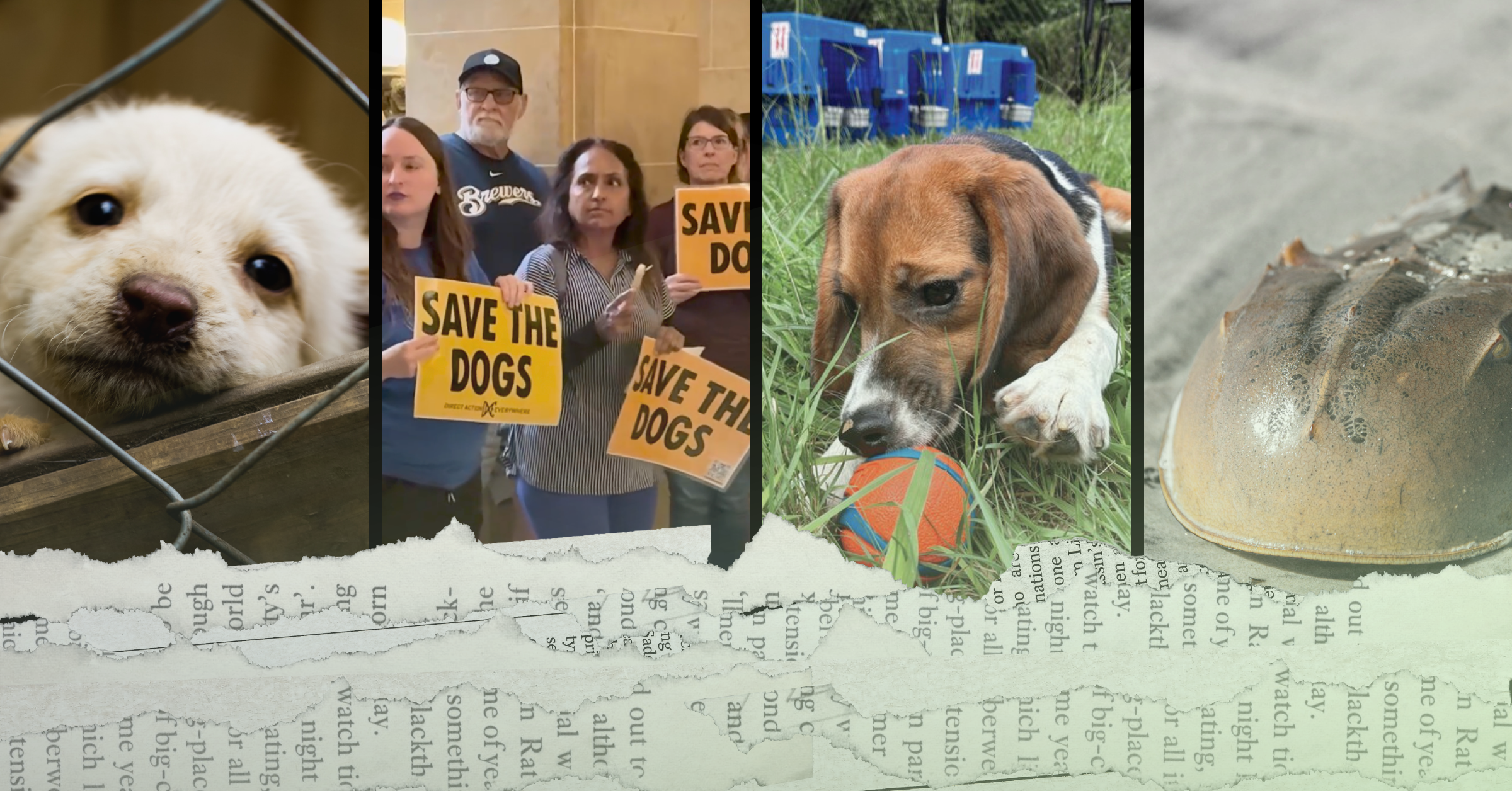
Here’s a roundup of the latest, biggest news stories related to animal research—all the recent media coverage you need to know right now to be the most effective activist for animals in labs.

The U.S. Federal Government is Helping Keep Marshall BioResources in Business
Lindsey Soffes, Rise for Animals, 9/10/2026
Federal records show the U.S. military is sending taxpayer dollars directly to Marshall BioResources, buying ferrets and pigs for painful and deadly government experiments. 📰 Full Story →

Marshall BioResources Faces Call for Criminal Investigation
Christie Hendrickson, Rise for Animals, 9/9/2026
Beagles at Marshall BioResources were allegedly killed while fully conscious, screaming, and thrashing as if being burned alive. Rise for Animals is a part of the Coalition to Save the Marshall Dogs that’s calling for a criminal investigation. 📰 Full Story →

Nearly 10,000 dogs force-fed pesticides for 90 days — most of it pointless, study finds
Kim Kwang-woo, The Herald Business, 9/4/2026
“Puppies just four to six months old — not yet fully grown — are cradled in the arms of researchers. At first glance, it looks as though they are simply being fed. The reality is the opposite. The animals are being force-fed pesticides and herbicides as part of toxicity tests conducted before agrochemical products reach the market, to determine how harmful the compounds are to humans. The forced dosing lasts a minimum of 90 days. And regardless of how toxic the pesticide turns out to be, the dogs’ fate is rarely a bright one. Even dogs that survive the dosing period are not spared. Their organs and tissues are examined after death to determine what toxic effects the pesticide caused — meaning none leave the laboratory alive.”
“It might be tempting to view this as an unavoidable cost of protecting human health. But a striking finding has upended that assumption. Cases where dogs were genuinely indispensable to pesticide hazard testing turned out to be a small fraction of the total. Just 4.6 percent, to be precise. Over the past 24 years, roughly 10,000 dogs were used in pesticide trials alone — and the vast majority, researchers now say, were subjected to experiments unnecessarily.”
“Yet dog testing for pesticides continues. Long-standing regulations and testing standards remain on the books, and progress toward establishing alternative criteria that would allow dog studies to be skipped has been slow.” 📰 Full Story →

Animal rights activists criticize Gov. Evers for Ridglan Farms inaction
Alex Loroff, Spectrum News 1, 9/4/2026
“Animal rights activists gathered at the Wisconsin State Capitol on Friday to criticize Gov. Tony Evers over his response to alleged animal abuse at Ridglan Farms, a Dane County facility that had housed thousands of beagles bred for medical research. The protesters sought a face-to-face meeting with Evers about inaction on Ridglan Farms, which activists had called on officials to close for years because of suspected abuse of dogs raised there.”
“Lead activist Wayne Hsiung specifically criticized comments Evers made to Spectrum News in April, when the governor said, ‘The idea that somehow the governor is going to wave a magic wand, and all of this is going to go away just isn’t going to happen.’ Millions of Americans were asking Governor Tony Evers, please, can you do anything, and not only did the governor not respond to this request, he got up in front of the press and joked about it,’ Hsiung said.” 📰 Full Story →

Madison reunion marks Ridglan Farms closure and renews fight against animal testing
Meredith Hackler, CBS 58, 9/5/2026
“To celebrate [Ridglan Farms’] closure dozens of animal activists and lovers gathered in Madison on Saturday for a reunion with a renewed focus to free more beagles from another facility with steps to do so already taking place. The group’s next target is to shut down Marshall Bioresources, which breeds an estimated 16,000+ beagles annually for U.S. laboratories, according to the activists.”
“‘We just released a criminal complaint against the largest facility of them all in upstate New York showing that dogs are literally injected with toxic chemicals leaving them thrashing and screaming on laboratory and breeding facility tables as if they burned alive,’ said Wayne Hsiung, the Co-Founder of the Simple Heart initiative.”
“As for this movements [sic] momentum the activists say they aren’t stopping until every dog in a testing facility is free and living in their forever home. ‘We are planning to use every tool in the tool kit but fundamentally we are planning to harness the compassion of Americans because this is a nation of animals lovers this is a nation of dog lovers,’ Hsiung said.” 📰 Full Story →

Navigating the politics of animal testing
Sophia Gardner & Kelly Hooper, Politico, 9/8/2026
“Early this year, the Trump administration approached one of the seven National Primate Research Centers to propose converting it into an animal sanctuary as part of the administration’s broader aim of reducing government-funded testing on animals, driven by political appointees like Health Secretary Robert F. Kennedy Jr. In July, the Oregon National Primate Research Center chose not to make the switch but instead agreed to significantly reduce its primate colonies and move toward developing nonanimal alternatives, often known as new approach methodologies. But that decision has led some researchers to question whether the nature of their work will change and whether they can continue their research at ONPRC or be forced to relocate.” 📰 Full Story →

VCU suspends cancer research project over animal mistreatment
Madeleine Biondi, The Commonwealth Times, 9/9/2026
“VCU laboratory staff failed to follow ethical protocol on mice subjects in a cancer research study, resulting in the suspension of the project in June and a voluntary end to all projects involving animal testing.”
“The VCU Institutional Animal Care and Use Committee determined that researchers failed to euthanize the mice in adherence with human endpoints designated by protocol. Humane endpoints are guidelines that researchers use to determine when an experimental animal’s distress should end through euthenasia [sic] or being removed from the study. Project suspension is reserved for cases of severe animal suffering.”
“In an official complaint to VCU, Stop Animal Exploitation Now stated, ‘Failure to follow these endpoints means that animals endured extreme suffering because lab workers were either unconcerned and couldn’t be bothered to perform euthanasia, or they intentionally chose not to perform the euthanasia/pain relief to collect more data.’” 📰 Full Story →

China needs monkeys: lab animal shortage could hinder biotech growth
Themis Qi, South China Morning Post, 9/9/2026
“China’s biotechnology market has ‘significantly’ driven up the demand for primate experimental models as the market recovers, tightening the supply of laboratory monkeys, according to a leading biotech firm. The continued recovery of fundraising and out-licensing deals in innovative drugs in China this year has led to significant growth in the demand for primate experimental models, contract research firm Joinn Laboratories (China) said….”
“Shanghai Medicilon, another global contract research organisation, also told investors in July that the overall supply of lab monkeys had contracted amid the biotech industry’s recent recovery. The shortfall of lab monkeys in China was projected to range between 15,000 and 20,000 from 2026 to 2028, according to a note by Zheshang Securities in March.”
“Laboratory monkey reserves and stable supply had become a core factor in the competitiveness of preclinical contract research organisations, according to Orient Securities analysts. Demand for the animals would continue to grow, as more Chinese-developed drugs were in the pipeline, they said in a note on August 31, adding that applications for pre-market drug candidates increased by 33 per cent year on year to 627 cases in the first half of 2026.” 📰 Full Story →

FDA Announces International Progress in Replacing Horseshoe Crab Testing
Physicians Committee for Responsible Medicine, 9/9/2026
“The FDA announced that it had successfully completed an international collaborative assessment of a protocol that companies can use when making manufacturing changes after a medicine has already been approved. The change evaluated in this case involved replacing the traditional Limulus Amebocyte Lysate (LAL) test, which relies on horseshoe crab blood, with a synthetic animal-free test for harmful bacterial contaminants known as endotoxins. The assessment marks an important step toward broader global acceptance of methods that can replace the use of horseshoe crabs.”
“The FDA conducted the assessment with regulatory authorities from Australia, Canada, Japan, Switzerland, and the European Union. The collaborative assessment, conducted through the International Coalition of Medicines Regulatory Authorities (ICMRA), resulted in approval of a Post-Approval Change Management Protocol in June 2026. For the first time, several regulators reached almost simultaneous and aligned decisions to approve this type of manufacturing change after reviewing it independently, demonstrating the reliability of the synthetic test method. The FDA’s involvement in this collaboration signals support for companies to transition their existing product registrations toward nonanimal endotoxin tests and offers a regulatory protocol for them to do so.” 📰 Full Story →

Agriculture Canada admits researchers breached scientific integrity rules
Sheila Gunn Reid, Rebel News, 9/9/2026
“Agriculture and Agri-Food Canada has acknowledged cases of potential scientific misconduct involving improper publication practices and unauthorized animal research, but the department is refusing to identify the employees or studies involved.”
“Officials [] received complaints involving the unauthorized use of animals for research. The department said the allegations were reviewed under its science-integrity policy but provided no details about the findings, consequences or affected research.” 📰 Full Story →

Big Dog Ranch Rescue & Paws of War secure release of 10 dogs from Marshall BioResources
Lake Okeechobee News, 9/9/2026
“For the first time, Marshall BioResources, America’s largest breeding and animal testing facility has released 10 retired breeding dogs to rescue organizations, marking a small but meaningful step forward for animal welfare. . . . Paws of War safely secured all 10 dogs following their release from the New York facility. Five will remain in the organization’s care on Long Island and five will be transferred to Big Dog Ranch Rescue in South Florida.”
“The organizations hope this historic release is a sign of more positive developments to come—and that many more dogs will be given the opportunity to leave breeding and research-related facilities as the scientific community increasingly adopts New Approach Methodologies, known as NAMs.” 📰 Full Story →

State senator leads interim study into Oklahoma law requiring pounds to surrender unclaimed pets for medical testing
Caroline Kelley, KFOR, 9/10/2026
“Oklahomans could soon see the end of a 1951 state law that allows research facilities to force municipal animal shelters to surrender lost and unclaimed pets for medical testing, according to U.S. Senate. Oklahoma remains the only state in the nation with a mandatory pound seizure law still on the books. State Sen. Nikki Nice, D-Oklahoma City, led an interim study on Wednesday at the state Capitol to examine the law and prepare legislation to repeal it. According to a Senate press release, while mandatory surrenders have not occurred in recent years, the active statute still creates a legal mechanism to force shelters to turn over pets.”
“The committee heard testimony from multiple animal welfare groups and agencies, including Humane World for Animals, Tulsa Animal Services, Rise for Animals, the Oklahoma Department of Agriculture, Food and Forestry and the Beagle Freedom Project….”
“Nice plans to work with fellow members of the Legislature during the upcoming legislative session to formally repeal the 1951 statute.” 📰 Full Story →

Non-Animal & Human-Relevant Research News Roundup
Rise for Animals, 9/9/2026
Explore the biggest news in non-animal methods and new approach methodologies (NAMs) from August 2026: lab-grown miniature human organs, AI-driven drug discovery, immune-on-chip systems, and much more. 📰 Full Story →