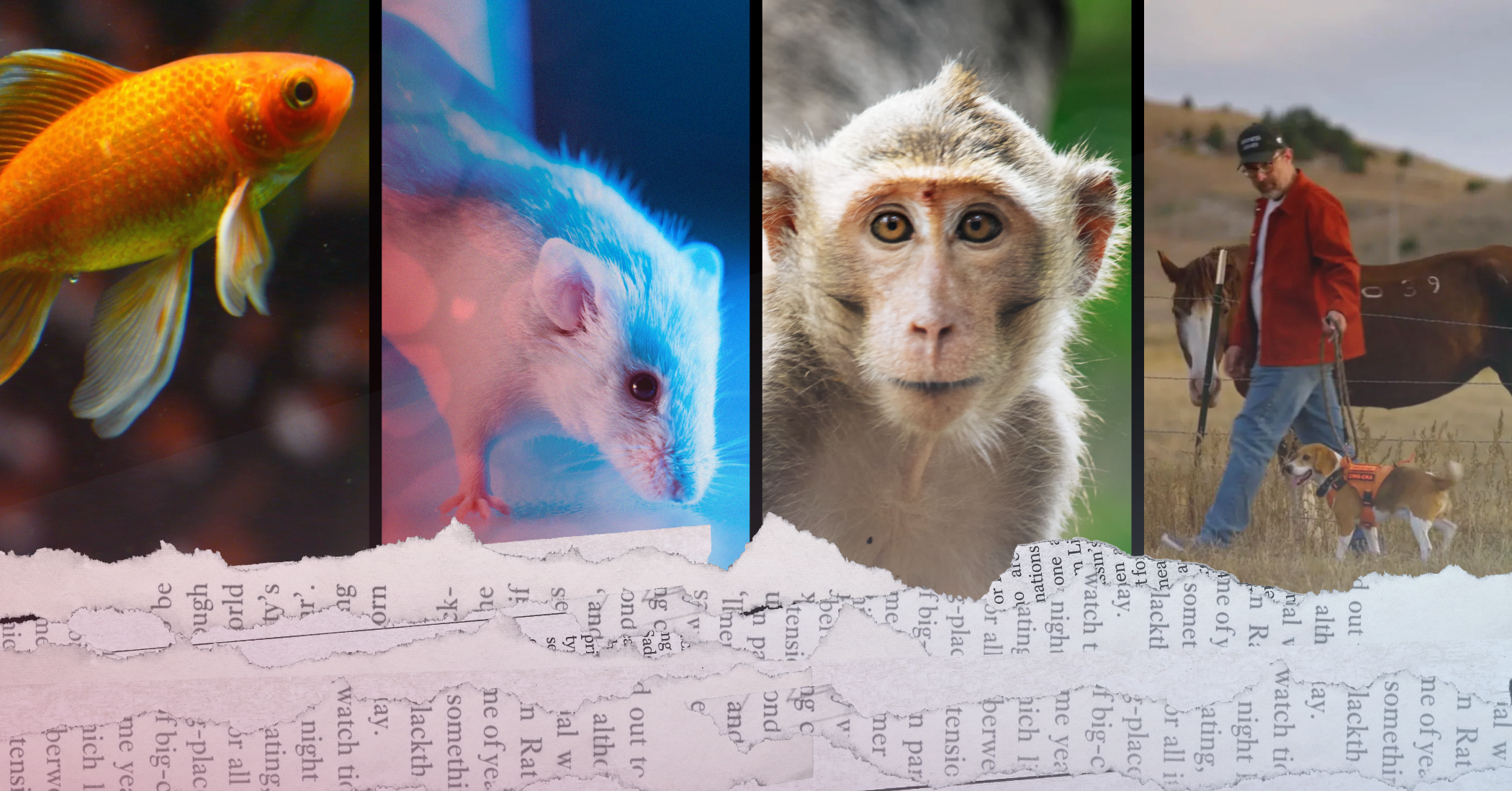

Animals Win as FDA Modernization Act 3.0 Advances in House
Rise for Animals, 7/21/2026
The U.S. House of Representatives has passed the FDA Modernization Act 3.0, moving federal policy closer to recognizing modern, human-relevant research methods instead of outdated reliance on animal testing. 📰 Full Story →

Animal Researchers Got Basic Human Blood Science Wrong
Rise for Animals, 7/23/2026
For decades, researchers based their understanding of human red blood cell formation almost entirely on mice. But now, a new study shows the basic assumption was wrong.
The truth is, animal models don’t merely fail to predict human biology. They can obscure it. 📰 Full Story →

This Beagle Is An ‘Accidental Ambassador’ For Former Research Dogs
Jen Reeder, Forbes, 7/16/2026
“Uno [a beagle rescued from Envigo] is popular at the United States Capitol, where he’s visited six times to meet with politicians from both sides of the aisle when there are discussions about animal testing in medical research. . . . ‘People in the most expensive suits I’ve ever seen are laying on the floor holding him and scratching his head and kissing his forehead and apologizing for all the horrible things that humans do to animals,’ . . . Uno has proven to be a poster dog for animals bred for and used in medical testing.”
“When people meet Uno and hear about his past life at Envigo, where he lost part of his tail and part of his ear, the typical response is confusion . . . ‘One of the first questions they ask is, “How could anybody ever test on such a beautiful dog?” And then the follow-up, depending on which side of the argument you’re on, is either anger and concerns about the ethical issues of testing on animals or you go straight to protecting the science and saying, “Well, I guess it’s a necessary evil” and the justification starts to fall in.’” 📰 Full Story →

After Wisconsin beagle rescue, New York lawmaker targets taxpayer-funded lab dog breeding
Leigh Cook, The Cool Down, 7/16/2026
“The shutdown of a Wisconsin breeding facility and the rescue of 1,500 dogs have intensified questions about how research laboratories obtain dogs. A New York congressman says those questions should now lead to the end of taxpayer support for breeding dogs for experiments.”
“Following the closure of Ridglan Farms in Wisconsin and allegations of severe neglect, Rep. Nick Langworthy, R-N.Y., said he wants legislation that would ban taxpayer-funded breeding of dogs for laboratory research. His attention is now on Marshall BioResources, also known as Marshall Farms, in Wayne County, New York . . . Langworthy said the company is the biggest United States breeding facility supplying dogs and other animals to universities, testing facilities, and other companies.”
“Langworthy said he wants the backlash to result in federal law. ‘We want to see this process banned. I want to do so legislatively. I want to codify this. Cut off the money and prevent this horrible research from going on,’ he said….” 📰 Full Story →

MPs Call For End To ‘Blind Approval’ Animal Testing
Liam Pritchett, Plant Based News, 7/19/2026
“MPs have backed a new motion calling on the UK government to end ‘blind approval’ animal testing. . . . British animal rights organization Animal Aid noted that a significant number of animal tests are approved ‘blindly’ each year, whereby laboratories are granted generic service licenses for a category of tests without full knowledge of the specifics. Critics argue that this makes it impossible to judge whether an animal test is necessary.”
“New Freedom of Information (FOI) data from the Home Office shows that six generic service licenses were granted in the first three months of 2026 alone, authorizing the use of more than 100,000 animals in experiments over the next five years. EDM 465 calls for an end to all new generic service licenses, the review of all existing licenses, and the urgent delivery of the ‘Replacing Animals in Science Strategy.’”
“‘What we are witnessing is suffering hidden behind process and paperwork. Licences should never be issued in the dark,’ Duncan-Jordan said. ‘When approval is “blind”, so is accountability, and animals pay the price. Behind every licence is a living creature subjected to fear, distress, and suffering that the public is never allowed to see. That must change.’” 📰 Full Story →

Animal testing action demanded as report reveals species increases
Allister Webb, Vet Times, 7/20/2026
“Governments and regulators must ‘force’ through reductions in the number of scientific tests being carried out on animals, campaigners have claimed. The demand follows new [British] Government figures which showed an increase in procedures carried out on cats, dogs, horses and primates, despite an overall [4%] reduction in tests across all species.”
“ . . . Animal Defenders International (ADI) vice-president Tim Phillips warned advances in alternatives appeared to have had ‘little impact’ on the number of animals used in experiments. He said: ‘There is a disconnect and it is up to governments and regulators to force the change. It is simply not going to happen otherwise.’” 📰 Full Story →

Orient Bio Expected to Benefit from Research Primate Supply Shortage
Lim Chunhan, The Asia Business Daily, 7/20/2026
“Recently, as the expansion of global new drug development has led to a shortage in the supply of research-purpose primates, Orient Bio’s non-clinical testing (CRO) business is receiving increased attention. According to Orient Bio on July 20, the company signed an exclusive business rights agreement for primate CRO services with its affiliated company Orient Cam on July 15. The strategy is to strengthen global competitiveness in the non-clinical CRO business by combining Orient Bio’s non-clinical testing capabilities with Orient Cam’s research-purpose primate production base.”
“Orient Bio plans to leverage Orient Cam’s research-purpose primate production base to promote its non-clinical testing business for pharmaceutical, biotechnology companies, and research institutions both in Korea and abroad. The company intends to respond to a wide range of client research needs by linking a stable primate supply chain with its non-clinical testing capabilities. In addition, Orient Bio is working to establish an artificial intelligence (AI)-based non-clinical platform using the data accumulated from primate non-clinical testing processes. The plan is to create an integrated research support system spanning primate procurement, non-clinical testing, data accumulation, and AI analysis….” 📰 Full Story →

Most people think a goldfish forgets everything within seconds, which helps make the little bowl seem humane — but that is a myth: goldfish can remember for months, push levers and tell colours apart
Mal James, Science Blog, 7/21/2026
“Nothing to remember, nothing to miss, no boredom piling up. One possible reason this belief has lasted so long is that it makes keeping a fish in a tiny container easier to rationalise, although that explanation remains a suspicion rather than something researchers have proved.”
“The evidence against the few-seconds claim is neither new nor thin. ‘We’ve known about the reasonably good memories of goldfish since the ’50s and ’60s,’ [Culum Brown, a professor at Macquarie University, who has studied fish intelligence for more than 25 years] says. Goldfish became a common laboratory animal for studying how fish learn and remember, and that research describes an animal capable of retaining information for far longer than a few seconds.”
Per Brown, ‘there are thousands of studies [on goldfish] that show fish have excellent memories.’ . . . So why does a belief with decades of evidence against it keep getting repeated as fact? . . . ‘I suspect it’s got more to do with making us feel good about putting them in a tiny little bowl,’ [Brown] says. As he puts it, ‘It probably says more about us than it does about the goldfish.’” 📰 Full Story →

Under New Proposal, OHSU Primate Center Would Change Gears. But Some Animal Tests Would Go On.
Andrew Schwartz, Willamette Week, 7/22/2026
“Animal rights activists declared victory early this year when Oregon Health & Science University said it would negotiate with the feds over a plan to turn the very contentious Oregon National Primate Research Center in Hillsboro into a primate sanctuary. But nearly six months later, OHSU leaders appear to be putting their weight behind a different idea. Under a new proposal awaiting approval by the OHSU oversight board, the primate center would still transform significantly. It would seek to become a ‘national leader’ in alternative experimental models to animal-based research. And it would ‘substantially’ reduce its primate population—by limiting new breeding and transferring many monkeys to sanctuaries. Notably, though, the primate center would continue monkey-based research in areas for which OHSU determines there are no good alternatives elsewhere.”
“The idea, which is really a plan to make a plan, remains aspirational, but skeptics and supporters alike say it has the makings of a viable path forward. . . . if approved, it could mark a new chapter in a yearslong battle over a sprawling laboratory home to several thousand monkeys subjected to a range of scientific experiments. ”
“OHSU did not answer questions about what happened to the primate sanctuary idea.” 📰 Full Story →

March To Abolish Animal Testing Launches 207-Mile Trek From NY Capitol To Marshall Bioresources
March for Animals, Scoop, 7/22/2026
“Activists nationwide are mobilising for a historic march to end animal testing at Marshall BioResources, one of the world’s largest suppliers of research animals.”
“Set to kick off at the New York State Capitol on September 12, 2026, the 207-mile march will wrap up on September 26 with a moving rally at the gates of Marshall Bioresources, located in North Rose, New York. Marshall has come to be known as the epicenter of animal testing serving as one of the largest breeders of animals–in addition to the dogs, more than 40,000 cats, ferrets, pigs, mice, and guinea pigs–supplied to laboratories worldwide.”
“Coming on the heels of the recent Ridglan Rescue of more than 2,000 beagles in Wisconsin in Spring 2026, the March to Abolish Animal Testing was born out of the swell of public support for ending animal research and the growing demand for cruelty-free products that are produced from better science and superior research methods that are not outdated animal models.” 📰 Full Story →

New rules for the European Chemicals Agency give fresh momentum to phasing out animal testing
Eurogroup for Animals, 7/23/2026
“The European Union has taken another important step towards ending the use of animals in chemical safety testing. EU institutions have reached an agreement on new rules for the European Chemicals Agency (ECHA), the body responsible for helping ensure chemicals used in Europe are safe. The updated rules make it clear that ECHA should support the development and use of non-animal methods when assessing chemical safety, helping turn the EU’s commitment to phase out animal testing into action.”
“This is an important milestone. For the first time, the Chemicals Agency will have its own stand-alone regulation setting out how it works. This creates an opportunity to better reflect the EU’s ambition and ECHA’s commitment to move away from animal testing and towards modern, animal-free science.” 📰 Full Story →