Here’s a roundup of the latest, biggest news stories related to animal research—all the recent media coverage you need to know right now to be the most effective activist for animals in labs.
The Loneliest Monkeys in America: How Labs Keep Primates in Solitary—and Get Away with It
Rise for Animals, 8/27/2026
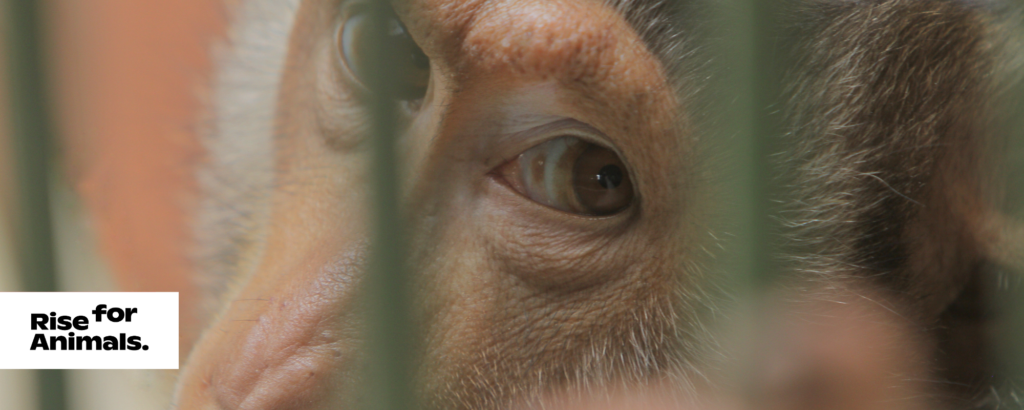
A monkey trapped alone in a laboratory bites herself in the same spot, over and over, until her fur is gone and her skin won’t close. Does she seem okay to you?
Without social companions, anxiety and fear set in. In a lab, she can be confined in a metal cage for her whole life. Her loneliness shows up as wounds on her body.
Researchers refer to this type of self-injury as “abnormal behavior.” But it’s happening at research facilities across the country. 📰 Full Story →
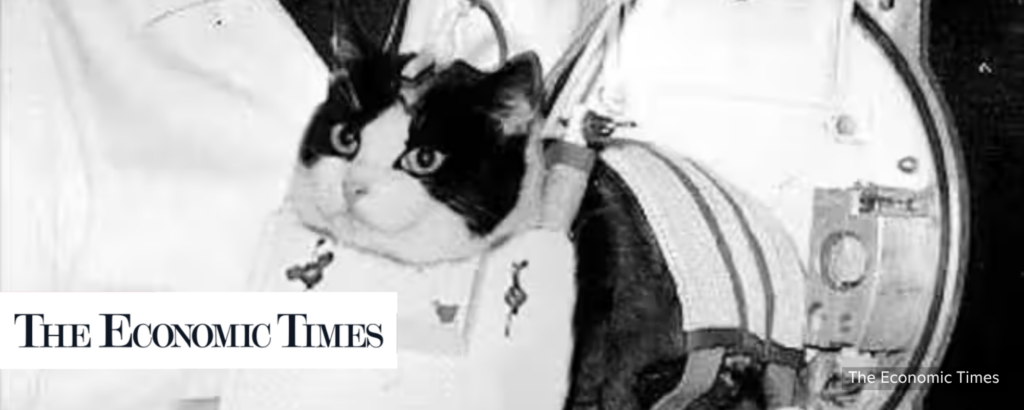
In 1963, France sent a stray cat 154 km into space; Félicette survived the flight, was euthanized for research, and honoured with a bronze statue
The Economic Times, 8/23/2026
“In 1963, France sent a Parisian stray cat 154 km into space, making Félicette the first and only cat to travel beyond Earth.”
“Launched on October 18, 1963, aboard a French Véronique rocket, Félicette completed a short suborbital mission and returned safely to Earth by parachute. . . . but her story took a tragic turn. About two months after her spaceflight, she was euthanized so scientists could study how the journey had affected her body. The subsequent examination did not reveal significant useful information….”
“During the early years of the Space Race, scientists wanted to learn what happened to living organisms during spaceflight. The Soviet Union famously sent dogs, while the United States used monkeys and chimpanzees in several missions. France took a different approach and selected cats for its research program. In 1961, staff at Cerma, the Centre d’Enseignement et de Recherches de Médecine Aéronautique, gathered 14 stray cats as potential candidates for a space mission. . . . Scientists deliberately gave the cats numbers rather than names because they did not want researchers to become emotionally attached to them. One cat, identified as C341, was eventually selected.” 📰 Full Story →
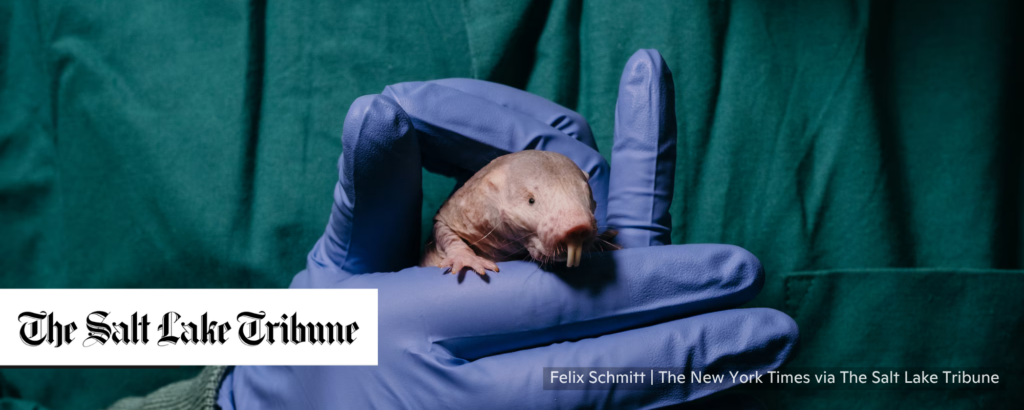
Utah State lab euthanized 82 naked mole rats in a way that took longer than necessary, federal investigators find
Courtney Tanner, The Salt Lake Tribune, 8/24/2026
“A research lab at Utah State University euthanized 82 naked mole rats using an unapproved method, according to a federal inspection report, which ultimately made the animals’ deaths take much longer than necessary. . . . PETA Vice President Alka Chandna said the violation is critical, showing the school fails to ‘properly put animals out of their suffering’ and the animals died a ‘a slow, agonizing suffocation.’”
“Last year, between Sept. 26 and Oct. 3, the research lab that had been working with the naked mole rats was authorized to euthanize them after its project. It did so by exposing them to carbon dioxide — ‘a method not on the approved protocol,’ the USDA report states. That’s because carbon dioxide has less of an effect on naked mole rats, which are hypoxia tolerant (meaning they can withstand less oxygen than other animals), according to the USDA inspection. That tolerance meant it took 40 minutes of ‘prolonged exposure’ for them to die, the report says. The rats were instead supposed to be euthanized by injection.” 📰 Full Story →

Talarico calls Paxton ‘anti-puppy’ over dog testing despite praising Fauci, who approved animal experiments
Ryan Foley, The Christian Post, 8/25/2026
“The campaign of Texas’ Democratic U.S. Senate candidate James Talarico is seizing on resurfaced reports about Republican rival, Attorney General Ken Paxton, ruling over a decade ago that animal testing at a public university could remain confidential….”
“The lab at Texas A&M University was the subject of 15 open records requests about the treatment of dogs tested there more than a decade ago. As highlighted in a 2015 Houston Chronicle article, Texas A&M reported using 428 dogs and 15 cats for research in 2014. The university also told the U.S. Department of Agriculture that three-fourths of the tests done on 82 dogs in 2009 left the animals in ‘some pain or distress.’ Paxton’s office issued an opinion in June 2015, concluding that research developed at a state university must stay confidential if it has commercial value. . . . In a subsequent opinion responding to additional requests for information, Paxton’s office cited a state law stating that ‘A veterinarian may not violate the confidential relationship between the veterinarian and the veterinarian’s client.’”
“‘Ken Paxton is anti-puppy,’ Talarico said. ‘I wish I was joking when I said that, but reports just came out revealing that as Attorney General, Ken Paxton protected a research lab that was notorious for torturing and killing hundreds of puppies . . .’ Talarico vowed that he was ‘going to be a senator for […] all Texans, including our […] four-legged Texans.’ However, Talarico has also sung the praises of Dr. Anthony Fauci, the longtime head of the National Institute of Allergy and Infectious Diseases (NIAID), who has also faced criticism over animal research. . . . Documents obtained by the White Coat Waste Project show NIAID awarded two grants totaling nearly $400,000 to Ohio State University and the Pasteur Institute of Tunisia. The grant application says ‘vertebrate animals’ were euthanized as part of the research, which involved injecting beagles with a prototype vaccine for leishmaniasis, a parasitic disease spread by sand flies. Researchers exposed the dogs to bites from wild sand flies carrying leishmaniasis.” 📰 Full Story →
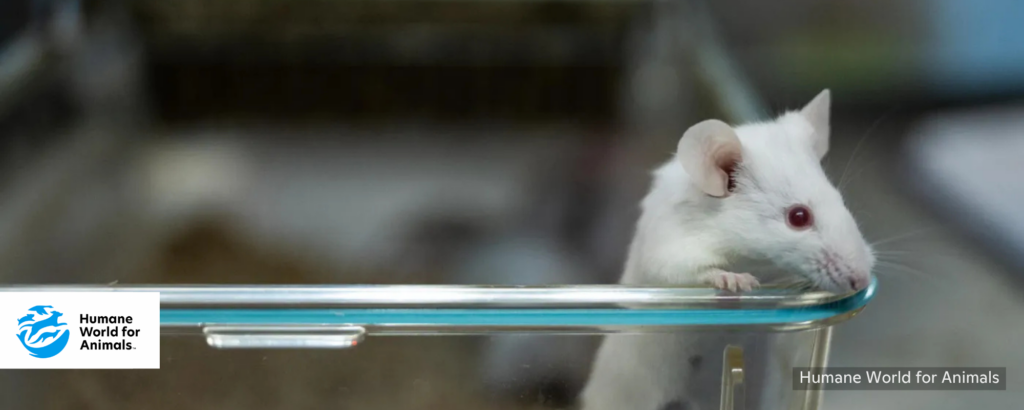
Animals still being tested for nothing in the EU, new findings show
Humane World for Animals, 8/26/2026
“Animals are still being forced to endure chemical safety tests that do nothing to better protect people or the environment, according to new peer-reviewed findings from the Animal-Free Safety Assessment (AFSA) Collaboration, founded by animal protection organization Humane World for Animals. The research paper, published in the latest issue of ‘Regulatory Toxicology and Pharmacology’, is part of the project ‘Overcoming Difficult, Impossible, and Meaningless (DIM) Animal Testing under REACH’. This[]is the first systematic, evidence-based effort to examine how often animals are used in chemical tests that are difficult to carry out, impossible to conduct properly, or meaningless for real world safety decisions.”
“Under the EU’s chemicals law, animal testing is supposed to be used only as a last resort. But the findings suggest that, in practice, animal tests are still being requested even when modern non-animal methods could provide more relevant information, or when the animal test itself is unlikely to add meaningful value.” 📰 Full Story →
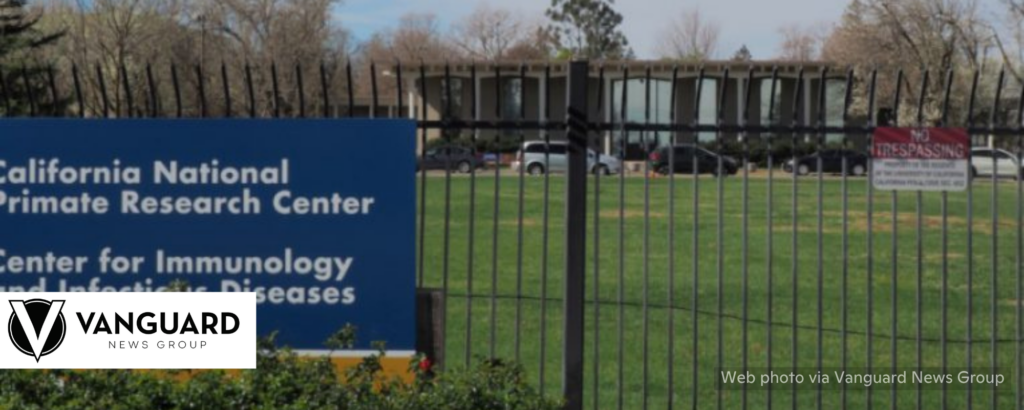
Federal Inspectors Cite UC Davis Over Monkey Injuries, Unsafe Enclosures
David M. Greenwald, Vanguard, 8/26/2026
“Federal inspectors have again cited the University of California, Davis, for violations of the Animal Welfare Act after monkeys suffered injuries linked to broken equipment, unsafe enclosures and handling errors, including one incident that resulted in a finger amputation and another in which a monkey had a piece of broken PVC pipe removed from her mouth. . . . The latest findings come months after UC Davis received other federal citations involving monkeys at its California National Primate Research Center….”
“PETA Chief Science Advisor for Primate Experimentation Dr. Lisa Jones-Engel said the latest findings demonstrate continuing problems at the UC Davis primate center. ‘The California National Primate Research Center needs to be shut down because, even when they’re not being experimented on, no monkey is safe there,’ Jones-Engel said in a statement. ‘Broken equipment, dangerous enclosures, careless handling, and wanton neglect cause amputations, injuries, and fights between stressed monkeys.’” 📰 Full Story →
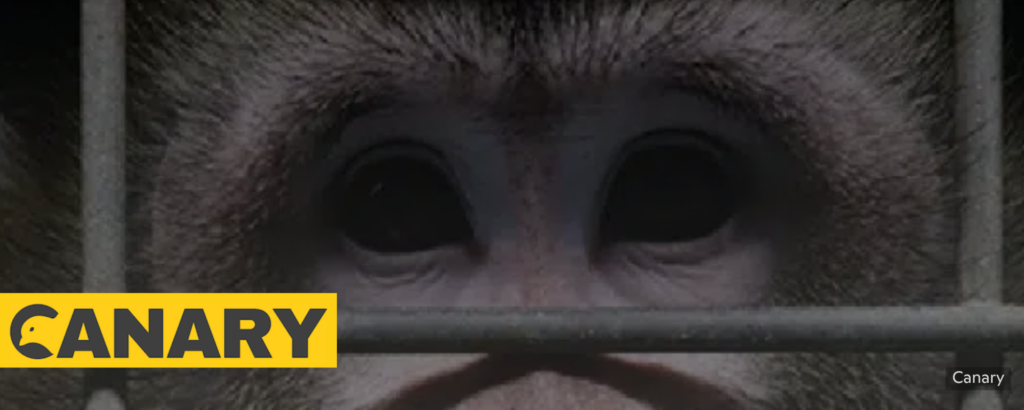
Upper Tribunal says secrecy around animal experiments is unlawful
The Canary, 8/26/2026
“The secrecy which surrounds information on the use of animal experiments in science has been ruled unlawful by the Upper Tribunal in a landmark case brought by animal protection organisation, Cruelty Free International.”
“The case, ‘Cruelty Free International v Information Commissioner and Home Office’, concerned Section 24 of the Animals (Scientific Procedures) Act 1986 (ASPA). This prohibits Home Office ministers and officials from disclosing information given to them in confidence by animal researchers. Crucially, this includes detailed applications for licences to conduct animal testing. . . . Cruelty Free International argued that Section 24 is contrary to Article 10 of the European Convention on Human Rights, which, following a European Court of Human Rights case called Magyar, obliges governments to disclose information in certain circumstances. These include where the information is publicly important and the requester acts as a public watchdog, such as the media or a responsible NGO such as Cruelty Free International.”
“The Upper Tribunal has now decided that Cruelty Free International met the Magyar tests and the Home Office could not rely on the exceptions to Article 10. . . . The Upper Tribunal has limited remedies available to it. Cruelty Free International now expects the case to go to the Court of Appeal for final resolution.” 📰 Full Story →
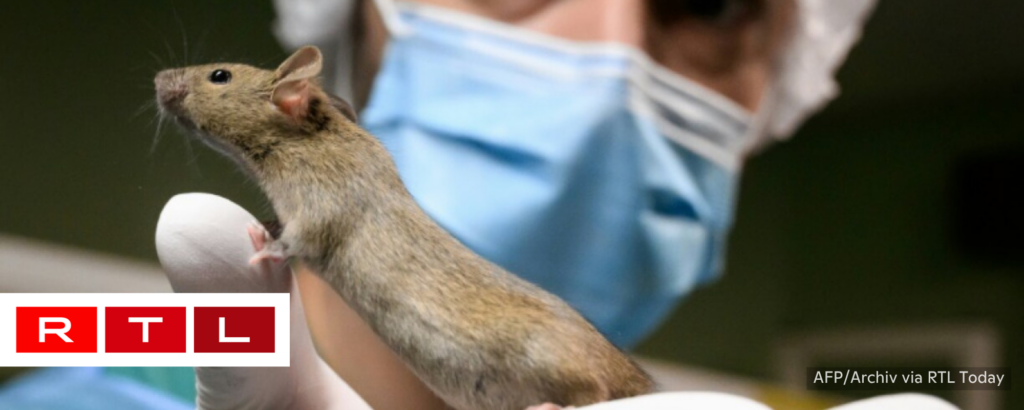
German court bans experimental procedure that surgically joins live mice
RTL Today, 8/26/2026
“A professor from the University of Bonn is no longer allowed to perform controversial parabiosis experiments in which two living mice are surgically joined at the torso and legs so that their circulatory systems are connected. The Cologne Administrative Court upheld an existing ban on Wednesday, rejecting the professor’s appeal against the prohibition. The court concluded that the method places extreme stress on the animals and breaches Germany’s animal welfare law.”
“In these experiments, the two mice remain joined for eight weeks before being separated and dissected. The research had been intended to study the development of a malaria vaccine. The researcher argued that the procedures would only moderately burden the animals. However, the court found the mice’s level of distress to be extreme and argued that the professor failed to present documentation to justify such suffering.” 📰 Full Story →

VCU cancels research project due to inhumane treatment of lab mice
Eric Kolenich, Richmond Times Dispatch, 8/26/2026
“Virginia Commonwealth University suspended a research project after the laboratory staff repeatedly treated lab mice inhumanely, the university reported to federal authorities last month. The researchers did not provide mice with ‘humane endpoints,’ which is generally euthanasia to end the test animal’s pain [sic], said Michael Budkie, executive director of a group called Stop Animal Exploitation Now, a watchdog that aims to end animal testing.”
“VCU has self-reported three other incidents this year involving animal testing . . . In one case, mice were given drugs that were not listed in the approved protocol, resulting in the death or euthanasia of nearly 50 mice. In another case, 23 mice and mouse pups were ‘found dead and dehydrated’ after lab workers replaced the water valve with one the animals could not use. In another instance, a student performed procedures on mice and rats that were not accurately described in the protocol, and researchers did not follow pain management practices.” 📰 Full Story →
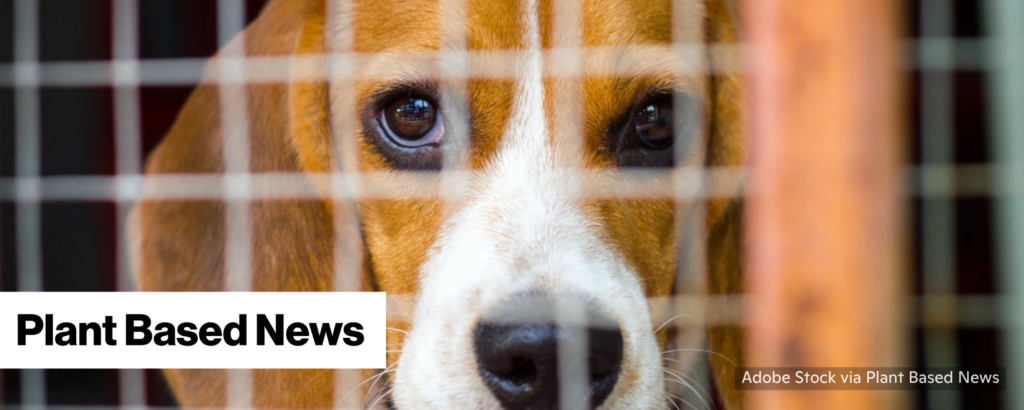
UK Government Announces £22 Million Investment In Animal Testing Alternatives
Liam Pritchett, Plant Based News, 8/27/2026
“The UK government has announced a £22 million investment to ‘ramp up’ the move away from animal testing in favor of ‘cutting-edge’ alternatives. This includes a £20 million center to grow miniature organs from human tissue, and £2 million from the government’s Innovate UK for nine projects including lab-grown ear models, AI modeling, and ‘beating heart cells in a dish.’”
“‘This is all about backing our world-leading researchers and innovators to improve lives, giving them the tools they need to deliver more effective treatments for horrendous diseases like cancer, while also preventing the need for animal testing wherever possible,’ McDonald [the Minister of State and Minister for Science, Innovation, and Investment] continued. ‘It’s also a boost for our life sciences sector – with British firms using samples donated by real people and harnessing AI to predict how a medicine behaves – fuelling opportunities for new investment and new jobs, and ensuring Britain is better off.’” 📰 Full Story →
EPA Announces Two Major Scientific Advancements to Further Eliminate Animal Testing, Raise the Scientific Bar for Chemical Reviews
EPA Press Office, 8/27/2026
“ . . . U.S. Environmental Protection Agency (EPA) announced two major scientific advancements designed to modernize safety reviews of new chemicals and pesticides while further eliminating the agency’s reliance on animal testing. The new methods will help EPA assess the potential inhalation and oral risks of certain chemicals and pesticides faster and with greater human relevance, advancing the agency’s commitments to transparency, regulatory certainty, and the protection of human health and the environment. ”
“[The] announcement introduces two integrated solutions to eliminate animal testing and modernize toxicity reviews: • Modernizing Surfactant Assessment . . . using 3D human airway tissue . . . • Adopting GHS Mixture Standards . . . to predict oral toxicity for some pesticides.” 📰 Full Story →