How Labs Keep Primates in Solitary—and Get Away with It
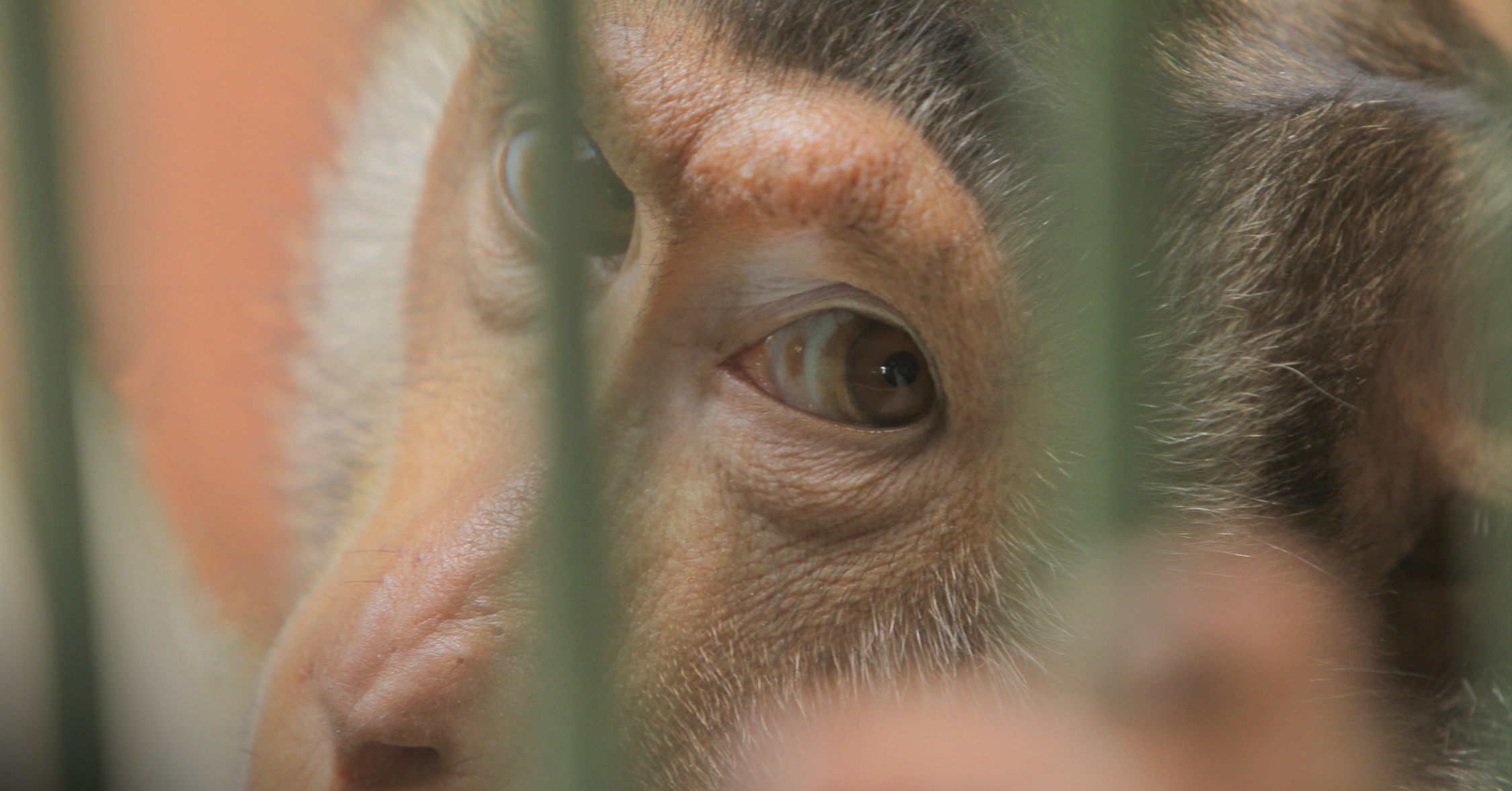
A macaque trapped in a laboratory bites herself. In the same spot, over and over, until her fur is gone and her skin won’t close. Does she seem okay to you?
In the wild, she’d be climbing trees with her troop, squabbling, and cuddling while she sleeps, fur-to-fur. She’d spend hours grooming—one monkey working her fingers through another’s fur. Grooming is how macaques bond, comfort each other, and stay calm.
Take away touch, and anxiety and fear set in. In a lab, she can be confined in a metal cage for her whole life. Her loneliness shows up as wounds on her body.
Researchers refer to this type of self-injury as “abnormal behavior.” But it’s happening at research facilities across the country.
Records Reveal Isolation
In March 2025, 16 long-tailed macaques were shipped to Arizona State University. According to a complaint submitted anonymously to federal regulators, and uncovered by Rise for Animals, the lab refused to house any of the monkeys together. They claimed the males might fight and threaten the study.
“[Management is] conveniently ignoring the fact that eight of the macaques are female,” wrote the complainant. “They refuse to consider any staff feedback or even attempt non-full-contact pairings to evaluate their behavior prior to making this decision.”
“Several of these macaques are supposed to exhibit serious abnormal behaviors, such as self-biting, that could potentially be curbed with pair housing.”
In May, a federal inspector visited Arizona State University to follow up. She reviewed records. She looked at the monkeys. And she left without a single citation or note of concern. Under the rules that govern animal research in America, keeping a monkey in solitary confinement, biting herself, is the system working as intended.

Machines for Despair
How did a scene like this become common and legal?
In the 1950s and ‘60s, a researcher at the University of Wisconsin named Harry Harlow built machines to drive monkeys to despair. He took infants from their mothers, trapped them alone in steel chambers—some for a full year—and watched them break down. The monkeys came out wrecked. They paced, rocked, tore out their hair, and bit themselves. One stopped eating after release and died. By Harlow’s own account, 12 months of isolation “almost obliterated the animals socially.”
None of this torture told us anything new. That social animals suffer when isolated is not a scientific discovery. It’s obvious.
Harlow was open about his contempt for the animals. In a 1974 interview with the Pittsburgh Press Roto, quoted in Deborah Blum’s The Monkey Wars, Harlow said:
“The only thing I care about is whether a monkey will turn out a property I can publish. I don’t have any love for them. Never have.”

One-Third, Left Alone
The industry knows what isolation does. Its rules say so.
The federal Guide for the Care and Use of Laboratory Animals says social animals should be housed in compatible pairs or groups, and federal Animal Welfare Act regulations require labs to address the social needs of primates. But social housing is not guaranteed. Experimenters can seek exemptions by claiming an animal must be housed alone for the good of the research. The decision rests with the lab’s own veterinarian and oversight committee. The people who run the research decide what they can do to animals—and that’s a loophole.

Roughly a third of primates housed indoors in U.S. labs are kept alone, according to a 2026 evaluation of recent survey data. Behind these statistics are real animals, like the ones at Arizona State. Over a dozen monkeys were held captive, cut off from their own kind, and left to mutilate themselves. And the laboratory passed its federal inspection in full compliance.
But even together, they are still caged. These are wild animals made to move in troops, climb through the lush canopy, groom in the sun, and sleep in a warm heap of others. They should never be in a laboratory. We will fight until they’re free.
Your Call to Action: A companion in a cage will never make captivity right. The SPARE Act would phase out federally funded animal experimentation, redirect funding toward non-animal research, and require eligible animals held in federally funded laboratories to be released for adoption or sanctuary placement.
Tell your members of Congress to support the SPARE Act and help move animals out of labs for good.