It’s Not Just Marshall: Exposing the “Lab Dog” Pipeline
For years, public attention on the breeding of dogs for research centered on Ridglan Farms. With Ridglan’s closure earlier this year, the spotlight has shifted to Marshall BioResources, the nation’s largest breeder of dogs for experimentation.
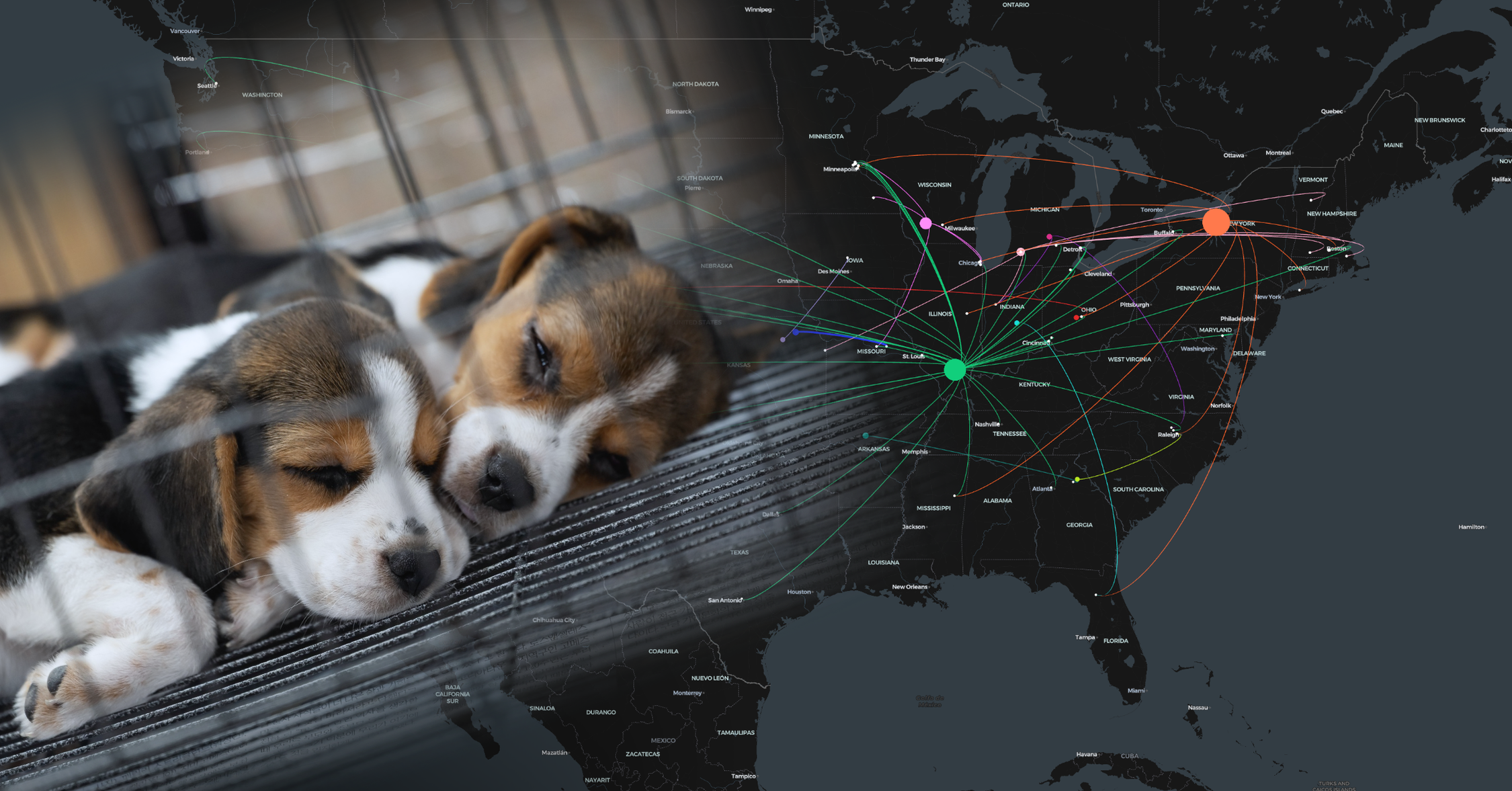
Marshall deserves the scrutiny, but, as we saw with Ridglan, any one supplier is only part of the story. That’s why we have been working to map out the rest of the pipeline: both those who supply dogs to labs, and those who buy them.
To do that, we have been piecing together public records from state agencies and from public institutions that use dogs in research.

You can view our interactive map here.
The picture changes each time new records arrive, and it has real limits.
- Records from different sources don’t always agree.
- Agencies and institutions produce records in different forms, with different scopes and different redactions.
- It isn’t always possible to tell whether two different documents reflect the same transactions or separate ones.
- Some records are out of reach altogether, because state laws don’t require entities to maintain or release them.
Yet, subject to these and other caveats, there’s still a lot to be learned.
Here are five preliminary takeaways from records documenting the sale or transfer of thousands of dogs between 2024 and 2026:
1. Marshall Is the Largest Dog Supplier, But It Is Far From the Only One
Illinois-based Oak Hill Genetics is an increasingly prolific supplier of dogs to labs: in 2026 alone, our records confirm that Oak Hill transferred hound mixes to 30 different recipients, from private entities to public universities. And White Coat Waste recently reported that Oak Hill, which it aptly describes as the nation’s second-largest breeder of dogs for research, shipped approximately 1,500 dogs between January 1, 2025, and June 30, 2026.

Together, Marshall and Oak Hill account for over 98% of the dogs in our 2026 transfer records—but other suppliers remain active, and we must keep watch:
- Wisconsin-based Tri-Valley Resources accounts for the rest of the 2026 transfers in our records, with shipments to the Mayo Foundation and the University of Chicago as recently as last month.
- Kansas-based Trailane Kennels transferred dogs for research as recently as October 2025, and an April 2026 inspection report listed 173 dogs and 74 puppies on-site.

We also need to keep our eyes on Class B dealers (businesses licensed by USDA to buy and resell animals) that hold or have recently held dogs but do not yet appear as suppliers in the records we’ve obtained:
- Animal Blood Bank in Michigan had 72 dogs listed on its June 2026 inspection report;
- Clinvet in New York, which is partnered with Marshall, had 161 dogs listed on its April 2026 inspection report;
- Q Test in Ohio had 43 dogs listed on its February 2024 inspection report; and
- Whale Branch Animal Services in South Carolina had 147 dogs listed on its August 2025 inspection report.
(Animal Blood Bank, Clinvet, and Q Test are also registered research facilities, so some or all of their dogs may be used on-site, but a license to sell dogs is reason enough to keep a close eye.)
2. The Private Sector Appears to Be Driving Demand for Dogs
Records identify commercial companies and contract research labs as leading buyers of dogs for research.
Marshall-specific records evidence the pattern. The vast majority of Marshall’s documented sales went to a single buyer: private animal research giant Labcorp. (Special thanks to Michael C. Taylor for collecting and sharing these records!)
This finding is all the more notable because private entities are not subject to public records laws, and we see their activities only when accessible public agency records happen to capture them.

3. Marshall May Not Be the Last Breeder of Beagles for Research
Every beagle shipment in our 2026 records came from Marshall, but earlier records call into question whether Marshall is the last breeder of beagles for research.
Freeman Farms,* a current Class A licensee based in Arkansas, shipped 40 dogs listed as beagles and beagle mixes to TRS Labs (one of Ridglan’s largest customers) in 2024—and a May 2025 APHIS inspection report recorded 109 dogs and 9 puppies on-site.

4. Beagles Are Not the Only Dogs Used for Research
Of the dogs whose breed is listed, the majority are beagles—but many are not.
Between 2024 and 2026, records document the transfer of more than 900 hound mixes and “mongrels,” as well as almost 60 Australian Shepherds, Collies, and Curly-Coated Retriever mixes.

5. Leaving One Lab Doesn’t Mean Leaving the Research System
Surviving research is not a common story for any animal in a laboratory, but records do show dogs being transferred between labs and institutions:
- Inotiv and other contract research companies providing dogs to Colorado State University at no charge;
- Charles River moving beagles to community-college and university programs; and
- Public universities transferring dogs among themselves.
These records don’t tell us what happened to these dogs before or after, but they show that leaving one facility doesn’t necessarily mean leaving the research system.
The Pipeline Relies on Multiple Dog Breeders
The picture remains incomplete, and it will remain so as long as states decline to share transfer records and private companies stay beyond the reach of public records laws. But, even this partial view makes one thing abundantly clear:
The pipeline that carries dogs into laboratories runs through more breeders, dealers, and institutions than any single name—whether it be Ridglan or Marshall—can even come close to capturing.
And ending animal research means confronting them all.
Your call to action? Help expose the “lab dog” pipeline. Most people never see how dogs move through the research system. Share this article and map to help more people understand the network of breeders, labs, universities, and companies behind it.
Share:
Facebook | X | Bluesky
*USDA lists this entity as “Freemen Farms,” but an Arkansas Interstate Small Animal Health Certificate obtained by Rise for Animals lists the entity as “Freeman Farms” with an email address beginning with “Freeman.Farms.”