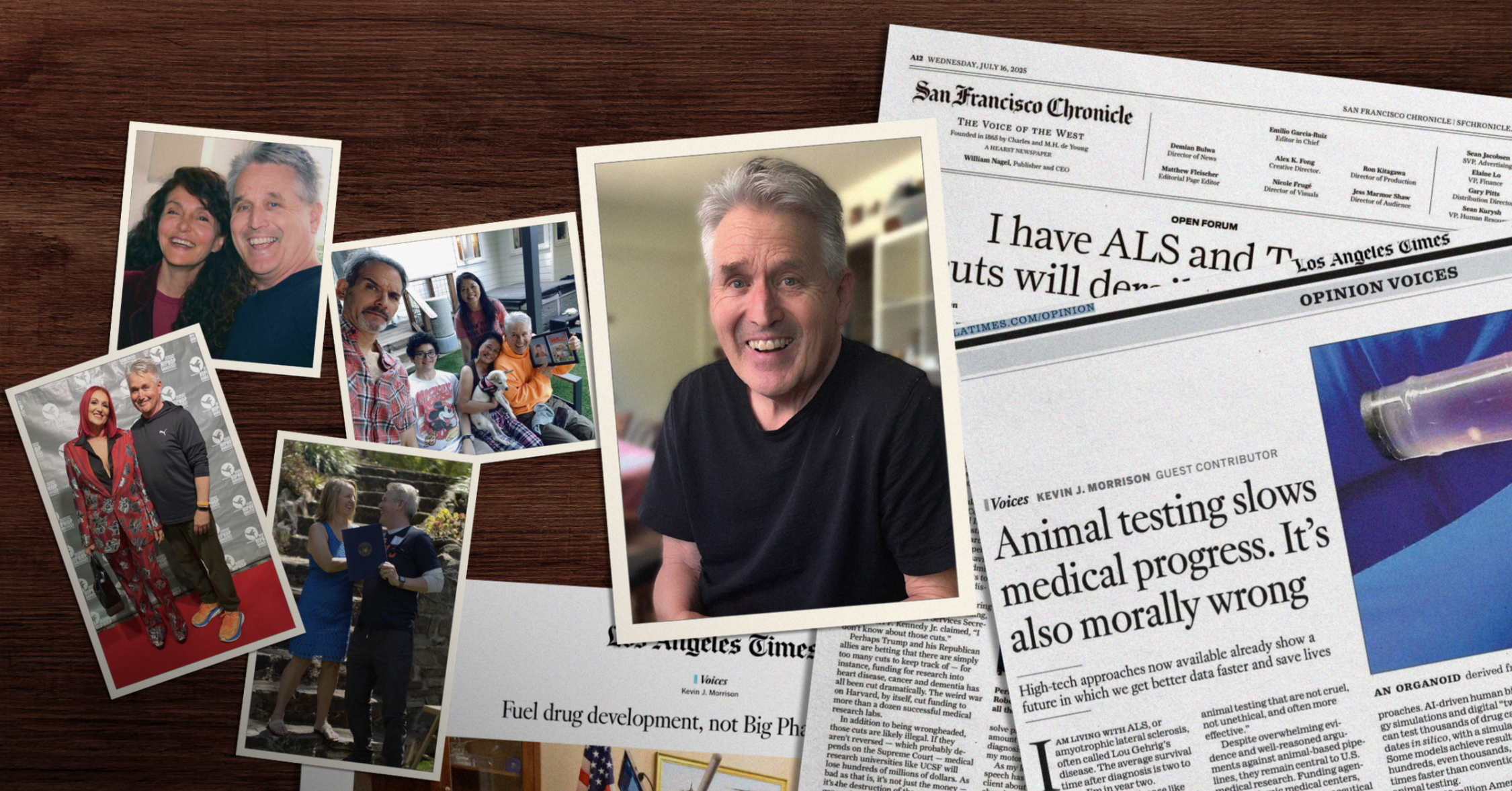
Kevin James Morrison is living with ALS—and using his voice to challenge the systems that delay progress for patients while continuing to harm animals. In this interview with Rise for Animals, Morrison reflects on his diagnosis of amyotrophic lateral sclerosis, the limits of animal-based research, and why the future of medicine must be rooted in human biology, evidence, urgency, and compassion.
Rise for Animals: You’ve written candidly about living with ALS. Before your diagnosis, what were your views on animal experimentation in medical research? Have those views changed?
Kevin James Morrison: I grew up in the 1960s with an expectation that science and technology would solve all problems. We went to the Moon. We transplanted hearts. There was nothing we couldn’t do, no problem we couldn’t fix. This translated into a wrong-headed feeling of entitlement. Whatever the cost in terms of animals, it was worth it. We were curing all the problems of the world, and at some point they would all be solved.
Also, I also grew up Catholic, and the concept of “dominion” was taught every day. Men were given “authority over the fish of the sea, the birds of the air, and all living things on earth.”
By the time I figured out that animal suffering was no different than human suffering, I was also deeply disillusioned with the Establishment in general and its promise of a better world. A better world for whom, and at what cost?

You’ve pointed out that the average survival time after an ALS diagnosis is two to five years—and that you are in year two. Why do you choose to use this precious time advocating for human-centric research?
Morrison: I live in the now. It’s essential for finding joy and meaning in my life. I accept the present as it is, I focus on what I can control, and I appreciate every moment rather than dwelling on the past or worrying about the future.
That said, it’s important to look forward to a better world. I look forward to a time when animal testing and factory farming are ended. I can see it ending. I can visualize a world where it has ended.
I can also visualize the world where ALS is reversible. Because it’s not impossible. We just haven’t seen it yet.

Challenging the Status Quo
How do you view the justification that animal experimentation is necessary for human benefit, particularly when more than 90% of drugs that appear safe and effective in animals fail to translate to people?
Morrison: The word “justification” is inappropriate here. There is no justice in doing something unnecessary, especially something cruel and immoral. But people believe demonstrably wrong and dangerous stuff, because they are used to it. Animal experimentation is what we are used to. It’s a familiar methodology that diverts time and resources from better, faster, cheaper human- and technology-centric methodologies.
Public debate around animal experimentation is often presented as a false choice between helping patients and protecting animals. How do you convince people that winding down animal testing is not anti-science—it is pro-patient, pro-ethics, and pro-progress?
Morrison: Most people don’t know there are better, faster, cheaper alternatives to animal testing. They don’t know because Big Pharma is a powerful force, with allies in academic research institutions, patient advocacy groups, “dark money” political groups, insurers, and hospitals. They prefer to maintain business as usual, and unfortunately that means animal testing.
Most people also don’t know that two of the biggest medical success stories in history depended on human-centric drug development. In the 1990s, AIDS activists demanded that drugs move more quickly into human testing, because AIDS patients were dying before animal trials finished. Waiting for lengthy animal testing and traditional trial phases meant losing lives, and people with AIDS were willing to accept higher risks. Groups like ACT UP argued that risk tolerance should be different for fatal diseases. A common activist argument was simple: “We are dying now. We don’t have time to wait.” They were right, and activist pressure led to major changes, including accelerated approval pathways, surrogate endpoints (like viral load), and expanded access programs.
The other major medical success story was the development of Covid vaccines. Again, moving to human testing was key. Phase 1 → safety, Phase 2 → dose finding, and Phase 3 → efficacy overlapped, with human testing in every phase.

Many argue that moving away from animal models is “too slow” or “too new.” From your perspective, isn’t the current, failing system actually the slower path for patients who live with a chronic or fatal disease?
Morrison: Yeah, that’s just ignorant.
Let’s talk about money in this industry. Who benefits from the continuing use of animal research methods, and how does greed protect the status quo?
Morrison: I believe the money is key. The animal testing ecosystem is a multi-billion dollar business involving animal breeders, training organizations, facility designers, equipment suppliers, transport companies, veterinary services, compliance consultants, genetic engineering firms, and more. I liken it to Big Oil and the business of transportation. Sure, Big Oil makes money on gas and diesel. But that money is peanuts compared to the infrastructure—every gallon sold supports, pipelines, refiners, traders, marketers, financiers, and governments collecting taxes and fees all along the chain. Automakers make money selling cars. But around that business is lenders, insurers, repair shops, parking operators, and more.
Looking Forward
What specific human-based research approaches—such as patient-derived cells, organoids, organs-on-chips, computational modeling, and other new human-centric methodologies—give you the most hope right now?
Morrison: If I had to choose the most transformative combination, it would be: patient-derived iPSC models, organs-on-chips, AI-driven analysis, and adaptive human clinical trials.
Together, these technologies create a pipeline that starts with real human biology, generates mechanistic insights in human tissues, and rapidly tests hypotheses in people. That is a fundamentally different paradigm from the traditional model of discovering a therapy in animals and hoping it translates to humans.

If you could speak directly to US lawmakers, NIH leaders, and major research funders today, what is the single most important shift you would urge them to make?
Morrison: Stop treating human-centered research as a niche alternative and make it the default starting point for biomedical research.
For decades, much of our research system has been built around models that often fail to predict what happens in actual patients. Today we have the tools to do better: patient-derived cells, organoids, organs-on-chips, advanced imaging, AI-powered analysis, real-world patient data, and innovative clinical trial designs. These technologies allow us to study disease in human biology from the outset, not as an afterthought.
The most important shift is not simply funding more research. It is changing what we fund first. Every federal agency, grant program, and research institution should ask a simple question: What is the most scientifically rigorous human-relevant approach available to answer this question?
If we prioritize human-centered methods, we can accelerate discovery, reduce costly failures, make better use of taxpayer dollars, and most importantly deliver treatments to patients faster. For people living with ALS, Alzheimer’s, Parkinson’s, cancer, and thousands of rare diseases, time is not an abstract concept. Every year lost to ineffective research pathways is measured in lives.

The Rise for Animals community advocates for cures without cruelty. What message do you have for all of us?
Morrison: To everyone in the Rise for Animals community:
Never lose sight of why this work matters. At its heart, this movement is not only about reducing animal suffering. It is about building a research system that delivers better answers, faster answers, and ultimately more treatments for the people waiting for them.
For generations, patients with ALS, Alzheimer’s, Parkinson’s, cancer, rare diseases, and countless other conditions have been told to wait. Wait for the next breakthrough. Wait for the next clinical trial. Wait for the next generation of therapies. Yet too many promising discoveries never reach patients because the models we rely on often fail to predict what happens in actual human beings.
Today, we have an unprecedented opportunity to change that. Patient-derived cells, organoids, organs-on-chips, advanced computational modeling, AI, and innovative clinical trial designs are giving scientists new ways to study disease directly in human biology. These tools are not science fiction. They are real, they are growing more powerful every year, and they offer a path toward research that is both more humane and more effective.
The goal is not simply to replace one method with another. The goal is to build a future where scientific excellence and compassion move forward together. A future where cures are discovered faster because we are studying the biology that matters most: human biology.
The challenge before us is significant, but so is the momentum. Every researcher, advocate, patient, caregiver, policymaker, and supporter has a role to play. Progress happens when people refuse to accept that the way things have always been done is the way they must always be done.
The future of medicine should be defined not by tradition, but by evidence. Not by inertia, but by innovation. And not by choosing between compassion and scientific progress, but by recognizing that the best science and the most humane science increasingly point in the same direction.
Let’s continue building that future together.
Share this interview on Facebook, X, or Bluesky
About Kevin J. Morrison: After a career advising CXOs and global thought leaders in finance and high tech, Kevin J. Morrison has been a communications strategist for nonprofits. Diagnosed with ALS in early 2025, he continues to work with environmental nonprofit Cool the Earth, arts nonprofit Micaya Presents, and animal media advocacy nonprofit DawnWatch, while building awareness and investment in ALS research and patient support.
