Recently, we exposed how countless nonhuman animals are traumatized in the name of failed—and failing—research into human post-traumatic stress disorder (PTSD).
Now, we’re joined by Animal Partisan in pulling back the curtain even further.
Behind the Language of Violence
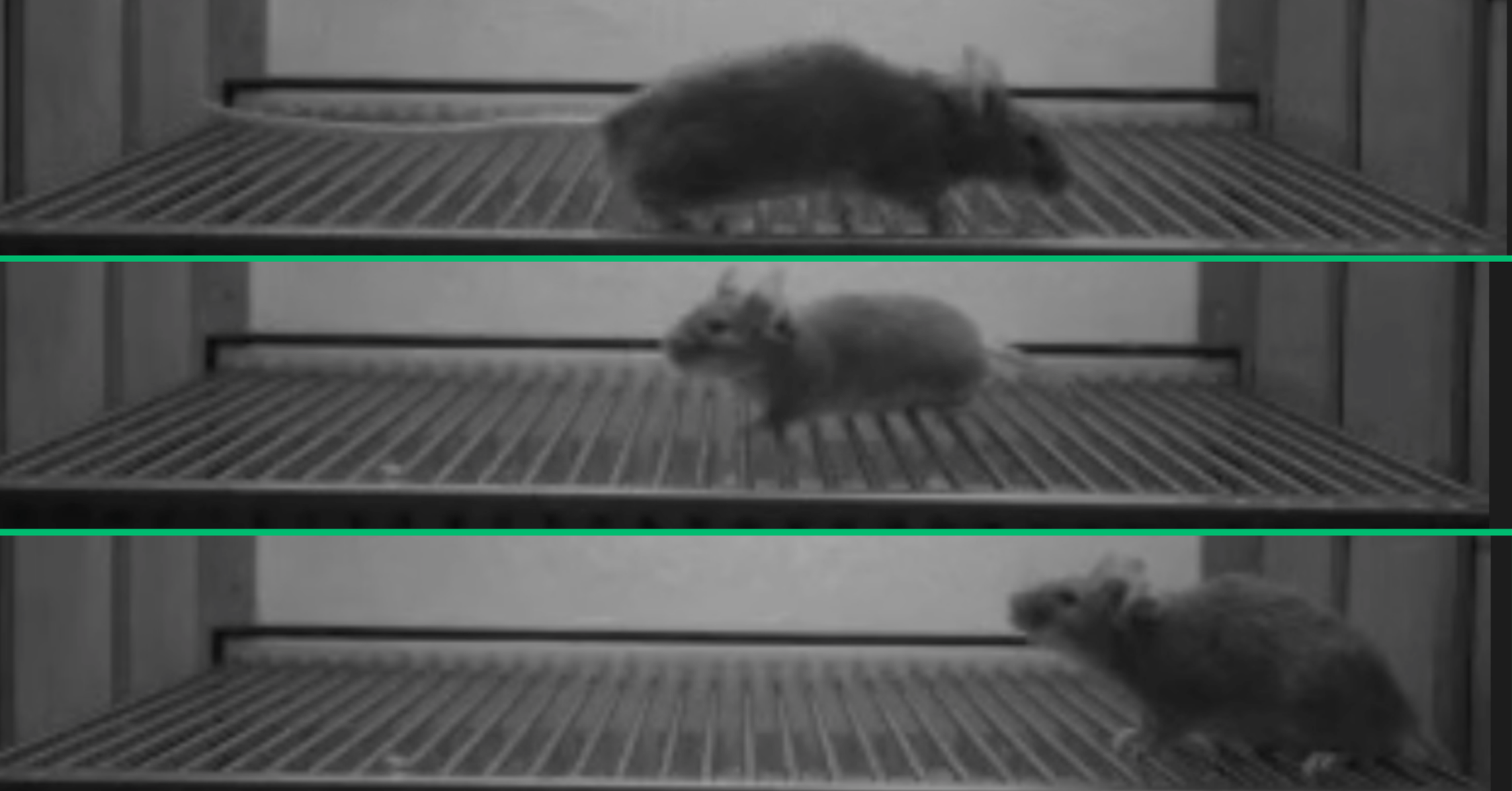
Animal Partisan has obtained and shared with Rise for Animals videos from a foundational experiment of the type that underpins much PTSD and similar animal research.
The study—conducted at the University of Texas and published in Neuropsychopharmacology under the sterile title Extinction training suppresses activity of fear memory ensembles across the hippocampus—reads as dense, technical, authoritative. And, that’s by design.
The heavy jargon doesn’t clarify the experiment—it insulates it. It signals complexity and specialization, implying that what follows must be sophisticated, important, and beyond question.
It also abstracts violence:
Breeding becomes “generat[ion].”
Electric shock becomes “contextual fear conditioning.”
Killing becomes “tissue collection.”
The jargon creates distance, not understanding—and that’s exactly the point. Because, when you strip away the vocabulary, what remains is simple: Taxpayer-funded scaring, electroshocking, and killing of animals.
What the Researchers Actually Did
In this experiment, researchers subjected mice (12-15-weeks-old and genetically-engineered) to electric foot shocks delivered through the floor of “conditioning chambers.” After they were “fear conditioned,” some mice were returned to the same chamber for ten consecutive days—re-exposed to the context in which they had been harmed—while their immobility (labeled “freezing behavior”) was recorded as a proxy for fear. Other mice were returned to the chamber only once more, for a final session.
After the last session, each victim was killed.
Some had their chests opened and their blood flushed from their bodies. Others had their heads cut off, and their brains “extracted” and processed for analysis.
In the journal paper that followed, researchers presented this experiment as acceptable, meaningful neuroscience: a supposed stepping stone toward understanding fear-related disorders like PTSD.
The False Comparison to Human Trauma Care
To be clear, this study does not claim to model PTSD itself. But the researchers do explicitly frame their work as relevant to PTSD and other fear-related human conditions.
One of the most recommended treatments for PTSD in humans—a condition characterized, in part, by persistent and intrusive fear memories—is exposure therapy. It involves the voluntary and structured revisiting of trauma reminders in safe conditions, with informed consent, therapeutic support, and cognitive processing. “Extinction,” in this human context, refers to the gradual reduction of fear responses when trauma-associated cues are repeatedly encountered without danger.
Somehow, researchers want us to believe that the traumatization of genetically-engineered, imprisoned, controlled, and coerced mice is a comparable fear “extinction” process.
Only it’s not.
Even the Researchers Admit the Limits
Even the researchers themselves admit that their core conclusion (about why some mice froze less during the final “test”) comes with critical limitations.
Researchers concede that the observed cellular differences could reflect differences in behavior (freezing versus mobility), rather than fear suppression itself.
They acknowledge that it was impossible to determine whether the observed cellular differences were caused by extinction training or were actually pre-existing.
They report discrepancies between chemical findings, note the limited statistical power in certain cell-specific analyses, and raise the possibility that “spontaneous representational drift” in certain brain cells could account for some of the observed changes.
Yet, they leave unexamined the most fundamental limitation of all: For a human, extinction-based therapy is an intentional and supported process. It involves awareness, consent, cognitive engagement, and the restoration of agency. For a mouse trapped in a lab, “extinction” consists of intentional trauma, followed by forced exposures, and, finally, by the ultimate loss of agency: death.
The System Depends on Endless Suffering
Exposure therapy can work in humans because we are willing participants and know we are safe. Because we understand what we’re doing and why. Because we’re supported in reinterpreting meaning and regaining control. None of this is true for the mice victimized by the University of Texas.
To present these processes as meaningfully analogous is nothing more than reductionism stretched to absurdity.
The University of Texas experiment is not an example of human-centered trauma research. It is, however, a clear illustration of how animal experimentation sustains itself.

Even the study’s self-acknowledged problems—the speculative interpretations, the unanswered questions, the technical caveats—do not slow the field. They propel it.
Each limitation becomes a rationale for “further investigation”—more funding, more experiments, more victims—as even confirmed by those who have spent decades as part of the cycle:
Every success or failure in the lab raises challenging new questions, and those questions often lead to yet more animal experiments . . . Through a scientist’s eyes, every new discovery raises dozens of new questions to investigate.
To a critic’s eyes, when those dozens of questions call for further experiments on thousands of animals, the obvious question is when does it ever end.
That is the question, indeed: Not whether mice freeze less after repeated shocks—but why we are still permitting and paying researchers to shock them at all.
Your Call to Action: Tell your U.S. legislators to support the SPARE Act, a bill that aims to end federally-funded animal research. If the SPARE Act is passed into law, it will prohibit biomedical, cosmetic, toxicity, and psychological testing on animals in federally-funded labs and mandate a three-year phase-out of existing animal experiments.