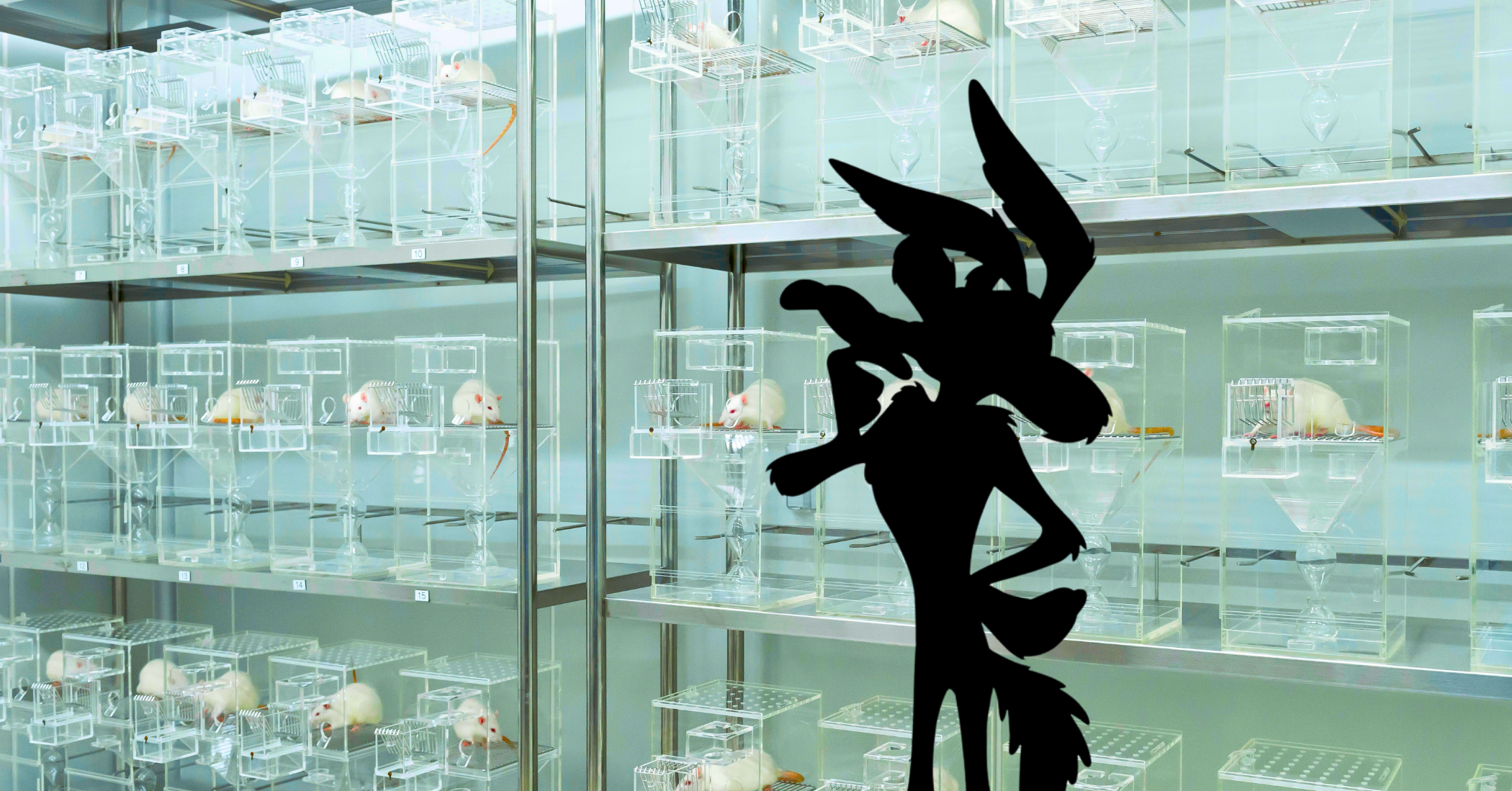
Wile E. Coyote gets his day in court in the newly-released blockbuster Coyote vs. Acme, and the case he builds turns out to be less about faulty product design than about a covert animal-testing program Acme spent years covering up.
A Family Comedy Unpacks a Covert Testing Program
Coyote’s attorneys discover that the Acme corporation ran Project Sisyphus, a program Time Out summed up accurately as “a hideous cartoon vivisection conspiracy.”
Project Sisyphus began as an internal Acme operation that used the company’s own cartoon employees—who can famously survive falls, explosions, and other violence that would kill anyone else—to test the safety of products before they entered the human market. The tests physically brutalized the cartoons and even drove some of them—including Daffy Duck—insane. When the Acme scientist running the program tried to blow the whistle, the company silenced him.
Over time, the program expanded past company walls: Acme started selling faulty, dangerous products directly to unsuspecting cartoons outside the company—like Wile E. Coyote—purely to gather field data on products it already knew would cause harm.
Cartoons were exploited as test subjects partly because of their “general lack of power in society”—and, ultimately, in service of Acme’s human customers.
Sound familiar?
The Company Confesses On the Record
At the Congressional hearing that forms the film’s climax, Acme CEO Foghorn Leghorn admits, on the record, that Acme experiments on cartoons and that its products cause them real, repeated harm. Then he explains why that’s supposed to be acceptable: the harm is deemed necessary for progress; cartoons can endure it; and victims like Coyote don’t matter enough for any of it to count, because no one cares what happens to them.
That reasoning isn’t unique to Acme—it’s a backbone of the real animal research industry.
Part of the justification for using animals in place of humans is the assertion that nonhuman animals simply matter less—that what could never be done ethically to a human becomes ethical when the subject is a different species.

Even among those different species, value judgments are made. Sentient creatures like mice and rats, not even considered “animals” under the law, are used in far greater numbers than animals like dogs and cats, at least partly because they don’t command the same public sympathy, or outrage.
And underneath this strategic exploitation sits another reality brought to screen by Coyote: animals in labs can’t object to their exploitation in a language the human-dominated system is built to hear—so their resistance is rarely recognized for what it is. Throughout the film, Coyote communicates only through hand-lettered picket signs and physical expressions; he can’t make his case in the language the tribunals run on, so he must rely on humans to speak for him—just like all animals in labs.
Change Doesn’t Come From the System
Ultimately, despite Foghorn’s admission, Congress declines to take any action against Acme. It isn’t until later—when more cartoons show up with grievances of their own and Bugs Bunny, a whistleblower with inside knowledge of Acme, leaks enough evidence to finally trigger a federal investigation—that Foghorn and Acme’s head legal counsel are arrested.
The formal legal process didn’t deliver justice. Public exposure and joint public action did.
Multiple reviewers have read the film as arguing that corporations, and the people who run them, will exploit whoever they can get away with exploiting for financial gain— and that the only way to stop them is by changing public perception.
Changing public perception, in turn, requires exposing the truth—again and again—until it can’t be ignored. Losing the case in court didn’t stop Coyote’s effort from working in the long term; it just meant the fight had to continue outside the courtroom.
That’s persistence, and the film centers it in Coyote himself long before the change he ultimately helps bring about.
Coyote’s lawyer describes him as approaching each day with both purpose and hope, despite having never yet achieved his goal. Indeed, Coyote displays the very persistence, day in and day out, that the film suggests it takes to bring down entrenched power: change doesn’t happen all at once, or on any predictable timeline, but it does follow from the choice to show up over and over again.
Coyote vs. Acme is fictitious. But what it depicts isn’t.

Humans, including those in the animal research industry, exploit whoever they benefit from exploiting, and whoever they’ve decided doesn’t matter enough to protect. And it will take exactly the persistence Coyote vs. Acme is built around—sustained pressure and repeated exposure—to change that.
Coyote never lets failure cost him his hope or his purpose. In our fight against animal experimentation, neither can we.
Take a look at the real version of Project Sisyphus’s filing cabinet: ARLO, Rise for Animals’ own, searchable database of animal research records. Search it, share it, and use it to join us in the hopeful, purposeful, and persistent fight to free all animals from all labs.