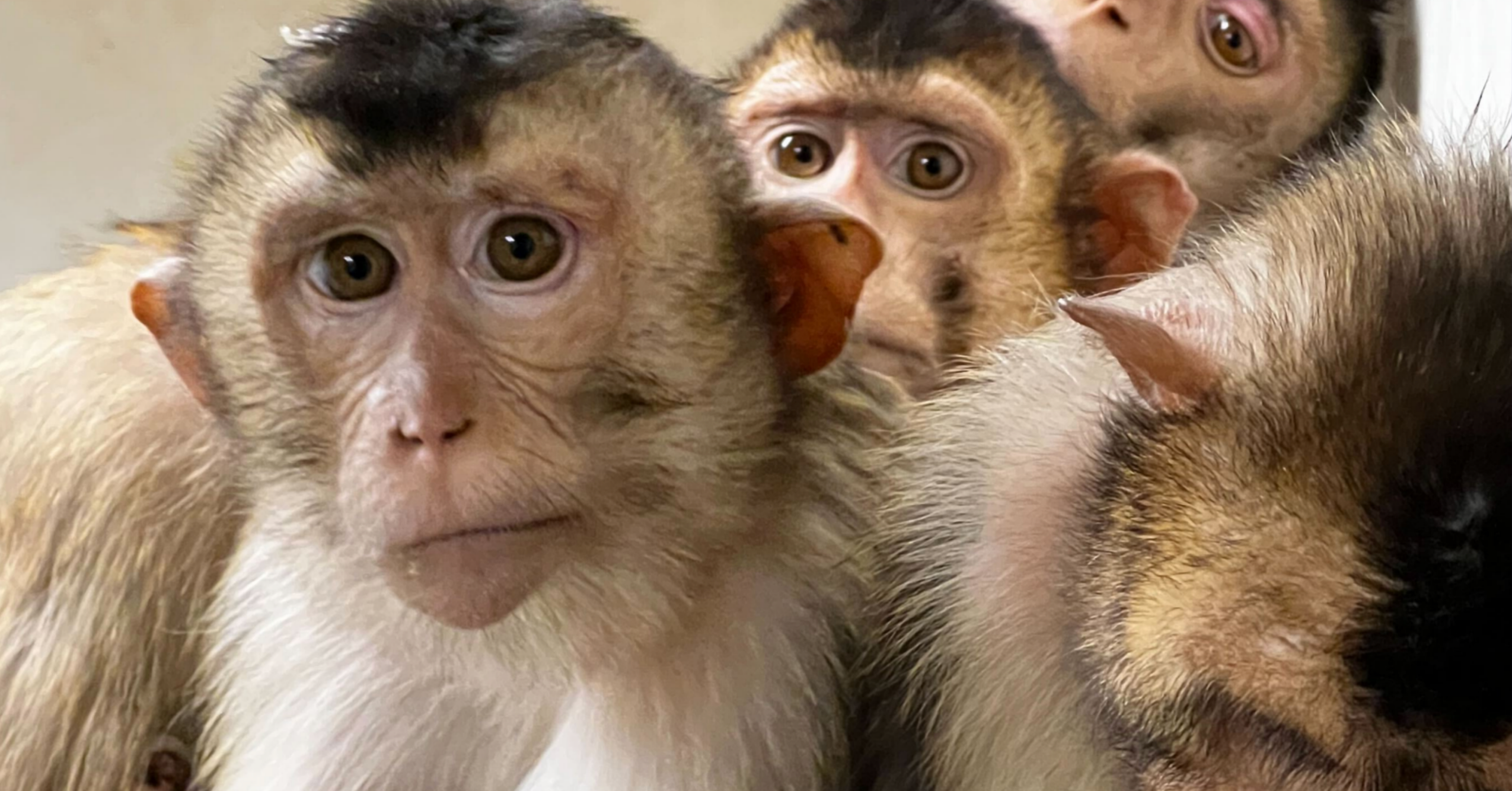
In late 2025, the Centers for Disease Control and Prevention (CDC) announced that it would end its in-house experimentation on nonhuman primates and seek to retire its survivors.
For the monkeys still trapped in CDC cages, that decision offered a chance to escape the animal research industry’s grasp and move beyond its reach once and for all—something the industry could not abide.
In May 2026, CDC announced plans to retire up to 162 rhesus and pigtail macaques by transferring them to Born Free USA, an accredited primate sanctuary in Texas with experience caring for monkeys who have survived laboratories.
Retirement and sanctuary are related, but distinct: Retirement should end the monkeys’ use for breeding, experimentation, and any other exploitative purpose within the animal research pipeline. Sanctuary should give them a permanent home organized around their own care and interests—not those of the institutions that exploited them.
CDC’s plan offered both: an end to the monkeys’ use as research tools and a permanent home outside the industry’s control.
Animal researchers erupted.
They attacked CDC’s decision to stop experimenting on primates, predictably warning that moving away from monkey research would threaten human health. When CDC moved ahead with its sanctuary plan anyway, the industry changed tactics. Research representatives challenged the proposed placement and promoted forms of “retirement” that would keep the monkeys within industry control rather than offer them sanctuary. They also cast animal researchers as indispensable to the monkeys’ future care.
The monkeys, industry representatives insisted, must not be allowed to reach sanctuary at Born Free USA—for their own good.
Animal Researchers Oppose Sanctuary Placement
On May 27, 2026, six of the National Primate Research Centers (NPRCs) and more than 15 allied “biomedical organizations”—including industry propaganda machine Americans for Medical Progress—sent a letter to CDC expressing “serious concerns regarding the CDC’s plan to retire” monkeys to Born Free USA.
In a perversion of reality characteristic of this industry, the letter presented members of the “biomedical research community” as authorities on “research-animal retirement.” The NPRCs and their allies attacked CDC’s description of how Born Free USA would receive, introduce, and house the monkeys—effectively asserting that their own judgment should override that of an experienced primate sanctuary.
Animal research facilities exist to experiment on animals. They do not offer their victims sanctuary; rather, they are the very institutions creating the need for sanctuary in the first place.
Even so, the NPRCs and their allies attempted to cast themselves as experts in the monkeys’ transition—and as guardians of their welfare and safety. The Washington National Primate Research Center (WaNPRC), for example, reportedly hoped to “retire” the monkeys to its primate breeding facility in Mesa, Arizona—the same operation that had previously housed many of them and the same place where a baby monkey was recently taken from their mother and placed in a cooler alive.

The WaNPRC’s proposal illustrates the problem at the very heart of the industry’s campaign: it uses the language of retirement while preserving research-industry control and denying the monkeys sanctuary.
The industry letter also claimed that Born Free USA lacks the expertise and resources needed to care for the monkeys properly. In doing so, the NPRCs and their allies described monkeys who have spent much of their lives singly- or pair-housed and warned that they may struggle to form stable social relationships.
In other words, the industry pointed to specialized needs created in large part by animal research practices, and then invoked those needs as reasons the monkeys should remain under industry control.
First, laboratories isolate and traumatize their victims. Then, the industry uses that trauma to justify keeping hold of them.
The Industry’s Accreditation Double Standard
Born Free USA is accredited by the Global Federation of Animal Sanctuaries (GFAS), a nonprofit organization that establishes standards of care and accredits animal sanctuaries. CDC selected Born Free USA as a GFAS-accredited sanctuary that could receive the monkeys, and GFAS has described Born Free USA as an “‘exemplary facility.’”
The animal research industry dismissed CDC’s reliance on GFAS accreditation as providing “little meaningful reassurance,” in part because GFAS inspection reports are confidential and unavailable to the public.
The industry’s newfound concern about confidential accreditation is deeply hypocritical.
Animal research institutions routinely promote accreditation by AAALAC International, a private organization whose materials are also hidden from public view. The industry treats AAALAC accreditation as proof that the public should trust accredited laboratories—even though they are responsible for the majority of the most serious animal welfare violations documented by USDA.
Apparently, confidential accreditation becomes suspicious only when it supports animal sanctuary, not animal exploitation.
“Retirement” Without Freedom
The NPRCs’ letter also claimed that “at least two USDA-regulated organizations (that exceed GFAS standards) expressed interest in retiring the monkeys.” Yet, it did not identify those organizations, explain how they purportedly exceed GFAS standards, or describe what they meant by “retiring” the monkeys.
Those omissions are telling—especially because Alpha Genesis appears to be among the organizations seeking control of CDC’s monkeys.

Alpha Genesis is a commercial primate breeder, supplier, and animal research contractor—with a long history of documented animal welfare violations, harrowing whistleblower reports, and an active interest in stockpiling supposedly “retired” monkeys. A few days after the NPRC letter was sent to CDC, Alpha Genesis reportedly filed a complaint with the U.S. Government Accountability Office (GAO) challenging CDC’s decision to transfer the monkeys to Born Free USA. The exact contents of that complaint remain unknown while Rise for Animals awaits a response to a records request, but Alpha Genesis made its objective clear in reporting by Science:
Alpha Genesis wants to take control of CDC’s monkeys “to keep them in biomedical research, if only as breeding stock.”
According to Alpha Genesis, these monkeys represent an “‘invaluable domestic resource’” that would be “‘forever lost to U.S. researchers’” if meaningfully retired and sent to sanctuary.
There it is: beneath the industry’s language of “retirement” lies its real objection to sanctuary—the loss of control over animals it still regards as financial assets.
Alpha Genesis is not offering retirement, much less sanctuary. A monkey retained as a “resource”—whether for breeding, future research, or any other industry use—has not been retired.
Keeping the monkeys available to industry is the point of Alpha Genesis’ proposal. As we have previously documented, Alpha Genesis promotes “retirement” as a way to keep monkeys within the “research ecosystem” as “biological resources” available for future exploitation, including experimentation.

Alpha Genesis also presents its proposal as an economical option, asserting that it could take CDC’s monkeys immediately and for less than $100,000—or, in the words of its president, “‘basically . . . for free.’” That price itself reveals the nature of the proposal: Alpha Genesis can offer cheaper custody because it is offering neither retirement nor sanctuary.
Its existing cages, staff, and industrial infrastructure reduce the cost precisely because they preserve the very system the monkeys are supposed to be escaping.
The Industry Has Stalled Their Freedom
On the heels of the NPRCs’ letter and Alpha Genesis’ complaint to the GAO, CDC stepped back from its original plan and announced an “open-market” solicitation for facilities interested in taking the monkeys.
At a minimum, then, the animal research industry has delayed the monkeys’ escape from its control.
And it did so while declaring that the monkeys’ “welfare . . . must be the overriding priority in any retirement decision.”
The welfare of these monkeys has never been an overriding priority for the institutions behind that declaration. Had it been, the monkeys would not be where they are now.
The NPRCs and their allies are part of the very system responsible for the monkeys’ confinement, exploitation, and present need for sanctuary—and for the physical, psychological, and social injuries now being used to argue against their release.

The Monkeys’ Future Hangs in the Balance
The outcome of CDC’s solicitation will help determine what comes next for its monkeys: genuine retirement in sanctuary, or continued control and exploitation by the research industry.
While that process unfolds, animal researchers are working hard to redefine the terms of the debate: to make continued incarceration and exploitation look like retirement, commercial breeding and research facilities sound like places of refuge, and the liberation of animals from human exploitation seem like a threat to everyone—including the animals themselves.
Once again, the animal research industry is showing us exactly what it is.
When a federal agency moved to end experimentation and remove its surviving victims from the research pipeline, the industry fought to keep control. It shifted the conversation from what had been done to the animals—and what should now be done for them—to what the industry itself stood to lose. Then, it grotesquely wrapped its self-interest in the language of expertise, responsibility, and welfare.
So let’s be clear:
The animal research industry’s expertise lies in creating victims who need liberation and sanctuary.
Its responsibility lies in the suffering inflicted on sentient beings like CDC’s monkeys.
And the welfare it protects is that of its own institutions and individuals—whose funding, influence, and careers depend on continuing to treat animals as resources.
Share on Facebook, X, or Bluesky
About the Author: Lindsey Soffes is Head of Programs at Rise for Animals. She holds a law degree from William and Mary Law School and has spent her career advocating for the rights of all animals—both human and non-human.