U of Cincinnati Bought Dogs to Cut Out Their Voice Boxes
Earlier this year, the University of Cincinnati (UC) bought dogs from Oak Hill Genetics for research funded by the National Institutes of Health (NIH).
These dogs were fatally injected immediately upon arrival at the University, then cut open—and apart.
UC Bought the Dogs as Sources of Voice Boxes
The dogs were killed for parts. Specifically, their larynxes.
The protocol to which they were assigned names its lone experiment the “Excised canine larynx model”—and it is blunt about what that means for the dogs:
Canines will be used as a non-survival source of larynges….
All procedures are terminal. Animals will be sedated and euthanized . . . The larynx will be immediately excised and used for acute ex vivo experiments.

According to the protocol, the “goal” of the research was to benefit humans: specifically, to improve “outcomes for patients with vocal fold paralysis.”
Dog Parts Were Used as Surrogates for Human Parts, Even Though They Differ in Critical Ways
The researchers insisted that the dogs were required for the research, even while conceding structural, or “morphological,” “differences between canine and human larynges.”
They also dismissed the use of human tissue on the grounds of “limited availability.” Yet a published study the protocol cites to justify using dogs, “Comparison of Aerodynamic and Elastic Properties in Tissue and Synthetic Models of Vocal Fold Vibrations,” used three human larynges from body donors alongside six canine larynges—and it reported that the canine larynx, “being 40% larger and requiring higher phonation pressures,” would “necessitate adjustments to the experimental parameters, potentially complicating the direct comparison to human phonation.”
In plain terms, findings from research on dog larynxes cannot be expected to translate to humans because dog and human larynxes differ in fundamental ways.
And, indeed, translation may not have been the researchers’ primary motivation for choosing dogs anyway. Elsewhere in the protocol, the researchers offer:
Continued use of the canine model ensures consistency with prior data and enables direct comparison across studies.

There we have it, in animal researchers’ own words: a driving reason animals are used in experiments is because they have been used before.
Further evidence for animal research begetting animal research.
The Dogs Were Described as Products
The protocol called for 14 dogs, described only as “purpose bred, mixed breed, >1 year old, >20kg, either sex.”

Oak Hill Genetics, the country’s second largest breeder of dogs for research—whose victims we’ve documented before—supplied at least six of the 14 dogs. Its packing slips list them, beside a redacted “Item Code,” as a “Female Research Dog 20.0+ kg,” and its invoices assign each a “Unit Price” of $1,477.00.
Oak Hill’s own courier service delivered them to UC in pairs in February, March, and August.
UC Killed the Dogs Immediately Upon Their Arrival
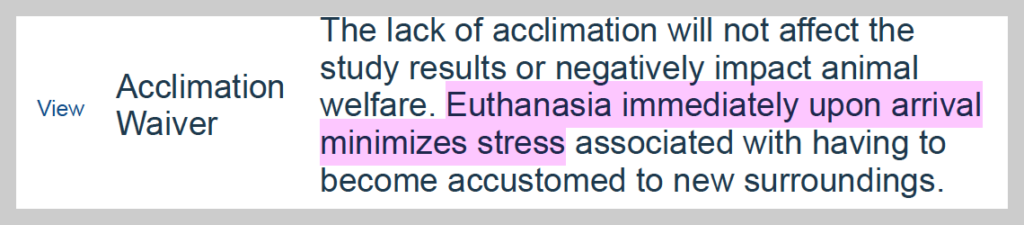
Normally, dogs delivered to UC would be given some time to settle in, but the researchers asked to skip that step for these subjects. In their “Acclimation Waiver,” they wrote that “[t]he lack of acclimation will not affect the study results or negatively impact animal welfare,” because “[e]uthanasia immediately upon arrival minimizes stress associated with having to become accustomed to new surroundings.”
Only in animal research can killing a dog the moment she arrives in a lab’s care be filed under her welfare.
UC’s Records Show How Literally “Immediately” Was Meant
UC records show the dogs were sedated as soon as they came off the transport truck, and, once the sedation took full effect, they were killed through injection with a euthanasia solution. Records suggest that all of this happened within a matter of minutes.
One female dog, for example, was charted as arriving at 8:40am, being sedated at 8:43am, and being injected with a fatal solution at 8:57am.
She was killed within 17 minutes of arriving at the University.
Once dead, the dogs’ bodies were taken to “necropsy,” where a “bilateral thoracotomy” (an incision opening both sides of the chest) was performed as a “secondary euthanasia method,” followed by collection of their “tissue.”
The Dogs Were Known Only by Inventory Numbers
Victims of this protocol were identified only by their Oak Hill Genetics IDs:
F526
F614
F615
F833
G004
G335
All six were female hound mixes (“Hound X” on their veterinary certificates, “Mongrel” on UC’s order forms): tri-colored, brown, and black-and-tan, weighing between 47 and 60 pounds. The youngest appears to have been seven months old, and none appear older than 1.5 years.
Two of them arrived with scars on their legs.
One had been previously treated for a laceration and another for “Fight/bite wounds.”
And another had suffered from an ear infection the last week of her life.
F526, F614, F615, F833, G004, G335 were bred to be exploited, sold for the purpose of “Research,” and dead within minutes of arriving at their destination.
Oak Hill claims to raise “happy healthy animals for biomedical research”—these six among them—while UC’s protocol identifies each dog as a “source” of research materials. Between the breeder’s marketing and the researchers’ paperwork, the dogs themselves disappear.
But we see them for who they were: not products or parts, but individual victims of an industry that values animals only for what they can be sold for and what can be done to them—including what can be cut from their throats.
Records like these are the only reason we know these six dogs’ stories. Explore thousands more animal research records in ARLO, our free, searchable database.
Explore Animal Research Records