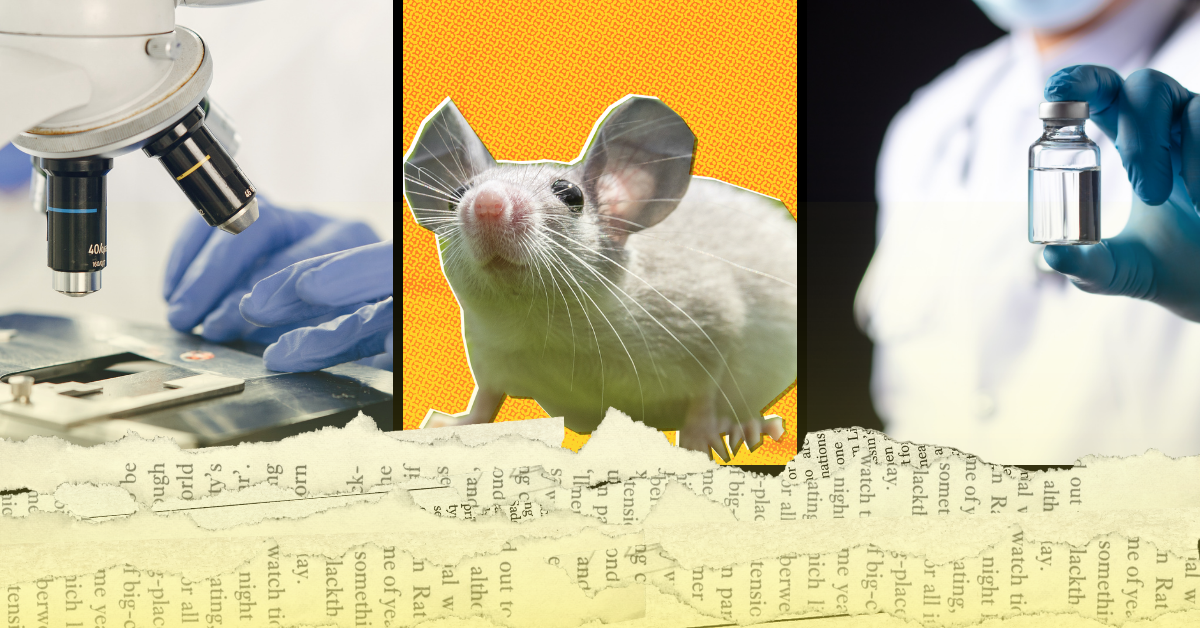
While the animal research industry continues to breed, buy, cage, torture, and kill sentient beings, progressive scientists are busy proving that human-relevant science is not only possible but, in fact, better for us all. Highlights in science from the last month are below.
Global regulators call for advancing alternatives to animal testing across the medicine lifecycle
European Medicines Agency, 10/01/2026
“EMA has endorsed a joint statement from the International Coalition of Medicines Regulatory Authorities (ICMRA) calling on medicine developers, manufacturers, regulators and national control laboratories to continue to advance and implement alternative methods or approaches to animal testing throughout the lifecycle of human medicines, wherever, and as soon as possible.”
“The development of the joint statement was led by EMA, the UK Medicines and Healthcare products Regulatory Agency (MHRA), the Irish Health Products Regulatory Authority (HPRA) and Swissmedic, the Swiss Agency for Therapeutic products. Adopted by the ICMRA plenary, the statement sets out the long-term goal of replacing animal testing throughout all stages of a medicine’s lifecycle: from initial candidate screening and early development, through pre-clinical and non-clinical testing to licensing and post-authorisation activities.”
“The ICMRA statement acknowledges that different regions and countries will move at different paces to accept a transition towards drug development, licensing and batch release without testing in animals. ICMRA encourages medicines manufacturers, developers and regulators to work together to enable this progressive paradigm shift, and to support harmonised implementation as much as possible.” 📰 Full Story →
Aelius Biotech: reducing animal use in product testing
UK Research and Innovation, 10/05/2026
“Testing how foods and medications behave during the processes of digestion and absorption is a critical step in the development of these products. . . . To gain this information, one method is to use animals as models in digestion studies. However, there are big differences between animal and human digestive tracts which can hinder translatability. This, as well as ethical concerns associated with animal use in science means that new models have been sought.”
“Researchers at Newcastle University . . . have developed an advanced lab model that more accurately mimics the complexity of human digestion by modelling digestion and absorption together for the first time. The team have shown their model correlates strongly with human clinical data, demonstrating the absorption model’s predictive capability. Significantly, the model does this without the need for animal testing, marking a step forward in our ability to conduct product testing without using animals.”
“The technology is now on offer through the university spin-out Aelius Biotech. With their technology, Aelius is helping the food and pharmaceutical industries to produce and refine products, and to make decisions about product testing. This doesn’t just mean a cheaper alternative to animal testing for industry. It means quicker delivery of new (and improved) products that can boost public health and the UK economy.” 📰 Full Story →
Intero Biosystems wants drugmakers to test on mini human intestines, not animals
Kate Park, TechCrunch, 10/14/2026
“Drug development has long relied on animal models, but differences between species mean what works in animals doesn’t always translate to humans, and most drugs still fail during development. Intero Biosystems, a Denver-based startup, is developing human intestinal organoids, lab-grown tissue that mimics the gut, as another way to study how drugs and other compounds might affect the human body before they are tested in people. Researchers and pharmaceutical companies are increasingly looking for models that better reflect human biology to supplement animal testing and reduce their reliance on it.”
“Intero, which spun out of the University of Michigan, says its organoids differ from simpler models that replicate only part of the gut. They contain multiple cell and tissue types found in the human intestine, which the company believes makes them a more human-relevant model for testing drugs and other compounds . . . The startup’s flagship product, GastroScreen, is a human intestinal organoid model that it sells to pharmaceutical, biotech, food, and chemical companies for testing drugs and other compounds. Each organoid is about 1 millimeter across, and the company ships roughly 100 at a time in a tube, co-founder and CEO Charlie Childs said. Customers can use them as healthy intestinal models or induce disease-like conditions to test how the tissue responds to different compounds.” 📰 Full Story →
Inside the UC Davis Testing Center Putting Lab-Grown Organoids and AI Models to the Real-World Test
Bioengineer.org, 10/17/2026
“Organoids grown from patient cells, miniature organs-on-chips, engineered tissues and artificial intelligence models are transforming how biomedical research is done, offering scientists direct access to human biology without relying on laboratory animals. But as these New Approach Methodologies, known as NAMs, multiply across laboratories worldwide, a critical bottleneck has emerged: how do researchers actually know when one of these models is good enough for the job they want it to do? A new perspective article published in Frontiers in Medical Technology argues that the answer lies not in building more models, but in building independent infrastructure to test them, and it points to the UC Davis NAMs Testing Center as a working blueprint for how that can be done.”
“Trust, [K. C. Kent Lloyd of the Department of Surgery and Mouse Biology Program at the University of California, Davis] argues, will ultimately determine how quickly useful NAMs are adopted in biomedical research. Independent testing centers can contribute by providing comparative expertise, reproducibility testing and evidence that is separate from the developer’s own evaluation. The goal at UC Davis is a domain-of-inference statement that describes what a model can support, what remains uncertain and which evidence was used to reach that conclusion, which is far more informative to subsequent users than a general label of validated. A negative or discordant result can be genuinely valuable if it identifies a limitation before a model is used more widely. Similar testing nodes, connected through national and international networks, could provide a practical route from method development to evidence-based use, ensuring that the next generation of human-based models earns its place in the research arsenal on merit rather than on promise.” 📰 Full Story →
What will it take to trust human-relevant models in drug discovery?
Jim Corbett, Drug Target Review, 10/21/2026
“Predicting how a potential drug will behave in humans remains one of the biggest challenges in preclinical development. Conventional cell cultures cannot reproduce many features of human physiology, while findings from animal models do not always translate into patients. New Approach Methodologies (NAMs) are giving researchers more options. Organ-on-a-chip systems, advanced in vitro models and computational approaches are designed to provide human-relevant information before a candidate reaches clinical trials.”
“Interest in NAMs is growing as researchers seek more reliable ways to predict human efficacy and toxicity before compounds reach clinical trials. . . . Rather than treating human-relevant models as an additional experiment late in preclinical development, Corbett argues that they should be considered earlier, where they may help inform which compounds progress.”
“Scientific relevance alone will not drive widespread adoption. One of the main challenges facing organ-on-a-chip technology has been scalability. Early systems could reproduce aspects of human biology but often required substantial manual effort, limiting their compatibility with the throughput expected in pharmaceutical research. Reproducibility is another important consideration. ‘Researchers need confidence that results can be replicated across laboratories and that variability is driven by biology rather than differences in how experiments are performed,’ Corbett explained.”
“‘Ultimately, broad adoption depends on delivering systems that are scientifically robust, operationally practical and capable of fitting seamlessly into existing drug discovery workflows,’ Corbett said. . . . To become routine tools, NAMs will need to show that their results are predictive, reproducible and practical enough to determine which compounds move forward.” 📰 Full Story →
Scientists stunned as new AI unlocks game-changing cancer treatment
Paul Farrell, Independent, 10/22/2026
“Researchers at UCLA have designed a novel artificial intelligence system that can discover promising drug combinations to combat treatment resistance in cancer, according to a university announcement . . . . The computational platform, named MAESTRO and detailed in the journal Advanced Science, uses large language models, or LLMs, to process established scientific knowledge regarding drug mechanisms and the biological pathways malignant cells exploit to survive treatment. The system evaluates potential therapeutic pairings, ranks the most promising candidates, and generates biological explanations that researchers can subsequently test in the laboratory.”
“While artificial intelligence has shown promise in predicting successful drug combinations, many existing computational approaches require vast amounts of experimental training data and offer little insight into why specific drugs might work together. The UCLA team engineered MAESTRO specifically to overcome these limitations. . . . ‘This is where MAESTRO demonstrated its strength, helping us identify a promising combination that might have been overlooked by examining each pathway separately.’” 📰 Full Story →
Swiss startup Atlas Bio secures $12.5M to tackle drug development’s 70% failure rate and move beyond animal testing
Cate Lawrence, tech.eu, 10/27/2026
“Swiss tech-bio firm Atlas Bio today launched from stealth with a $10 million Seed round . . . bringing its total funding to $12.5 million. Atlas Bio is developing a foundational AI model to run in silico clinical trials. By simulating patient-level efficacy and safety signals before Phase II, Atlas Bio aims to de-risk clinical development, improve trial design, and support the industry’s shift toward more human-relevant evidence.”
“The company’s first-of-a-kind AI foundation model is trained on roughly 2 million RNA readouts from human tissue, the molecular signals that show how genes switch on and off inside the body. By learning these patterns, the model can simulate how a drug will behave in each individual within a virtual cohort of patients, replacing both expensive Phase II trials and the animal studies that precede them.”
“According to Simon Romanski, CEO and co-founder of Atlas Bio, for sixty years, drug development has been built on two flawed assumptions: that mice predict humans, and that the only way to learn whether a drug works is to give it to thousands of patients and wait. ‘Both are now becoming outdated. Human biology is finally legible to AI – and that changes the economics of this entire industry. Many failed Phase II trials is a treatment that didn’t reach a patient who needed it, and the cost of that failure has become impossible to defend when the technology to fix it exists. Atlas Bio is the end of Phase II as we know it, and the end of animal testing as the price of progress.’”
“One Atlas Bio client – a Basel-based biotech – has already eliminated animal testing from a specific drug development workflow, proceeding directly to human trials on the basis of Atlas Bio’s simulation output. It is one of the first commercial uses of AI-driven simulation as a direct substitute for preclinical animal studies.” 📰 Full Story →
Why In Vitro Alternatives Are Equivalent to Animal Testing
Beate Escher, Heimholtz, 10/30/2026
“The safety of new chemicals is frequently assessed by administering a substance to rats via their food or drinking water over several days. The researchers then observe at what dose the animals’ weight, clinical condition or behavior begins to change. Based on these results, they determine which dose is safe for humans. However, there are alternatives to this method. For example, we can study how chemicals act and what damage they cause directly in human cells. Modern testing methods allow these tests to be conducted quickly, systematically and on a large scale. Nevertheless, these methods are often considered too simplistic to replace animal testing. But that’s not the case, as our research shows.”
“Our ‘One Health’ approach is based on the fact that many cellular processes can be found in humans and environmental organisms alike. Although ecotoxicology is primarily intended to protect populations and human toxicology to protect individuals, the fundamental effects of cytotoxicity, genotoxicity, endocrine disruption and adaptive stress responses can be studied in both human and animal cells. Therefore, the same animal-free methods can help to protect both humans and the environment.” 📰 Full Story →
When you share these breakthroughs, you’re helping expose a truth the animal research industry wants to hide: ethical science is better for everyone.
Share this science news roundup on Facebook, X, or Bluesky now.