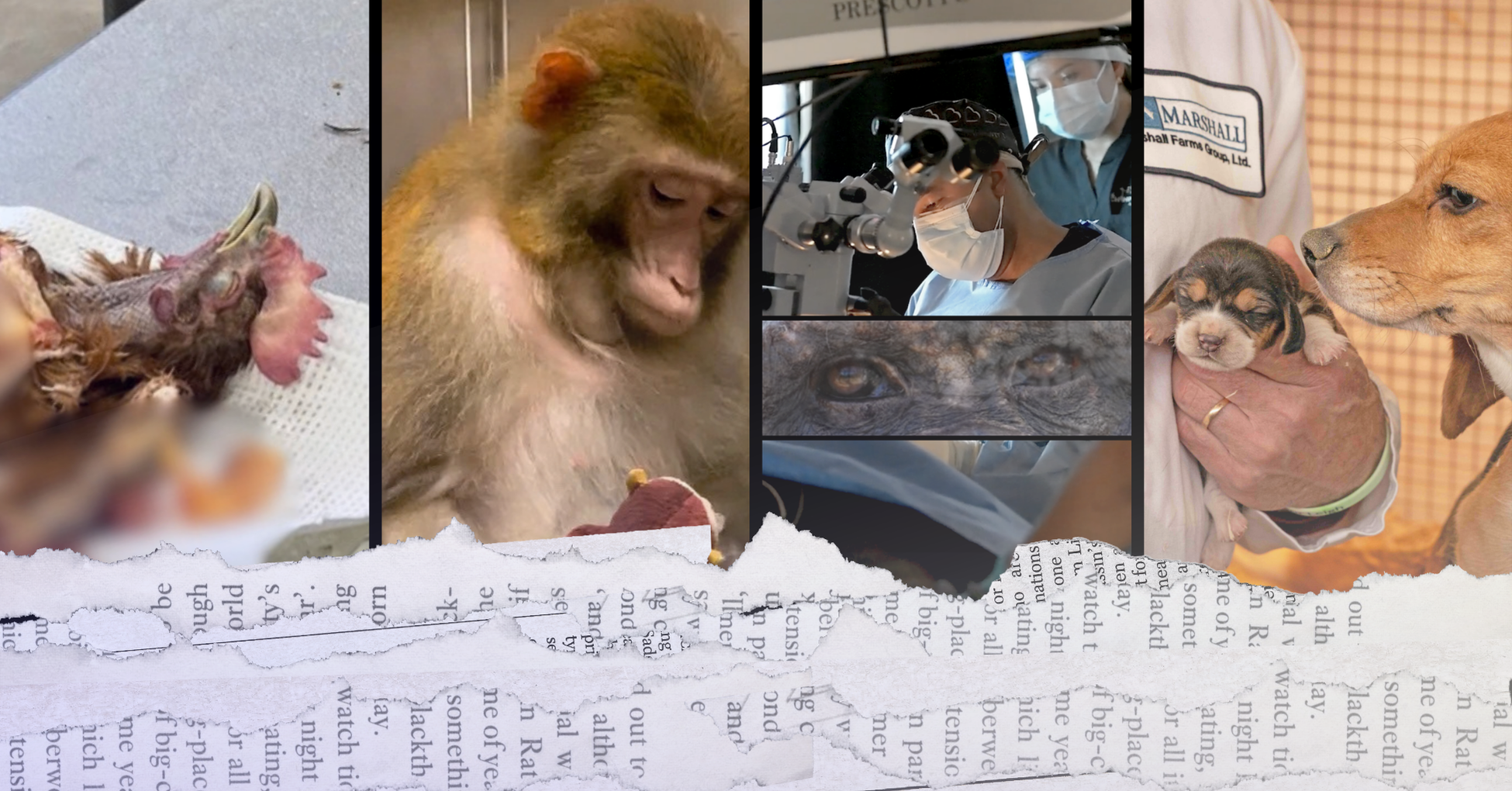
Here’s a roundup of the latest, biggest news stories related to animal research—all the recent media coverage you need to know right now to be the most effective activist for animals in labs.

Pierre Sees the World Again
Christie Hendrickson, Rise for Animals, 9/25/2026
Sanctuary is about much more than getting animals out of laboratories. It’s about caring for them for the rest of their lives.
At Chimp Haven, caregivers noticed when Pierre—a chimpanzee rescued from a New York research lab—began withdrawing from his group and struggling to navigate his surroundings.
They discovered that cataracts were taking his sight. And then they found a way to give it back. 📰 Read More & Watch →

UW-Madison Students Call It the Poultry Lab. They’re Right.
Rise for Animals, 9/24/2026
Look inside UW–Madison’s “poultry lab,” where students are taught to kill and dissect birds, open developing eggs, and witness freshly killed animals being cut apart.
It’s a disturbing example of how animal suffering is normalized across both agriculture and research. 📰 See Inside the “Poultry Lab” →

State files tax lien against Ridglan Farms
Joe Vanden Plas, In Business Madison, 9/16/2026
“The Wisconsin Department of Revenue has filed a one-page tax warrant against Ridglan Farms, a shuttered dog breeder, that claims the company owes $23,950.13 in employee income taxes that it collected but didn’t send to the agency. The warrant, which acts like a lien against a taxpayer’s property . . . gives Ridglan 60 days to pay taxes.” 📰 Full Story →

The battle over the beagles
Devin Holdraker, Times of Wayne County, 9/19/2026
“Marshall BioResources [] raises ferrets, cats, minipigs and beagles which are in turn sold to accredited laboratories around the world for various types of biomedical research. . . . Protestors and opponents say it’s no longer necessary and are calling for a complete stop to animal testing.”
“Scott Marshall is the third generation of his family to raise animals at their North Rose facility and is the CEO of Marshall BioResources . Scott says when he first started in the business, there were 7 large commercial breeders in the United States. Now his family’s company is one of the last. . . . ‘For many years we never had protests at our sites. Now within last [sic] couple years due to our main competitors going out of business, we’re the last man standing and we’re a big target.’”
“‘I know the writing is on the wall’ Scott shared, but his customers say animals will still be needed for the foreseeable future.” 📰 Full Story →

FDA Updates Regulations to Advance Innovative Alternatives to Animal Testing
U.S. Food & Drug Administration, 9/21/2026
“The U.S. Food and Drug Administration [] issued a direct final rule that updates its regulations to clarify that non-animal methods can be used where appropriate for testing the safety of drugs and biological products intended for human use before they’re tried in humans. The update reflects advances in science and technology that have expanded the range of testing options available in human drug development, including methods using human cells, organs-on-chips, computer models and other advanced technologies.”
“The rule replaces terms like ‘animal tests’ and ‘animal studies’ with the terms ‘nonclinical tests’ and ‘nonclinical studies.’ Related terms, including ‘preclinical’ and ‘in vitro,’ are also replaced. . . . The law recognizes newer methods that do not use animals and traditional animal studies as possible ways to provide the evidence needed to begin studies in people. The rule removes language that could suggest that animal testing is the only acceptable way to generate safety information for regulatory decisions in products intended for human use. It does not eliminate or prohibit animal studies, change evidentiary standards or impose new costs or requirements on drug developers.” 📰 Full Story →

NIH makes major investments to advance human-based research infrastructure and technologies
National Institutes of Health, 9/21/2026
“The National Institutes of Health (NIH) is making its biggest push yet to move biomedical research beyond animal model use, unveiling five major initiatives that could reshape how new drugs and treatments are developed and evaluated. Together, the efforts signal a significant investment into human-based technologies as the future of preclinical science, aiming to make research faster, more predictive, and more directly relevant to human health.”
“Efforts include more than $88 million in funding for biomedical infrastructure projects nationwide; a new challenge offering over $7 million in awards to demonstrate how quantum-enabled approaches can improve detection and measurement in lab-based New Approach Methodologies (NAMs); a state-of-the-art laboratory at the NIH Clinical Center that will integrate standardized human organoid models, robotics, AI, and advanced data capabilities to enable experiments on reproducible human biological systems; an initiative to recruit grant reviewers who are experts in human-based science; and a new request for information from the scientific community to assess the feasibility of an annual public report tracking the number of vertebrate animals used in NIH-funded research.” 📰 Full Story →

Rep. Nancy Mace Introduces PUPPS Act to Shut Down America’s Puppy Pipeline to Research Labs
Office of Congresswoman Nancy Mace, 9/22/2026
“ . . . Congresswoman Nancy Mace introduced the Prohibiting Unethical Procedures on Pets in Science (PUPPS) Act, legislation to shut down America’s puppy pipeline to research labs, protect dogs already trapped in the system, and hold violators accountable with tough financial penalties. . . . ‘This bill ends the breeding of dogs for research, cuts off the supply to these labs, and gives dogs already trapped behind those walls a second chance through adoption instead of euthanasia. Man’s best friend belongs in a loving home, not a lab.’”
“The PUPPS Act amends the Animal Welfare Act to: • Ban breeding dogs for research purposes, including intentional mating, reproduction, artificial insemination, and embryo implantation. • Prohibit the commercial distribution of dogs for research, including selling, transporting, brokering, importing, exporting, leasing, transferring, donating, or otherwise providing dogs to research facilities. • Prohibit knowingly acquiring, receiving, or using any dog bred for research purposes. • Revoke or deny USDA licenses and registrations for anyone engaged in prohibited activities. • Impose civil penalties of up to $10,000 per dog, increasing to $40,000 per dog for repeat offenders.” 📰 Full Story →

Lung Cancer Study Retracted Over Animal Ethics Concerns
Bioengineer.org, 9/22/2026
“A scientific paper that claimed to reveal why a promising cancer drug can fail in lung cancer treatment has been retracted, after the journal’s editor determined that animal experiments in the study exceeded accepted ethical limits. . . . The decision highlights the growing scrutiny applied to animal research in oncology and the increasingly central role of international reporting standards in deciding whether published findings can stand.”
“In the retraction note, the Editor-in-Chief of the journal stated that the article has been retracted because the tumors presented in Figure 5 of the paper exceed the accepted limits for tumor burden. In animal cancer studies, tumor burden refers to the total volume or mass of tumor tissue carried by an experimental animal. Research ethics frameworks impose upper limits on how large tumors may be allowed to grow . . . When tumors surpass those limits, the study is considered to have breached the ethical standards under which animal research is permitted.”
“The editor’s decision was anchored explicitly in the ARRIVE 2.0 reporting guidelines, a widely adopted framework for the design, conduct and publication of animal research. . . . The retraction note states that, as a result of the excessive tumor burden shown in the paper, the study does not appear to meet the animal ethics standards described in those guidelines.” 📰 Full Story →

Exclusive – White Coast Waste Project Reveals Oak Hill Genetics Shipped Over 1,500 Hound Dogs for Experimentation Including to Labs Funded by NIH
Hannah Knudsen, Breitbart, 9/22/2026
“Between January 1, 2025, and June 30, 2026, Oak Hill, which breeds lab dogs – shipped 1,518 hound-mix dogs to laboratories for experimentation. This included puppies as young as three months. Recipients included universities still receiving money from the National Institutes of Health, funded by taxpayers. Further, the dogs shipped to these labs – at least 44 across the nation – were used to study a range of issues, including but not limited to heart failure, strokes, and nerve injuries.”
“The taxpayer watchdog identified several recipients of Oak Hill Genetics dogs, used for cruel NIH-backed experiments, including the University of Utah, which received $12 million for heart experiments on dogs. The dogs were subjected to having their ‘arteries tied off’ and were given pacemakers. According to WCW, ‘the animals are subjected to electric shocks before being killed.’ . . . Similarly, Ohio State University conducted experiments involving putting pacemakers in dogs and making their hearts beat 600 beats per minute, causing heart damage. . . . Washington University in St. Louis is another recipient of these dogs for NIH-funded experiments, which include one involving researchers slicing the dogs’ laryngeal nerves, implanting stem cells, then killing the dogs to harvest their larynxes and muscles.” 📰 Full Story →

U.S. Reps. Pocan, Langworthy: Introduce bipartisan COMPACT Act to end taxpayer-funded biomedical testing on dogs and cats
WISPolitics, 9/23/2026
“Congressmen Mark Pocan (WI-02) and Congressman Nick Langworthy (NY-23) [] announced the introduction of the Companion Animal Protection Against Cruel Testing (COMPACT) Act, the most comprehensive legislation in history to modernize federally funded biomedical research and end inhumane testing practices on dogs and cats.”
“The COMPACT Act prohibits the use of federal public-health research funds for biomedical research involving live dogs and cats while protecting animals currently in research facilities and preserving flexibility for genuine national emergencies. The legislation, developed with input from the medical and bioscience community, comes as advances in biomedical science have created alternatives to traditional animal testing, including in vitro systems, computational modeling and other non-animal technologies.”
“‘What happened at Ridglan Farms was a wake-up call for our community and for the country,’ said Congressman Mark Pocan. ‘We saw thousands of beagles confined in inhumane conditions and bred for research, and we saw what was possible when people came together to demand change. This is a nonpartisan issue, and I am glad to work with Congressman Langworthy to build on that progress with the COMPACT Act,’….”
“‘The horrific abuse and barbaric treatment of beagles uncovered inside research facilities like Ridglan Farms and Marshall Biosciences has outraged Americans from every corner of the country and political spectrum,’ said Congressman Nick Langworthy. ‘Dogs and cats are companion animals and part of the family for millions of Americans; they should never have to endure inhumane suffering, particularly at expense to taxpayers and when science has evolved to develop more effective research methods.’” 📰 Full Story →

Jay Bhattacharya Appears To Keep Infamous Harvard Project Torturing Baby Monkeys On Life Support
Emily Kopp, Daily Caller, 9/23/2026
“The National Institutes of Health under director Jay Bhattacharya continues to be keep funding Harvard research involving the torture of baby monkeys despite having announced it was terminating it.”
“Office of Management and Budget Director Russ Vought, who oversees the implementation of Trump’s agenda across federal agencies, confronted Bhattacharya in a heated meeting in the White House with Trump present, according to several news reports. The Trump administration is seeking steeper cuts to Harvard, per the reports. But Bhattacharya has been a mentee of Harvard President Alan M. Garber for three decades and maintains close communications with several professors in Cambridge who oppose the Trump administration, according to the Harvard Crimson.”
“Bhattacharya has shown a similar reluctance to relinquish any NIH funding, and public records show that taxpayer funding continues to flow to Livingstone’s lab through four separate grants, including a new $850,000 tranche earlier this month. They also include a multi-year grant in May 2025 that funds her research until 2029.” 📰 Full Story →