UW-Madison Students Call It the Poultry Lab. They’re Right.
Content Warning: This article contains descriptions and images of animals being killed, dissected, and used in classroom demonstrations, including developing chick embryos.
University of Wisconsin-Madison offers an undergraduate course titled Introduction to Poultry: From Backyard Chickens to Commercial Production. Students call it what it really is: a “poultry lab.”
Students interrupt developing embryos mid-incubation, learn how to kill and dissect birds, and watch freshly gassed, still warm animals get cut open.
They witness, and may partake in, much of the same violence that defines animal research laboratories—and they are greeted with much of the same callousness.
A student photograph depicts chicken bodies—understood to have been purchased by the professor at a grocery store—hanging in front of the chalkboard. Behind them, a sign reads “PARTS AND CARCASS GRADING.”

Like in labs, participants are more than just acclimated to the deaths of nonhuman animals. They are encouraged, and empowered, to be their killers.
These methods—CO₂ gassing, cervical dislocation, decapitation, exsanguination—are the same ones routinely used in animal research facilities across the country.

And just like in labs, killing is taught as a routine, vocational skill.
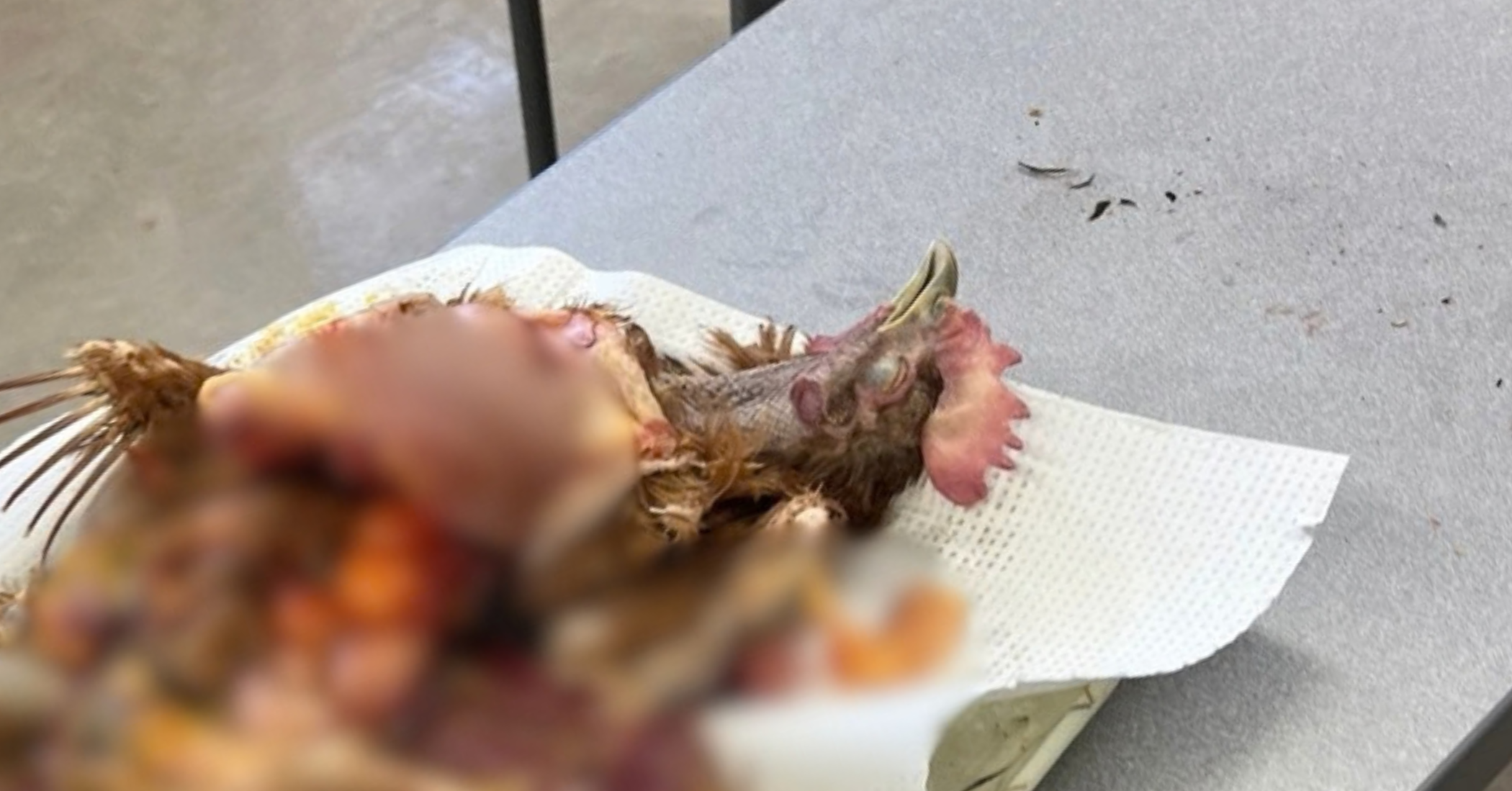
Students documented the consequences: a chicken, gassed to death moments before class and still warm to the touch, splayed out on a table and hacked open.

The violence even extends beyond those already born, to include birds who never got the chance to be birds at all.
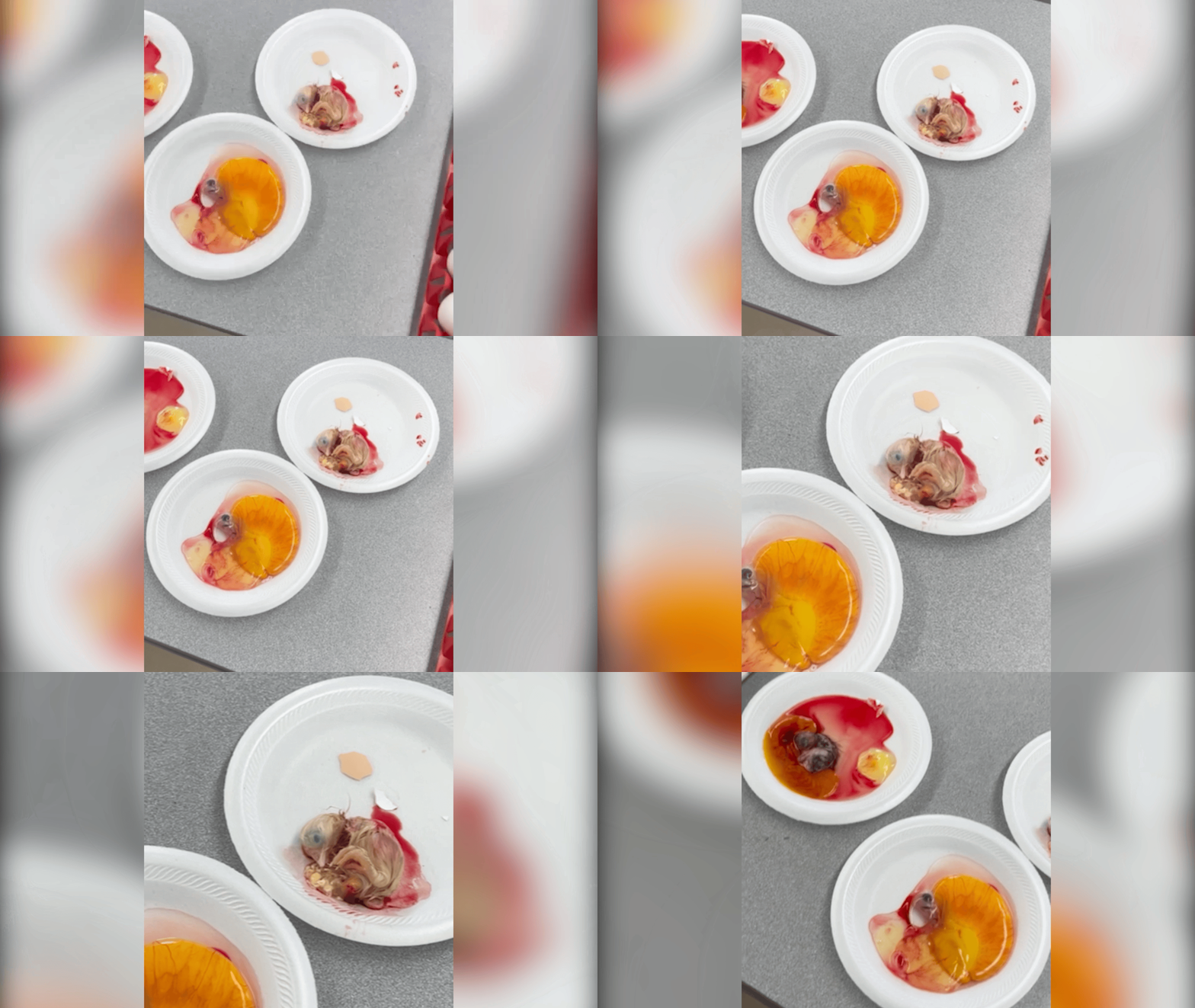
Students opened fertilized eggs and embryos to observe the first three-or-so weeks of chick development, up to a day or two before hatching.
In one video clip, movement can be seen inside a punctured egg.
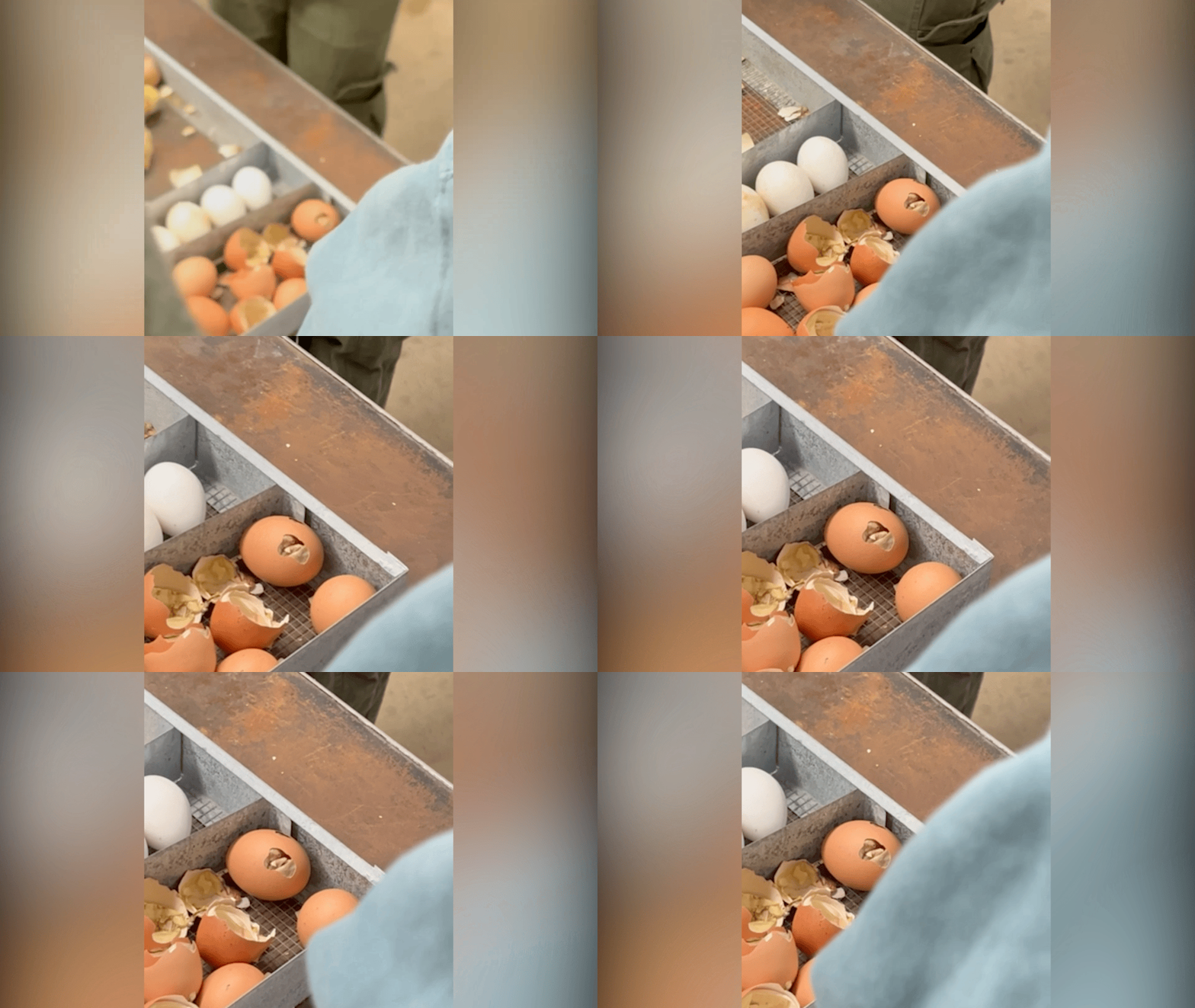
In another, a voice can be heard saying “it is moving,” shortly after someone else says “yeah, we can euthanize.”
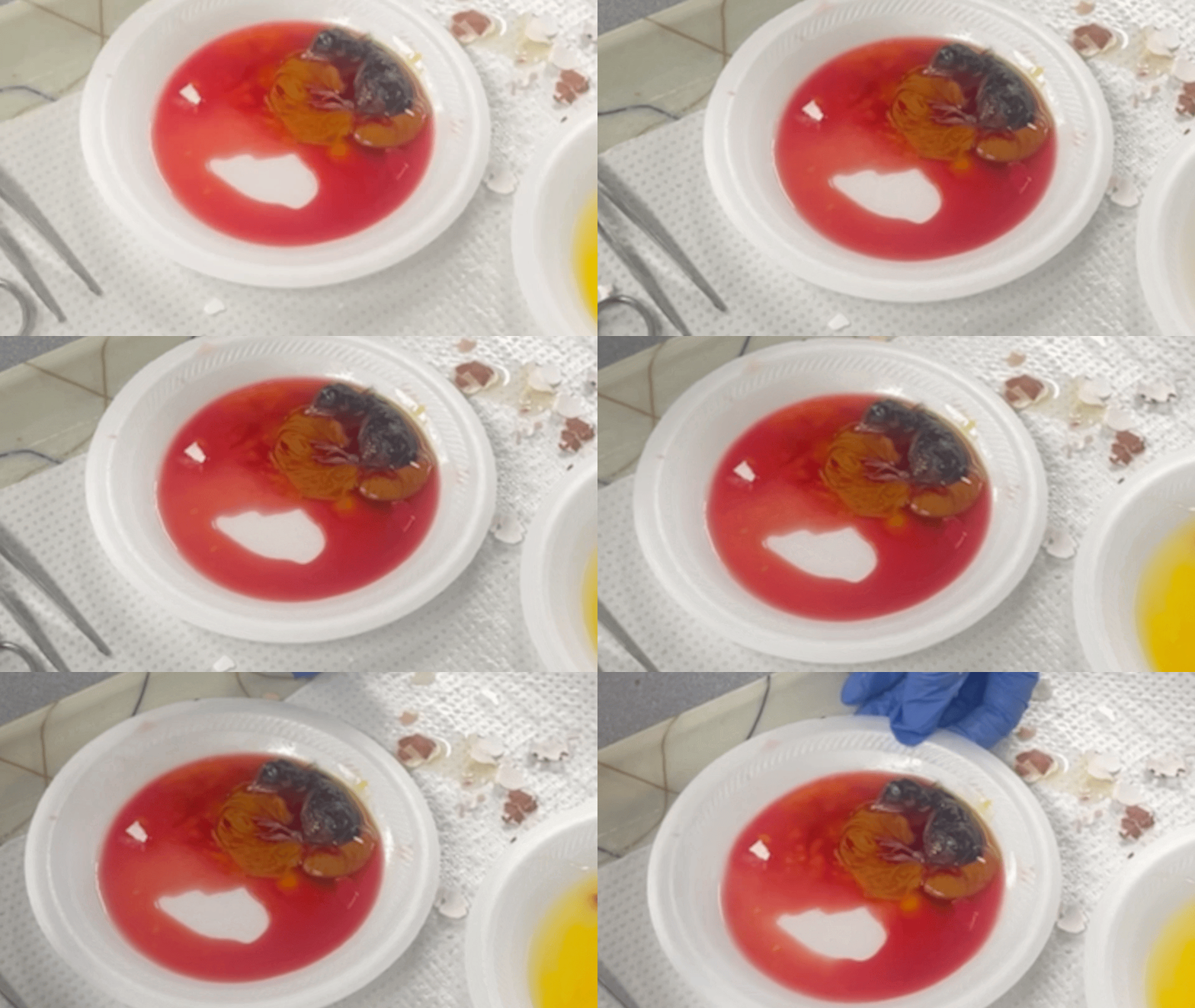
And, in another clip shared with the label “Professor ‘euthanizes’ chick,” human hands can be seen manipulating and apparently killing an embryo dumped onto a plate.
These practices aren’t only disturbing. Several are questionable by the animal agriculture industry’s own standards—and appear to contradict industry literature included in the course syllabus.
National Chicken Council welfare guidelines, for example, call for euthanizing unwanted embryonated eggs—not opening them.
That’s saying something, given that the same “welfare” guidelines don’t take issue with routinely breaking birds’ necks by hand, killing animals in a macerator, and inducing them to “bleed-out” via contact with an “automatic knife.”

But, of course, students aren’t being taught to evaluate the animal use industry. They’re being taught industry’s own internal operations as neutral fact by the very public, land-grant university responsible for their “education”—a modern consequence of industry’s long history of reaching into classrooms.
Classes like these are more workforce conditioning than science education, teaching students that obedience is rewarded and emotion must be curbed.
This may help explain how, in the same class where chickens lay dead and dying, students can be seen petting a cat who wanders the lab. It’s proof that the inclination toward empathy, and the instinct to befriend other animals, isn’t absent in these students. Rather, they are being trained to compartmentalize their feelings, to apply their ethics inconsistently, and to hold two irreconcilable realities at once.

If anything being done to the birds in this lab was being done to the cat, we could expect outrage.
That’s the nature of speciesism—the belief that a being’s species determines their value—which both lays the foundation for, and is a fundamental take-away of, classes like these.
Similar contradictions are routine in other animal labs, too. For example, at a Louisiana State University facility that used pigs as research models for fetal cesarean sections—cutting pre-term fetuses from pregnant sows’ bodies—a “pet dog” was described as a “continuous[],” on-site presence and as routinely interacting with staff.
Chickens (and pigs) are no different from the animals we favor—like cats (and dogs)—in any way that matters.
Yet, we shackle birds’ paws while we gently hold others’.
In a “Market Poultry – Parts Identification” guide shared by University of Wisconsin as part of its poultry lab, birds’ dismembered body parts are displayed and labeled. Their feet are designated “paws.”

This is a rare example of industry language bringing us closer to reality rather than farther from it, and it evidences that the lines drawn by industry between species have never been about the animals themselves.
Birds matter just as much as animals with the types of paws that first come to our minds—and they suffer just the same, too.
Students at University of Wisconsin-Madison know this intuitively, calling the “poultry” class what it really is: an animal lab.
No different, and no more defensible, than any other.