Animal Researchers Got Basic Human Blood Science Wrong
For decades, scientists have told us they understand how the human body makes red blood cells. That understanding, it turns out, was not based on studying humans at all.
A new study out of Northwestern University, published this month in Nature Genetics, has upended one of biology’s most basic assumptions: that human red blood cell formation mirrors what happens in mice.
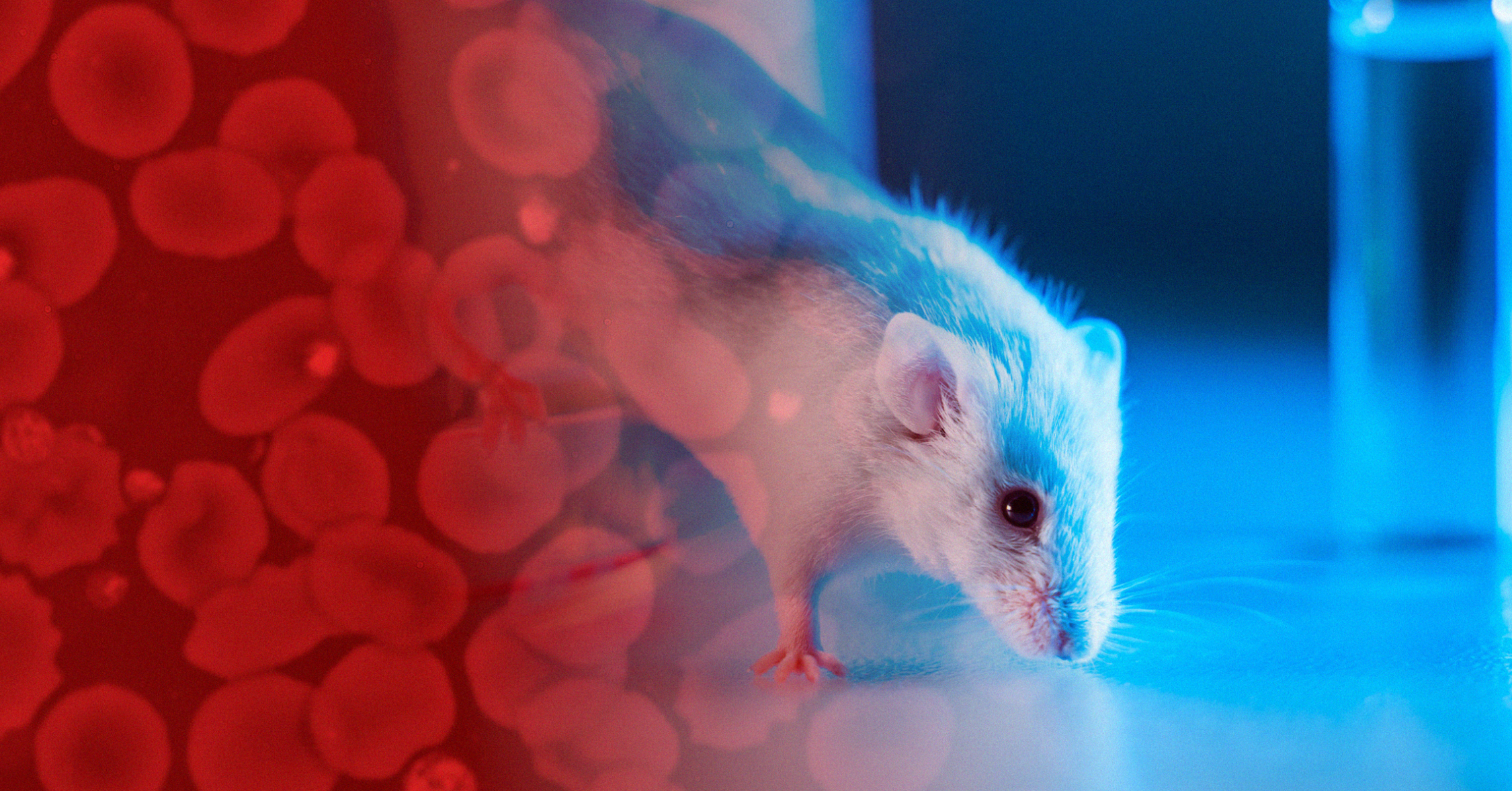
According to senior author Dr. Peng Ji, MD, PhD, and Marie A. Fleming Research Professor of Pathology at Northwestern, our knowledge of the microscopic “nurseries” where red blood cells mature, has, for decades, come “‘almost entirely from mouse studies.’” Now, using spatial transcriptomics—a technology that maps gene activity across intact tissue—Dr. Ji’s team found that in mice, red blood cells cluster around a central macrophage that organizes their development. In humans, there is no such organizing center. Human red blood cells cluster on their own, adhering to one another through an entirely different molecular mechanism.
Humans and mice do not form blood cells in the same way. They never did.
A Fundamental Assumption Falls Apart
The study’s punchline is not a minor technical correction. It represents an admission, from within the institution of animal research itself, that a “long-standing assumption” extrapolated from another species to humans was wrong—and led researchers astray for decades.
Red blood cell formation is one of the body’s “most fundamental biological processes,” and researchers’ assumptions about this process have shaped their interpretations of disease and their designs for treatment. Once a false assumption is embedded at such a foundational level, it does not stay contained. It bleeds into every study built on top of it.

The Costs of Getting Human Biology Wrong
Northwestern’s study uncovered that, in the case of red blood cell formation, animal research did more than fail to predict human biology. It obscured the human biology that mattered for treating human patients.
That is where the full cost of this error comes into focus. It is not only the animals bred, used, and killed to construct a “model” of blood formation that never applied to humans. It is the animals’ lives, the decades of research, and the countless dollars biomedical research spent building on that “model” before anyone set about to check it in humans.
It is also the opportunity cost: the human-relevant discoveries researchers might already have made, and the true answers they may have already uncovered, had the same time and money gone toward studying human biology directly rather than exploiting mice as human stand-ins. We will never know exactly all that we have lost.
The Problem Runs Deeper Than Blood
This is the kind of story that animal research apologists never want to reckon with, because it is not about one mistaken study—it is a story about the mistaken premise underneath them all.
Dr. Ji himself admits that “[m]uch of biomedical research depends on mouse models”—just like those underpinning the false assumptions his team debunked. As such, we can only speculate how many other long-standing, controlling, yet erroneous assumptions have guided and continue to guide research efforts into human disease.
Researchers’ continued reliance on nonhuman species as proxies for humans is itself based on erroneous assumptions. At its core, it ignores the basic science of biological complexity. Nonhuman animals are not “simplified versions of humans.” They are “evolved systems, differently complex in their own right.” Relying on “one complex system, be it a mouse or a monkey” to make predictions for others runs “counter to complexity science, evolutionary biology, and empirical science.” Northwestern’s new findings drive this point home, concluding that one of the most fundamental biological processes is “‘species-specific.’”
A Paradigm Shift Must Change the Paradigm Itself
Dr. Ji himself calls Northwestern’s finding a “paradigm shift,” and he is right to do so. Our job is to make sure it does not stop with red blood cells.
The animal research industry has a long history of absorbing findings like this one as isolated corrections—quietly revising the science within a single subfield while leaving the larger system untouched. The new discovery is celebrated; the failed assumption that preceded it is treated as an afterthought. Attention turns toward what researchers now know, rather than toward the animals harmed, the resources squandered, the human patients left waiting, and the critical lessons the failure demands.
Researchers must stop responding to each new translational failure by adjusting the animal model, selecting another species, or treating the discrepancy as an isolated complication. Species differences are the biological reality. We are all complex, and we cannot—and should not—be treated as proxies for one another.
Northwestern’s findings should therefore prompt more than revised diagrams of blood-cell formation. They should heighten the urgency of moving toward ethical, human-relevant science, and they should hasten the shift the federal government claims to be underway.
That shift must include ending the exploitation of mice and other animals as stand-ins for humans—and committing, at last, to the study of human biology on its own terms.
Your Call to Action: Take two minutes now to urge your members of Congress to support the SPARE Act. This legislation would:
- Phase out animal experimentation conducted or funded by federal agencies,
- Invest in the transition to human-centric, non-animal research, and
- Require the release of eligible animals held in federally funded laboratories for adoption or sanctuary placement.
Share this article on Facebook, X, or Bluesky
About the Author: Lindsey Soffes is Head of Programs at Rise for Animals. She holds a law degree from William and Mary Law School and has spent her career advocating for the rights of all animals—both human and non-human.