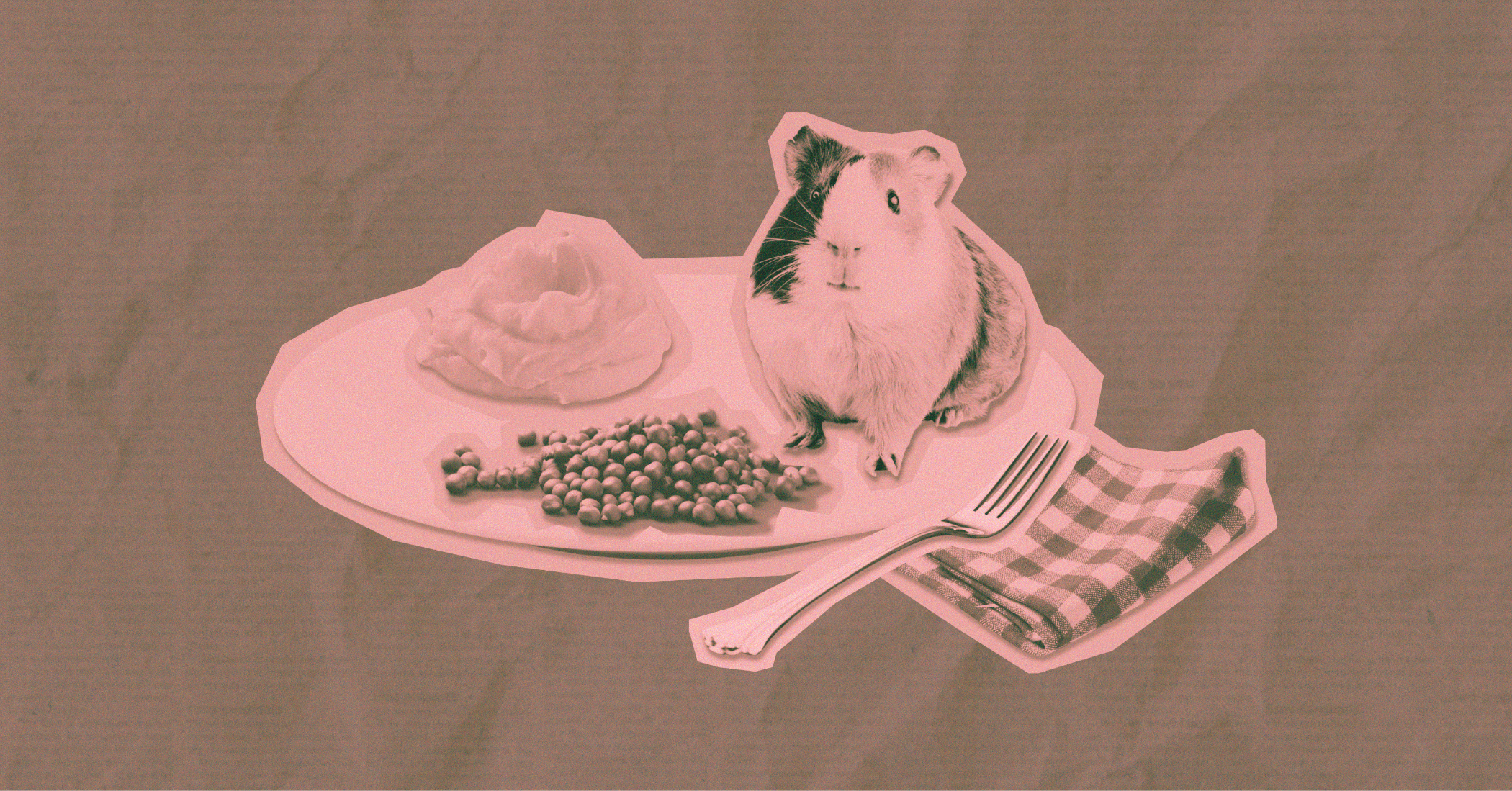
There is a fight underway in Pembrokeshire, Wales, over whether a couple should be allowed to raise guinea pigs for meat. More than 3,500 people have signed a No Guinea Pig Meat in Wales petition, objecting to the eating of guinea pigs because they are sweet, gentle animals with unique personalities, who bond with humans and deserve love.
One petitioner put it this way: “‘You wouldn’t eat your cat or dog, so why are [guinea pigs] classed differently?’”
It is a fair question—and, followed all the way through, it leads somewhere far bigger than a single Welsh farm.
You Wouldn’t Eat Your Cat or Dog
For Americans and Britons, it is not an accepted practice to eat cats and dogs. But researchers experiment on both—as well as on guinea pigs, in far greater numbers still. In 2025 alone, U.S. laboratories reported exploiting more than 125,000 guinea pigs, and UK labs reported almost 1,700.
The same animals being defended in Wales as too beloved to be eaten are, at this very moment, being bred, confined, and killed by the thousands in laboratories.
And, the very characteristics petitioners cite as reasons not to eat guinea pigs are the same characteristics researchers prize them for most.
Guinea pigs, like cats and dogs, have never been fixed into a single category. Humans tag them as companions, as research subjects, or—less often in the West—as food. The label typically depends on what serves human interest and industry profit at any given moment, and humans switch labels whenever convenient.

The petitioners’ instinct, which implicitly cuts across every label, is the right one: guinea pigs are not commodities. But confining that instinct to a single label is dangerous—and guinea pigs’ own history shows us why.
Exploitation Begets Exploitation
Humans raised and traded in guinea pigs as food commodities long before forcing them into laboratory cages.
That earlier exploitation for food led to their later exploitation in labs. Indeed, one form of exploitation built the infrastructure for, and inclination toward, the next.
Guinea pigs’ prolonged use as food animals accustomed them to cage confinement and handling. Combined with their quiet, gentle demeanors, that made them desirable victims for vivisectors.
The farming of guinea pigs for food directly enabled their use as research subjects. Now, that mechanism threatens to run in reverse.
“Guinea pig” has become synonymous with “test subject.” That entrenched status as a laboratory commodity could just as easily be invoked today to justify eating them. Because guinea pigs are already bred, confined, and killed by humans for one purpose, industry and others can claim (in)ethical consistency in arguing for their breeding, confinement, and killing for another purpose.
This is actually the same rhetorical move made by one of history’s most notorious vivisectors
Industry Uses Meat-Eating to Defend Animal Research
Claude Bernard asserted that humans have the “right” to experiment on and vivisect animals because we eat and otherwise exploit them:
It would be strange indeed if we recognized man’s right to make use of animals in every walk of life, for domestic service, for food, and then forbade him to make use of them for his own instruction in one of the sciences most useful to humanity…
Bernard’s reasoning has held persuasive power for decades. Today, it could run from lab to plate just as easily as it once ran from plate to lab.
Either direction, the mechanism is identical: one accepted form of exploitation becomes evidence that another form of exploitation should be accepted, too.
Animal Researchers May Consider “Lab” Animals as “Meat”
Revered anti-vivisectionist Albert Leffingwell observed over a century ago that accepting the slaughter of animals for food leads to accepting harm to animals in labs. More recently, former animal researcher Michael Slusher wrote candidly about this dynamic from the inside. Slusher describes how researchers who eat animals may find it easier to mentally “turn their subjects into meat”—into specifically consumable things—because they have already made that same move at the dinner table.

Slusher traces this rationalizing impulse to something more basic than any single human-assigned animal category or any particular industry talking point: a human “sense of entitlement to consume without restriction.” That entitlement shapes how modern humans treat animals—whether we are eating them or experimenting on them.
Fundamentally, both forms of exploitation rely on the same underlying principle (that animal interests matter less than human desires), and each quietly helps launder the other into acceptability.
Consistency Is the Only Category Industry Can’t Exploit
Leffingwell identified the trap this creates for anyone who opposes only one form of animal exploitation:
To object to killing animals for scientific purposes while we continue to demand their sacrifice for food, is to seek for the appetite a privilege we refuse the mind.
The reverse is equally true:
To object to eating animals while accepting their sacrifice in labs is to seek for the mind a privilege we refuse the appetite.
Neither position is stable on its own, and both leave the door wide open for animal-use industry propaganda.
The Welsh petitioners are right to object to the raising of guinea pigs for food, but the answer does not lie in relitigating which category guinea pigs belong in—”pets,” “food,” “research subjects.” Any human-use category we accept is a label industry can exploit for its purposes.
Ending Animal Exploitation Requires Universal Opposition
The only position that does not hand industry a ready-made defense is rejecting the labels altogether—and, with them, every form of exploitation they are used to justify.
Guinea pigs are not commodities to be bred and sold as products of the pet trade, as food stuffs, or as research tools. They are sentient individuals—the only classification that should determine how we treat them.
No human purpose entitles us to the bodies of others, and justice calls for the emptying of all cages—no matter what species they confine, and no matter whether they are on farms or in labs.