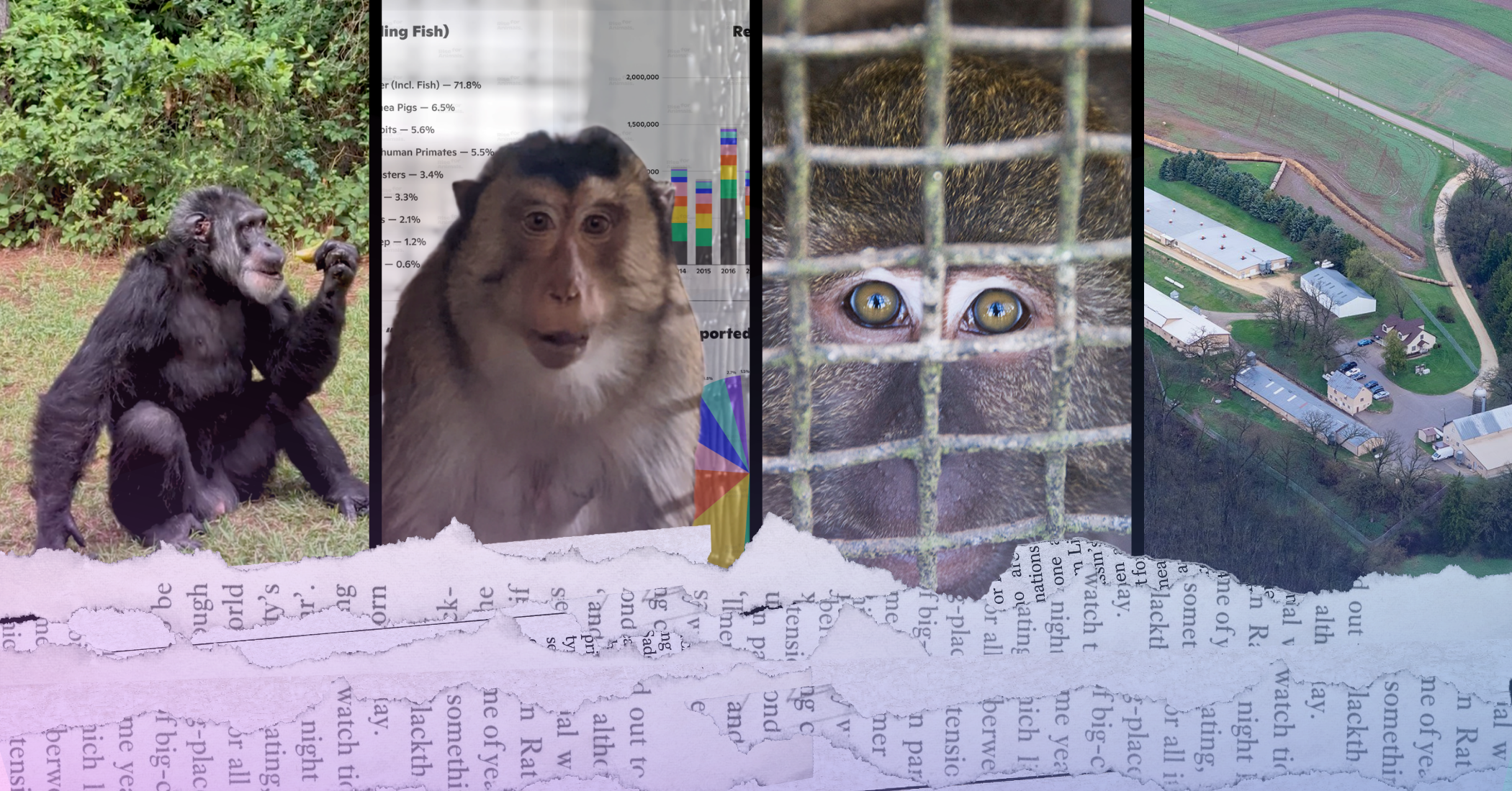
Here’s a roundup of the latest, biggest news stories related to animal research—all the recent media coverage you need to know right now to be the most effective activist for animals in labs.
First Look: The Newest Animal Research Data
Rise for Animals, 6/12/2026
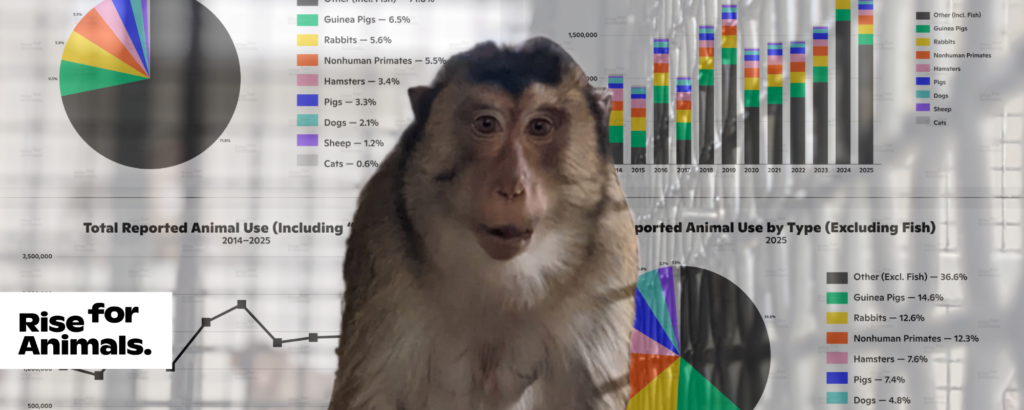
Have you ever wondered how many animals are used in U.S. labs each year? We have some answers for you.
The USDA has released its 2025 animal research numbers. Reported animal use appears to be down overall, but cat use increased, monkey use rose, and the number of dogs held surged. Here’s what our preliminary analysis reveals—and what the federal data still leaves out. 📰 Full Story →
After Decades in Research, They Entered the Woods
Rise for Animals, 6/11/2026
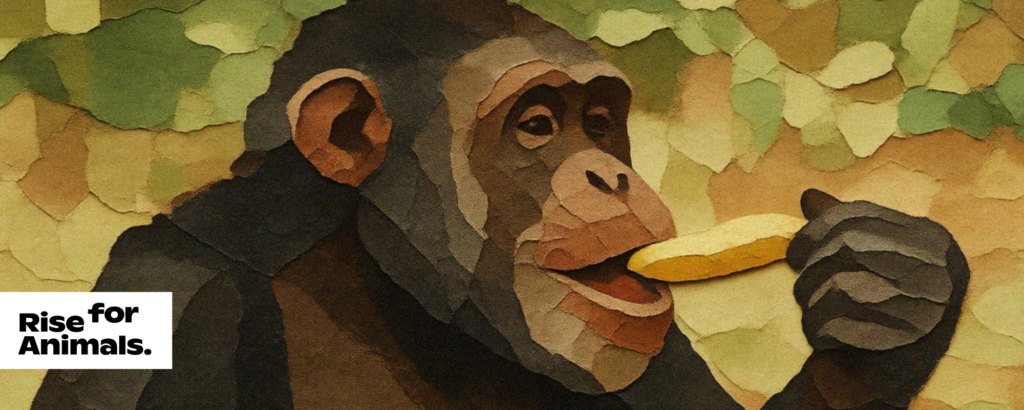
Chimpanzees freed from a laboratory just reached a new milestone at Chimp Haven! They’ve entered a forested habitat for the first time, experiencing freedom, friendship, and sanctuary after decades in research. 📰 Full Story →
Non-Animal & Human-Relevant Research News
Rise for Animals, 6/10/2026
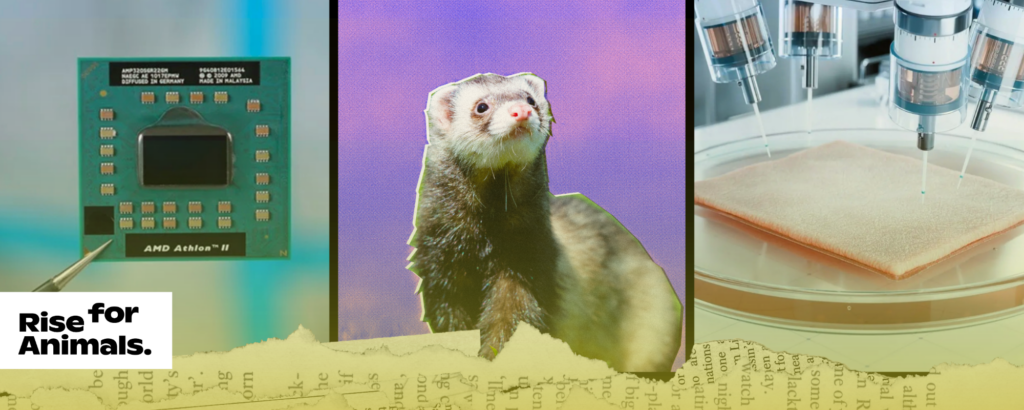
Explore the biggest news in human-relevant science and alternatives to animal research from last month. NAMs are transforming life sciences, preclinical research, cancer studies, medical treatment safety, and more! 📰 Full Story →

RML Researchers Arrested as Lab Critics Campaign Against Animal Testing
Robert Chaney, Mountain Journal, 6/4/2026
“RML’s latest controversy arose this week when the U.S. Department of Justice arrested and charged two of its researchers with smuggling monkeypox virus samples into the United States and lying to investigators. That came on top of accusations by an animal welfare advocacy group called White Coat Waste Project Inc., which published an ‘exclusive whistleblower report’ alleging that the facility, part of the National Institute of Allergy and Infectious Diseases, was covering up accidents involving exposure to dangerous pathogens. The specific allegations . . . have [] illuminated a larger debate over animal testing….” 📰 Full Story →
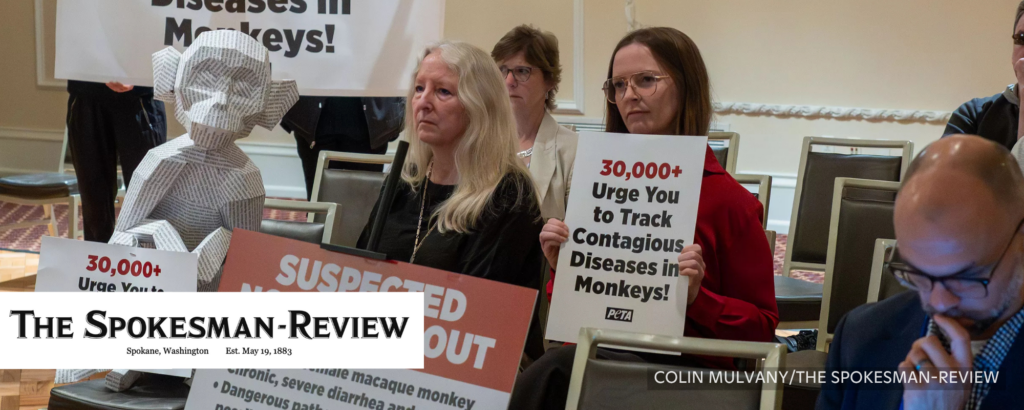
Reporting requirements of diseased monkeys used in state medical research under question
Amanda Sullender, The Spokesman-Review, 6/4/2026
“The Washington state health board shot down a proposal Thursday to require greater reporting of diseased monkeys used for research. About a dozen animal rights activists from People for the Ethical Treatment of Animals (PETA) and other organizations protested at the board’s monthly meeting, which was held Thursday in Spokane. More than 30,000 Washington residents signed a petition to get the issue before the state health board. If approved, the rule would have required primate research facilities in Washington to report certain diseases found in monkey populations directly to the state Department of Health.”
“The state Board of Health unanimously shot down the proposal Thursday on grounds current reporting requirements are sufficient to protect human populations. If an employee at one of these research facilities develops a reported illness from a research monkey, that disease is still reported to the Department of Health and the disease’s origin to the facility could still be tracked.”
“[Lisa] Jones-Engel [PETA chief science adviser for primate experimentation] called the board meeting an ‘absolute circus’ and said PETA would continue to pursue stricter reporting for disease in research monkey populations. ‘This was a bunch of people throwing up a smoke cloud to what was a very straightforward issue, and we’re not done now,’ she said.” 📰 Full Story →

Did Ismael Ozanne drop the ball on Ridglan Farms?
Bill Lueders, Isthmus, 6/5/2026
“Hsiung and other animal rights activists are especially critical of Dane County District Attorney Ismael Ozanne, who disregarded repeated calls to prosecute Ridglan for violating the state’s animal cruelty laws. Hsiung, an attorney, made multiple efforts to get Ozanne to act, including drawing up and presenting an actual criminal complaint for the office’s potential use. ‘DA Ozanne has shown no shortage of energy to pursue charges related to Ridglan Farms,’ muses Steffen Seitz, a litigation fellow for the Animal Activist Legal Defense Project at the University of Denver. ‘Sadly, each time it has been to punish activists who have saved dogs, rather than to prosecute Ridglan for cruelty.’”
“Seitz, who has represented Hsiung and others in court, says ‘so much litigation and other turmoil could have been avoided if, at any point, Ozanne had done the right thing. As the outcome of the special prosecutor investigation showed, animal cruelty at Ridglan Farms festered on Ozanne’s watch. He had a duty to enforce the law. Instead, he chose to protect cruelty and punish compassion.’”
“Ozanne, a Democrat appointed by Gov. Jim Doyle in 2010 and elected four times since, most recently in 2024, did not respond to a detailed request for comment from Isthmus.” 📰 Full Story →

‘This is a blatant violation’: UW-Madison probes student club over flyer tied to beagle farm raid
Jennifer Green, The Cool Down, 6/7/2026
“The University of Wisconsin-Madison is investigating a student animal-rights group over a flyer tied to the April 18 raid at a Wisconsin beagle breeding facility . . . The case is now driving a broader online debate over animal welfare, free speech, and whether student organizations should be punished for drawing attention to alleged abuse.”
“Animal Advocacy [“a registered student organization”] is expected to make its case to the Office of Student Conduct and Community Standards in June.” 📰 Full Story →
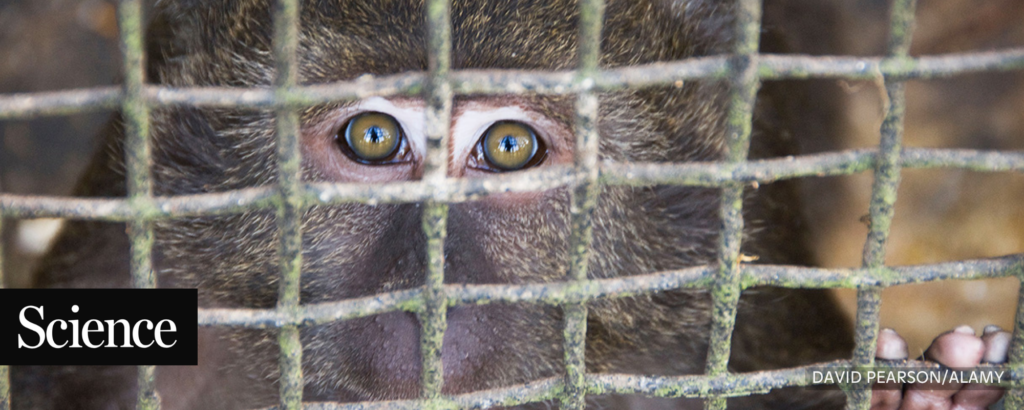
Leading supplier of research monkeys declares bankruptcy
David Grimm, Science, 6/8/2026
“One of the world’s leading suppliers of monkeys and other animals for biomedical research has declared bankruptcy. In court filings last week, Inotiv, a West Lafayette, Indiana–based company, said it is nearly a half-billion dollars in debt and is seeking ways to continue operations as it financially restructures.”
“Inotiv was founded in 1975, and the contract research organization began to aggressively expand its operations in 2018; over the next 4 years, the company acquired more than a dozen animal suppliers, drug-testing facilities, and other research operations. It currently houses thousands of monkeys and tens of thousands of rodents, rabbits, and other research animals, which it supplies to labs in the United States, Europe, and elsewhere.”
“In its Chapter 11 court filings, first reported by Bloomberg, Inotiv tied its financial woes to ongoing litigation related to the Envigo case. It also blamed cost competition from other contract research organizations that conduct animal studies, as well as a ‘highly regulated environment’ including animal welfare oversight by the U.S. Department of Agriculture and control of monkey imports by the U.S. Fish and Wildlife Service. Threatened cuts to U.S. National Institutes of Health funding and a desire among U.S. agencies to move away from animal research—and monkey research in particular—had also disrupted its business, Inotiv said in its filing.”
“Inotiv did not respond to a request for comment, but in a press release on the bankruptcy filings, the company said it has arranged to borrow $25 million for its overhaul. ‘The Company will maintain normal operations without disruption and continue to deliver critical research models and services to its clients,’ it said.” 📰 Full Story →
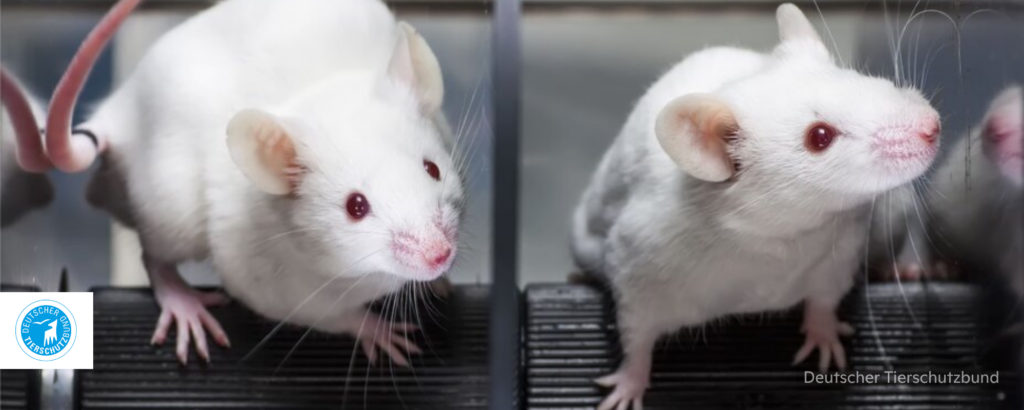
German Government Wants to Undermine Protection Mechanisms for Laboratory Animals – Broad Resistance from Animal Welfare Organizations
Deutscher Tierschutzbund, 6/8/2026
“Millions of animals in German laboratories face a significant weakening of their legal protections. The federal government intends to enact an ‘Animal Experimentation Act’—a standalone law that would establish regulations governing animal experimentation, separate from the Animal Welfare Act. Key legal safeguards against inflicting pain, suffering, and harm, as well as killing for economic reasons—which are currently enshrined in the Animal Welfare Act—could thus be eliminated.”
“The German Animal Welfare Federation, together with a total of eight animal welfare organizations, is sounding the alarm. In a petition submitted to the Petitions Committee but not yet published, they call on the German Bundestag to stop the planned Animal Experimentation Act and to retain the existing regulations in the Animal Welfare Act. The veterinary community has also already spoken out against the law. . . . Instead of further easing the requirements for experimental permits, the organizations are calling for a consistent and complete implementation of the EU Animal Testing Directive.” 📰 Full Story →

Why the Cruelty-Free Cosmetics Market is Hitting $37 Billion
Mark K. Belton, Futurism, 6/8/2026
“Most people still think cruelty-free cosmetics is a niche — a corner of the market reserved for vegan activists and indie brands with hand-lettered logos. That assumption is badly out of date. The cruelty-free cosmetics market is valued at $17.5 billion in 2025 and is on track to reach $37.1 billion by 2035, expanding at a compound annual growth rate of 7.7%. This isn’t a fringe movement consolidating. It’s a mainstream consumer reclassification, and it’s accelerating faster than most brand strategists have been willing to admit.”
“Survey data from Mytopicals indicates that 85% [emphasis in original] of consumers claim to use vegan and cruelty-free cosmetics on a regular basis. That number is worth approaching with some skepticism — stated preferences in consumer surveys almost always outrun actual purchasing behavior. But even if the real figure is closer to half that, it still represents a seismic shift in how beauty consumers want to be perceived and what identity they’re signaling with their purchases.”
“North America currently holds 45.7% of the global cruelty-free cosmetics market, valued at $7.9 billion, with the United States as the primary driver.” 📰 Full Story →
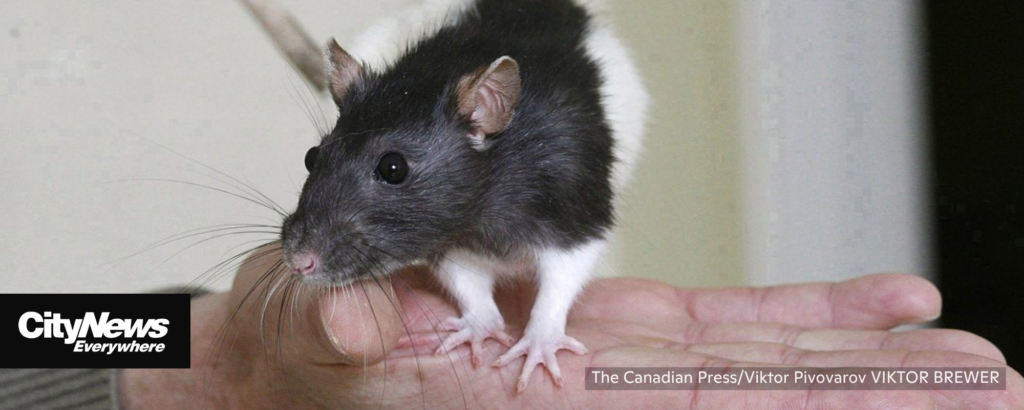
Use of animals in research: Quebec enters the era of transparency
Pierre Saint-Arnaud, The Canadian Press via City News Everywhere, 6/9/2026
“The use of animals in scientific research, a very sensitive issue indeed, will now be subject to greater transparency in Canada. Many Canadian scientific research organizations, including several in Quebec, announce that they have signed an agreement on open and proactive communication regarding science using animals. By signing the Transparency Agreement for Animal Science in Canada, 18 organizations commit, among other things, to disclosing how animals are used in their research and the reasons why they use them. The signatories include universities, health research centres, scientific institutes, companies and associations.”
“This agreement actually involves four basic commitments: to clearly state when, how and why they use animals; to improve their communications with the public and the media regarding their use of animals; to offer the public broader information on the use of animals in science, on the national oversight system (the Canadian Council on Animal Care (CCAC)) and on Canadian standards; and finally, to report annually on their progress.” 📰 Full Story →
Dying for beauty: doctors urge a ban on cruel botox tests on mice
Eurogroup for Animals, 6/11/2026
“Every year, 100,000 mice suffer across Europe for Botox quality testing, despite validated non-animal alternatives being available for over a decade. To help bring this practice to an end , our member organisation Doctors Against Animal Experiments (DAAE) together with the European Coalition to End Animal Experiments (ECEAE) have launched a new campaign calling on European regulators to close the loopholes that continue to allow animal testing for Botox products.”
“Throughout routine production, companies repeatedly conduct toxicity tests by injecting groups of mice with varying doses of botulinum neurotoxin, one of the most lethal substances known, and observing them for several days. The animals gradually develop muscle paralysis and severe breathing difficulties, ultimately dying from suffocation. Under EU law [], these tests are classified as causing ‘severe’ suffering.”
“The main barrier to ending these tests is not a lack of scientific innovation. Since 2011, several major global manufacturers have successfully developed and secured approval for human cell-based testing methods, proving the validity of non-animal models. However, the mouse test remains listed in the European Pharmacopoeia, which sets quality standards for medicines across Europe. As long as this outdated method remains the standard reference, some manufacturers continue to rely on animal testing rather than transitioning fully to modern alternatives.” 📰 Full Story →
U.S. Sunscreen is Actually Getting Better, for the First Time in More than 20 Years
Jim Vorel, Jezebel, 6/10/2026
“Did you know that by global standards, the sunscreen available in the U.S. kind of sucks? . . . there are more generally effective, multipurpose sunscreens out there that the rest of the world has been using for a long time, held back from ever reaching the U.S. market by an impenetrable wall of red tape. But no more, thankfully, as the FDA has finally gotten around to approving the ingredient [bemotrizinol] that makes up the base of some of the most effective European and Asian sunscreens, which sunscreen geeks (a category that apparently exists) have been importing for years.”
“One would obviously wonder, why are we just getting our hands on this stuff now? It has to do with the laws that undergird the Food and Drug Administration’s review process, including a 1938 U.S. law that classifies sunscreens as drugs, rather than as cosmetics, which is how most of the world classifies them. That means, among other things, that animal testing is required, which gives pause to global companies from countries where animal testing of cosmetics has been banned. It is, in other words, a bureaucratic mess that has contributed to U.S. sunscreen development effectively stalling out for the last few decades.” 📰 Full Story →
Island Pharmaceuticals expands US army research pact to advance Marburg antiviral
Tipranks, The Globe and Mail, 6/10/2026
“Island Pharmaceuticals Ltd [“an antiviral drug development company focused on treatments for high-consequence viral dieases”] has expanded its Cooperative Research and Development Agreement with the U.S. Army Medical Research Institute of Infectious Diseases and The Geneva Foundation, securing access to USAMRIID’s Biosafety Level 4 facilities for a Galidesivir dose-optimisation study in Marburg Virus Disease. The move strengthens Island’s ties with leading U.S. biodefence stakeholders….”
“The planned non-human primate study will test varying Galidesivir dose regimens and treatment start times after exposure to the Angola strain of Marburg, with survival to 28 days as the primary endpoint and extensive virological and pharmacokinetic analyses.” 📰 Full Story →
Gallup: Record few Americans find transgenderism, death penalty, animal testing ‘morally acceptable’
Sean Salai, The Washington Times, 6/11/2026
“The research firm found that just . . . 45% [of surveyed adults] favored animal testing . . . [a low point] in annual polls conducted since 2001.”
“Gallup noted the moral standing of an additional five out of 20 behaviours measured in the questionnaire ‘fell significantly’ the past year: . . . 27% [of adults professed belief in the ethics of] cloning animals.”
“Majorities of 57% to 89% described eight behaviors as ‘morally wrong’ in the survey,” including “cloning animals….”
“Republicans were likelier than Democrats to view . . . animal medical testing . . . as morally acceptable.” 📰 Full Story →
Help spread the word. Share this news compilation on Facebook, X, or Bluesky.