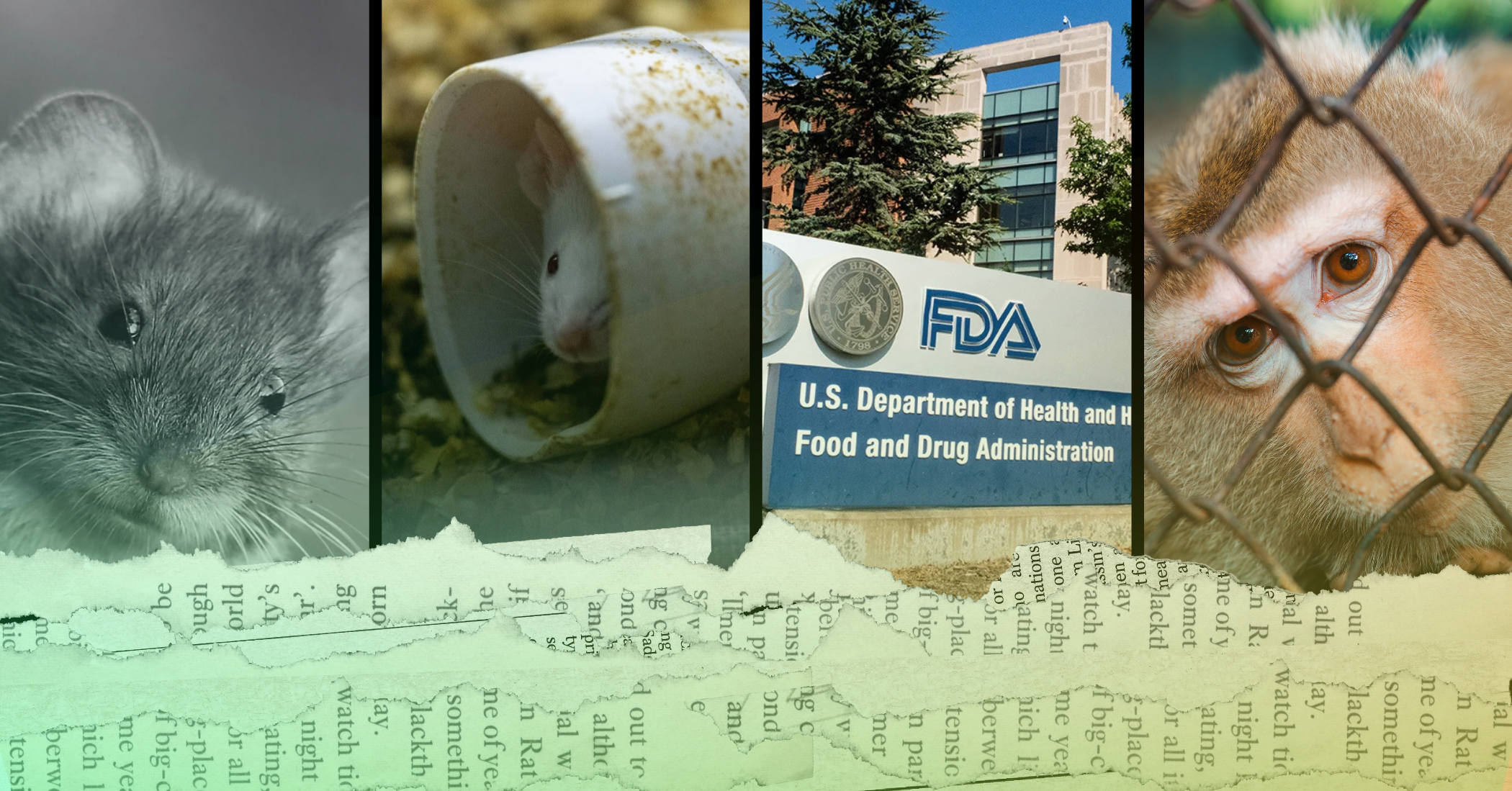
Here’s a roundup of the latest, biggest news stories related to animal research—all the recent media coverage you need to know right now to be the most effective activist for animals in labs.

Alpha Genesis Wants to Stockpile “Retired” Monkeys
Rise for Animals, 5/26/2026
For animals trapped in the research industry, “retirement” should mean sanctuary. But Alpha Genesis—the South Carolina primate supplier known locally as “the Monkey Farm”—appears to have something else in mind: keeping “retired” monkeys inside the research industry, warehoused as “biological resources” for possible future use.
That’s not retirement. That’s stockpiling.
Animals deserve refuge, protection, and permanent freedom from experimentation—not another industry cage disguised as compassion. 📰 Full Story →

Their Skulls Were Crushed. The Case Was Closed.
Rise for Animals, 5/28/2026
Two animals suffered fatal skull injuries during surgery at the University of Colorado Boulder. The university called it noncompliance. Federal oversight accepted retraining and paperwork as accountability.
This is what “oversight” so often means for animals in labs: their suffering is documented, their deaths are processed, and the system moves on. 📰 Full Story →

Industry says FDA’s guidance on animal testing alternatives needs work
Joanne S. Eglovitch, Regulatory Affairs Professionals Society, 5/21/2026
“Pharmaceutical industry groups say they support the US Food and Drug Administration’s (FDA) draft guidance on new approach methodologies (NAM), which aims to replace animal testing with innovative models, such as in silico modeling, to assess drug safety. However, in public comments submitted to the agency, they said that the guidance needs to be refined. Specifically, they are calling for more details to make the adoption of these methodologies feasible, including clearer guidelines on how to validate these new approaches. Respondents also expressed the need for FDA to provide additional information on how biologics makers can utilize NAMs.” 📰 Full Story →

Oregon primate center scientists fight proposed sanctuary transition
Calli McMurray, The Transmitter, 5/21/2026
“Researchers at a national primate center in Oregon have formed a grassroots nonprofit coalition to argue against the center becoming an animal sanctuary, a transition the facility’s host university has been exploring since February. The group, Oregon Voices for Biomedical Research, launched its first campaign at the end of April. The campaign includes ads on [“two of the billboards the Physicians Committee for Responsible Medicine used during their campaign”]….”
An OHSU representative declined to grant The Transmitter an interview about the sanctuary negotiations and the Oregon Voices group. ‘Negotiations with NIH are ongoing, deliberative and confidential. No final agreement has yet been reached,’ the representative said in an email.” 📰 Full Story →

Death of research hummingbird at UC Riverside triggers third animal welfare citation in 3 years
Rachel Fobar, The Orange County Register, 5/24/2026
“The death of a hummingbird used in research has landed UC Riverside in hot water with the federal government for a third time in three years over evidence of animal welfare buses. The U.S. Department of Agriculture . . . cited the university in March for the Jan. 15 death of the hummingbird — one of six that had been captured in the wild two days earlier. Another hummingbird death resulted in a citation from the USDA in August 2025, as did the deaths of nine voles used in research that provoked a citation in August 2023.”
“UC Riverside’s hummingbird research has focused on courtship, locomotion, evolution of behavior and acoustics, including the sounds they make when flying and during courtship displays. One of the researchers described his studies as ‘curiosity-based.’”
“The most recent hummingbird death wasn’t the first time researchers at UC Riverside failed to promptly contact their veterinarian when animals were sick. In the summer of 2022, nine voles died between late July and early September. Researchers didn’t notify the veterinarian until the ninth animal had died, USDA records show. A necropsy revealed that the last vole to die had a bacterial lung infection. Soon after, the remaining two voles were euthanized ‘as their health was declining,’ according to emails obtained by the nonprofit Rise for Animals.” 📰 Full Story →

Animal Justice challenges Queen’s stance on dog research after Ontario ban
Michelle Dorey Forestall, The Whig Standard, 5/25/2026
“Ontario’s newly passed ban on invasive medical research involving dogs and cats appears poised to directly affect Queen’s University’s controversial hemophilia dog colony, despite the university saying it remains unclear how the legislation will impact existing research programs.”
“Animal Justice, a Canadian animal law advocacy organization that pushed for the reforms, said the legislation clearly applies to Queen’s hemophilia dog program. . . . [Animal Justice Executive Director Camile Labchuk] pointed to published research involving liver biopsies, portal vein injections, repeated blood collection, surgical implantation procedures, experimental viral-vector gene therapies, immunosuppressive drugs, and induced treatment protocols for bleeding episodes. . . . The organization’s interpretation directly challenges suggestions from Queen’s officials earlier this spring that the procedures involved in the university’s hemophilia research are ‘non-invasive’ and comparable to routine veterinary care.” 📰 Full Story →

Do Laboratory Mice Get What They Need From Their Cages?
Emily Zomoroudi, Faunalytics, 5/26/2026
“Researchers compared mice housed in enriched companion-style cages to those kept in standard laboratory cages, finding that lab conditions fail to meet their basic behavioral needs.”
“The results showed clear differences in what mice did — and how much time they spent doing it — depending on their housing. • Mice in companion cages showed more running, digging, and gnawing. Mice in lab cages climbed the cage grid more, reared up on their hind legs more, and exhibited more abnormal repetitive behaviors such as circling, bar-mouthing, twirling, back-flipping, and route-tracing. • Mice in companion cages spent much of their time on the wheels and elevated shelves, as well as in the deep bedding. Mice in lab cages spent considerable time on the cage grid, and used their tunnel and house very little — though still more than the companion-cage mice did.”
Researchers’ “findings suggest that current standard laboratory housing conditions suppress natural mouse behavior, limiting movement, restricting burrowing, and creating conditions in which stereotypic behaviors develop. For animal advocates working on laboratory animal welfare, this research supports calls for enriched housing standards, particularly deeper bedding and equipment that encourages physical activity, such as running wheels. Whether kept in people’s homes or in research settings, mice deserve the cage upgrades needed to improve their well-being.” 📰 Full Story →

Langworthy joins bipartisan call for stricter NIH animal research standards
Bee Newsroom Staff, East Aurora Bee, 5/27/2026
“[Congressman Nick] Langworthy, R-23, joined with Rep. Mark Pocan, D-Wis., and 32 other House members in sending a letter to Health and Human Services Secretary Robert F. Kennedy Jr. urging changes to National Institutes of Health policies tied to animal acquisition for NIH-supported research. The lawmakers are seeking stronger oversight following concerns involving Ridglan Farms, a Wisconsin commercial beagle breeding facility cited by state officials for hundreds of animal welfare violations in 2025.”
“In the letter, lawmakers urged the Department of Health and Human Services to update NIH policies so that eligibility decisions consider more than whether a breeder maintains a USDA Class A license. They recommended including factors such as state animal welfare citations, enforcement actions and the surrender of state breeding licenses. . . . ‘HHS should consider additional steps to ensure that a USDA Class A license is not the only factor taken into account when determining whether a breeding facility is eligible to receive NIH funding or provide animals to NIH-supported research projects,’ the lawmakers wrote.” 📰 Full Story →

UW-Madison student group under investigation over support for attempted raid on Ridglan Farms
Sabine Martin, Wisconsin State Journal, 5/27/2026
“[UW-Madison] is examining whether Animal Advocacy UW-Madison violated campus policies by soliciting others to attend activists’ illegal attempt to seize Ridglan Farms’ nearly 2,000 beagles and improperly posted a flyer for an event, according to a letter obtained by the Wisconsin State Journal.”
“Before the attempted raid, Animal Advocacy posted a flyer around campus that said, ‘Help save 2,000 beagles,’ ‘Return to Ridglan Farms April 19, 2026.’ . . . The flyer features a QR code that links to a document calling on the campus community to contact lawmakers and links to the online blog of Wayne Hsiung, a leader of the attempted Ridglan raid who is one of the activists facing felony charges. The university says the blog ‘references not only protesting animal abuse but also entering Riglan Farms and removing dogs from the property,’….”
“The students in Animal Advocacy contend that the university’s investigation overlooks their First Amendment rights, said Jackson Ray, the group’s president and an incoming third-year student. ‘We have not directly tried to push students toward participation,’ Ray said. ‘What we were trying to do is get students involved in the very necessary, completely legal political advocacy leading up to these actions, because that is what primes these systems of power.’”
“UW-Madison’s inquiry into Animal Advocacy’s potential violations of student conduct isn’t a criminal investigation, though breaking a local, state or federal law is considered a violation of the university’s student organization code of conduct, said UW-Madison spokesperson John Lucas.” 📰 Full Story →

Ridglan Farms beagles: Dogs with cancer adopted by Wisconsin family
Bryan Polcyn, FOX6 Milwaukee, 5/27/2026
“Of the Ridglan Farms beagles the Wisconsin Humane Society took in, more than half are now in their forever homes. For 6-year-old Bailey, that freedom comes while her own mortality is in doubt.”
“Until quite recently, Bailey didn’t have a name. She had a job: pump out litters of beagles to feed America’s scientific research apparatus. Now, the beagle is free but faces an uncertain future, and her adoptive owners in Mukwonago are determined to prove even a short life can be a good one. ‘She’s trying. She’s trying really hard to be a dog,’ said Jeanne Truax.”
“ . . . just as Bailey started to come out of her shell, they had to take her back to the humane society to be spayed. Veterinarians found tumors on the beagle’s mammary glands. . . . Next month, Bailey will take her first trip to an oncologist. . . . Whether she has years or months or weeks, one thing is certain: 6-year-old Bailey will wake up every day to a safe home and a loving touch. ‘She has that will to live. I see it in her eyes,’ said Jenne [sic].” 📰 Full Story →

ECHA reports steady shift towards non-animal testing under REACH
Insight EU Monitoring, 5/27/2026
“The European Chemicals Agency (ECHA) has published its sixth report on the use of alternatives to animal testing under the REACH Regulation, providing an updated picture of how companies generate safety information for chemicals placed on the EU market. Under REACH, testing on vertebrate animals may only be used as a last resort. The regulation therefore encourages data sharing, joint submissions, waivers and scientifically justified adaptations to avoid unnecessary animal testing. ECHA’s latest report assesses how these tools are being used in registration dossiers and how far the regulatory system has moved towards non-animal approaches. ”
“ECHA identifies a continued increase in the use of in vitro methods, particularly for skin corrosion and irritation, serious eye damage and irritation, and skin sensitisation. The Agency says the shift from in vivo to in vitro approaches reported in the previous edition continued during the 2022–2025 period.” 📰 Full Story →