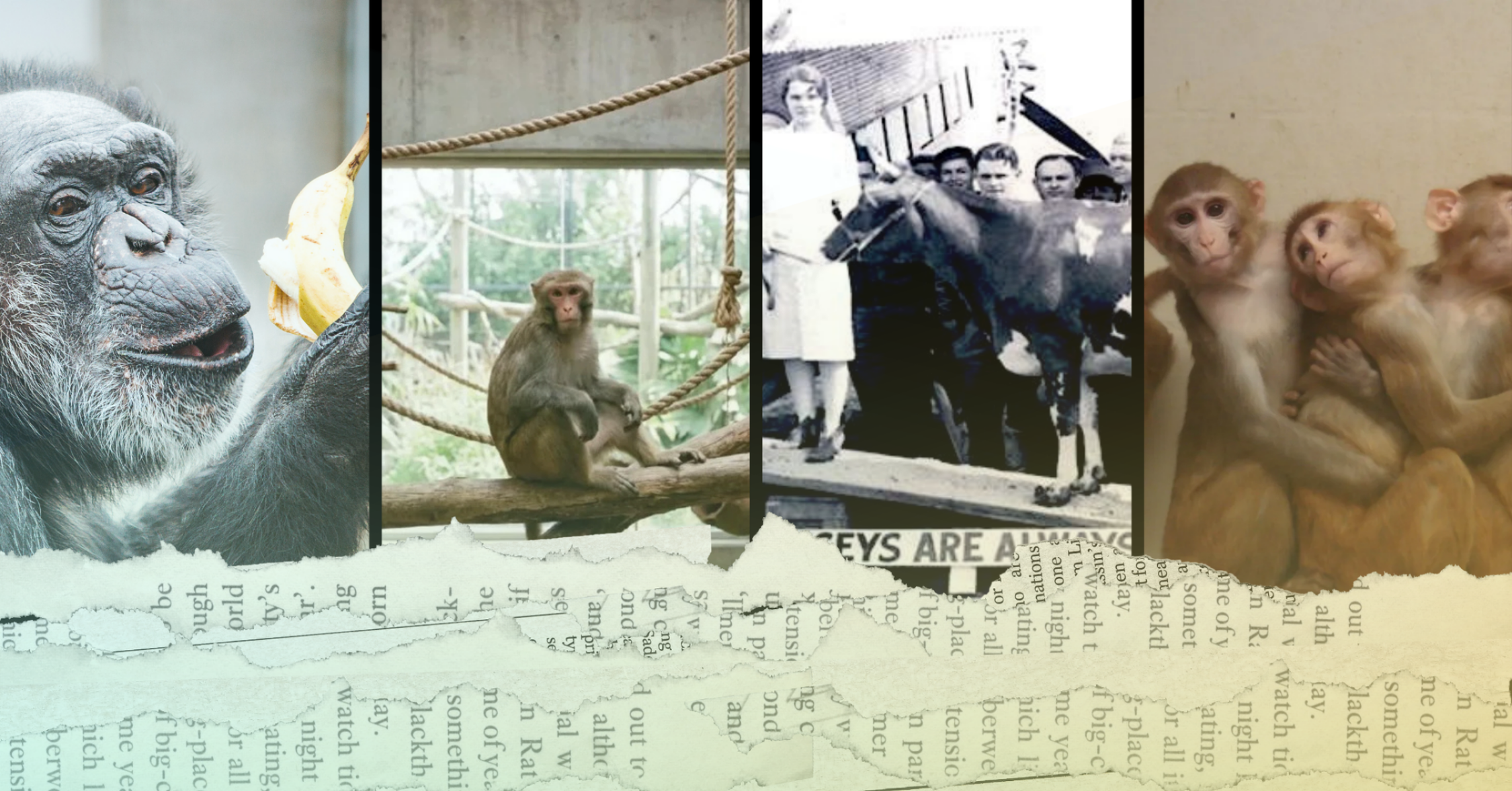
Here’s a roundup of the latest, biggest news stories related to animal research—all the recent media coverage you need to know right now to be the most effective activist for animals in labs.
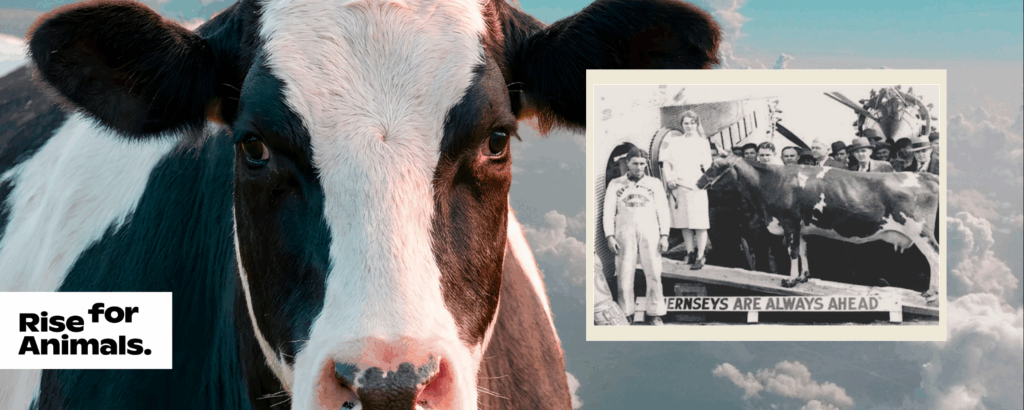
The “Science” of Stealing a Mother’s Milk Mid-Flight
Rise for Animals, 2/18/2026
In 1930, a cow named Elm Farm Ollie was forced onto an airplane and flown from Bismarck to St. Louis, her “fresh-squeezed” “sky milk” parachuted down to spectators below. The bizarre publicity stunt was framed as “science.”
Here’s what history leaves out—and how the animal use industry uses the same playbook today. 📰 Full Story →
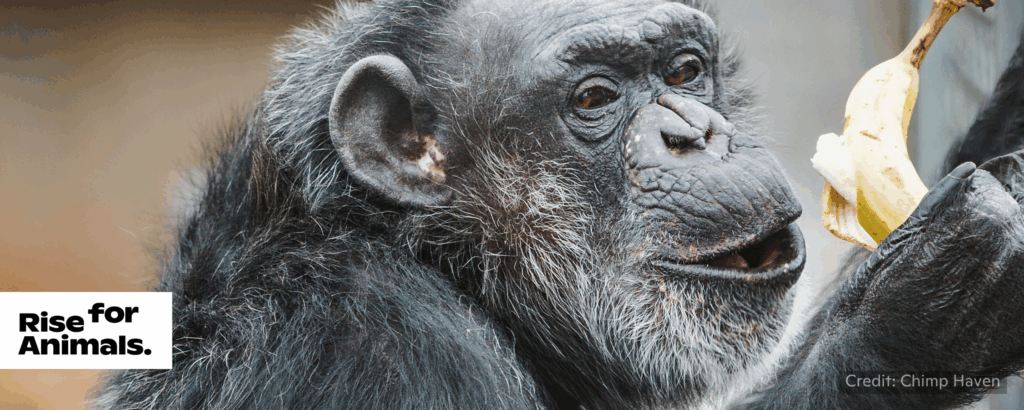
One Year Later: Friendships Bloom Among Freed Chimps
Rise for Animals, 2/19/2026
After decades in a laboratory, it took a few months for the Alamogordo chimps to settle into sanctuary life at Chimp Haven. By last autumn, many of the individuals began the careful process of social introductions after months of observing one another from across hallways and yards.
Watch new friends JD and Socorro in one of their first ever play sessions: 🎥 📰 Watch & Read →
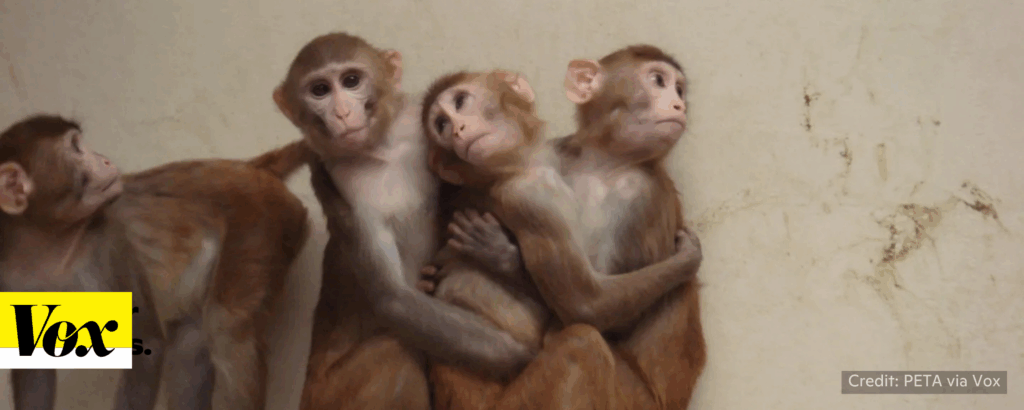
One good thing the Trump administration might actually do for science.
Marina Bolotnikova, VOX, 2/13/2026
“ . . . the board of Oregon Health and Science University (OHSU), which runs one of the nation’s largest university centers for biomedical research on primates, voted unanimously to begin negotiating with the NIH about the agency’s proposal to end experiments on the primates and turn the center into a sanctuary for the animals. Many opponents of animal research hope this can create momentum for a phaseout of experimentation on our primate cousins.”
“Primate research, like most things in science, is the product of path dependency and historical circumstance. In the 1960s, the US created a system of federally funded primate centers, like the one at OHSU. The NIH at the time ‘thought primate experiments were the future,’ . . . and it has shaped the way lots of medical science is practiced to this day. But today, the sight of caged lab monkeys looks more like a relic of the past. It now appears beyond doubt that at least some of what primates are used for in US labs is of extremely limited value….”
“ . . . the mere presence of primate data in the evidence chain for a medical treatment does not prove that that research was indispensable. And given the high moral stakes of research on social, cognitively complex animals, and the substantial opportunity costs of devoting resources and careers to primate labs, merely being sometimes useful does not seem like sufficient justification for subjecting monkeys to lifelong captivity and invasive experiments. The NIH deserves credit for acting on this perspective.” 📰 Full Story →
Dozens of animals found dead in LSU research lab after being abandoned by staff, according to SAEN
FOX 8 staff, FOX 8, 2/12/2026
“Louisiana State University reports show that dozens of animals died after being abandoned by laboratory staff in a temporarily suspended research project, according to a complaint filed by a national watchdog group . . . calling for the permanent termination of the project, a ban on the staff involved from participating in animal research and the return of project funding to the federal government.”
“According to SAEN, one report states that a medical procedure was performed on 40 animals on Friday, Aug. 22. All 40 animals were found dead on Monday, Aug. 25, in the same position they had been placed for recovery following the procedure. The report alleges the animals were not observed for three days.” 📰 Full Story →

Neuroscience has a species problem
Nanthia Suthana, The Transmitter, 2/16/2026
“Neuroscience has never been richer in data . . . Yet despite this abundance, neuroscience remains deeply organized along species lines. Animal and human researchers often operate within separate conceptual frameworks, attend different conferences and develop theories that rarely confront data across species. This separation is no longer a minor inconvenience but a growing liability. The problem is not simply that cross-species translation is difficult; it is that the field has largely accepted this difficulty rather than treating it as a central scientific challenge. Neuroscience has also struggled to confront the fact that different species often tell different stories.”
“For much of my career, I have watched this divide only perpetuate and deepen. I have attended conferences where animal research overwhelmingly shaped the agenda and human work was treated as secondary. At human-focused meetings, the reverse was true, with few researchers whose primary work involved non-primate species having influence over the event. These experiences shape not only which conversations happen but which questions young scientists learn to ask. The result has been the emergence of parallel scientific cultures that rarely engage deeply with each other.” 📰 Full Story →
The Hidden Lives of Lab Animals and the Need for Reform
Marc Bekoff, Psychology Today, 2/17/2026
“Countless millions of nonhuman animals (animals) of all sorts are used in a diverse array of laboratory research . . . The lives of these animals truly are hidden, and most people are incredulous when they learn that laboratory rats and mice still are not considered ‘animals’ under the current federal Animal Welfare Act. The ways in which these intelligent sentient beings are used in invasive experiments demands deep reflection. Lifelong veterinarian Larry Carbone has seen it all; for this and other reasons, I was excited to learn about his new book The Hidden Lives of Lab Animals: A Vet’s Vision for a More Humane Future.”
“‘My central message is simple: We will end laboratory animal suffering only when we end laboratory animal use. Until then, animals deserve more humane treatment, rigorous ethical review, and public accountability.’” 📰 Full Story →
Commercial Spaceflight Proposal Involving Monkey Sparks Ethical Dispute
Big News Network, 2/17/2026
“A quiet research proposal tied to space infrastructure company Nanoracks, a Voyager Space subsidiary, is now facing growing public pushback after details emerged about a potential biological experiment using a primate on a suborbital launch. People familiar with the internal planning say the monkey named ‘Yuri,’ would be put aboard a short research flight intended to observe how the nervous system adapts to reduced-gravity environments. The mission profile would cross the edge of space for only a few minutes before returning to Earth.”
“The revelation has prompted immediate reaction from animal-rights organizations, which have begun contacting regulators and lawmakers in an effort to prevent authorization . . . Regulators have yet to indicate whether a license application will move forward, leaving the proposal’s future uncertain as the ethical debate intensifies. Meanwhile, the lobbying for Yuri to stay on earth continues.” 📰 Full Story →
No First Amendment Right to Force Government to Provide Live Feed of Macaques in Government Lab
Eugene Volokh, Reason, 2/18/2026
“In addition to a separate administrative law basis, the court dismissed [PETA’s claim that its First and Fifth Amendment rights were violated by Defendants’ denial of PETA’s request to install a 24-7 audio visual life feed of macaques currently housed in a laboratory] for lack of standing, reasoning: ‘PETA’s claimed injury to its First Amendment right to ‘listen’ is not, as pleaded, a legally protected interest sufficient to confer standing. Although the First Amendment ‘protects both a speaker’s right to communicate information and ideas to a broad audience and the intended recipients’ right to receive that information and those ideas,’ the narrower claimed right to ‘receive speech’ requires the plaintiff ‘show that there exists a speaker willing to convey the information to her,’ and that ‘the listener’ maintains ‘a concrete, specific connection to the speaker.’ Nowhere does PETA establish any authority whatsoever for the extraordinary proposition that the macaques’ sounds and movements constitute protected speech to which a companion right-to-listen exists.”
“Defendants noted that PETA could submit a FOIA request ‘for any existing audiovisual recordings of the macaques,’ but PETA argued that ‘FOIA will not ‘satisfy PETA’s First Amendment right to receive communications directly’ from the macaques.” 📰 Full Story →

Review clears dog research of welfare breaches, urges better communication
Reta Ismail, CTV News, 02/19/2026
“St. Joseph’s Health Care London released the results of several independent reviews into its animal research practices, including a third-party assessment commissioned after public and political outcry over the use of dogs in cardiac studies.”
“The review by CCAC, into dog-based cardiac research at St. Joseph’s Health Care London has found no breaches of animal care standards, concluding allegations of ‘mistreatment’ were unsubstantiated. However, the review identified shortcomings in governance and public communication that must be addressed.” 📰 Full Story →
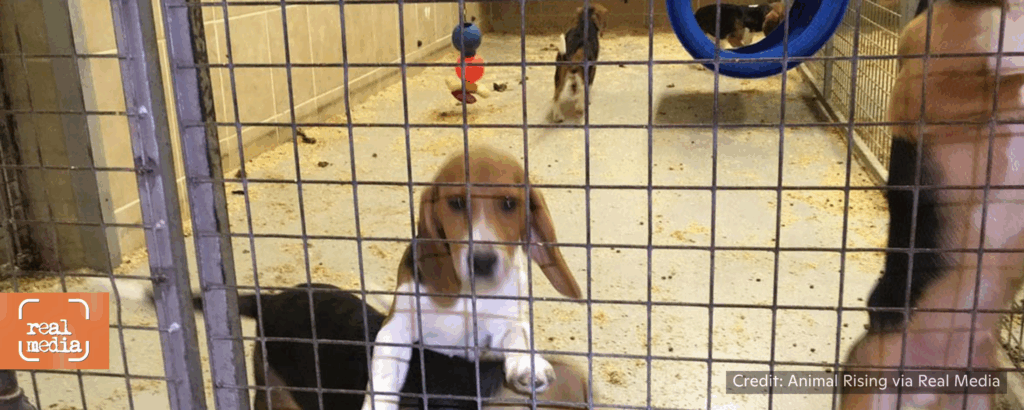
No Prison for Animal Rising Beagle-Rescues
Real Media, 2/19/2026
In December 2022, 18 members of Animal Rising broke into the Marshall BioResources beagle-breeding facility (MBR Acres) in Cambridgeshire and rescued 20 beagle puppies who otherwise faced a short life of torture in the name of animal testing. They were eventually charged with burglary in June 2024….”
“The first group faced trial at Cambridgeshire Crown Court in December, and were found guilty after a 12-day trial. Four of them were sentenced today. Three received 18-month suspended sentences, with 120 hours unpaid work and £860 prosecution costs each, and the fourth received a conditional discharge and £200 costs.”
“The second trial reportedly had more leeway to speak about what goes on inside the beagle factory and what fates lie in wait for animals supplied to laboratories. In January after a seven-day trial a jury at Cambridgeshire Crown Court found them not guilty in a unanimous verdict which only took two hours. The defendants relied on a defence of honesty, denying any of the elements of dishonesty which are required in order to prove guilt under the Theft Act 1968.”
“In the third trial at the end of last month, the jury at Peterborough Crown Court returned a guilty verdict and sentencing happened immediately the following day, with all four defendants avoiding immediate custodial sentences. Two were given suspended nine-month sentences and over a hundred hours of unpaid work. The other two received conditional discharges.”
“The final trial begins next Wednesday.” 📰 Full Story →
Help spread the word. Share this news compilation on Facebook, X, or Bluesky.