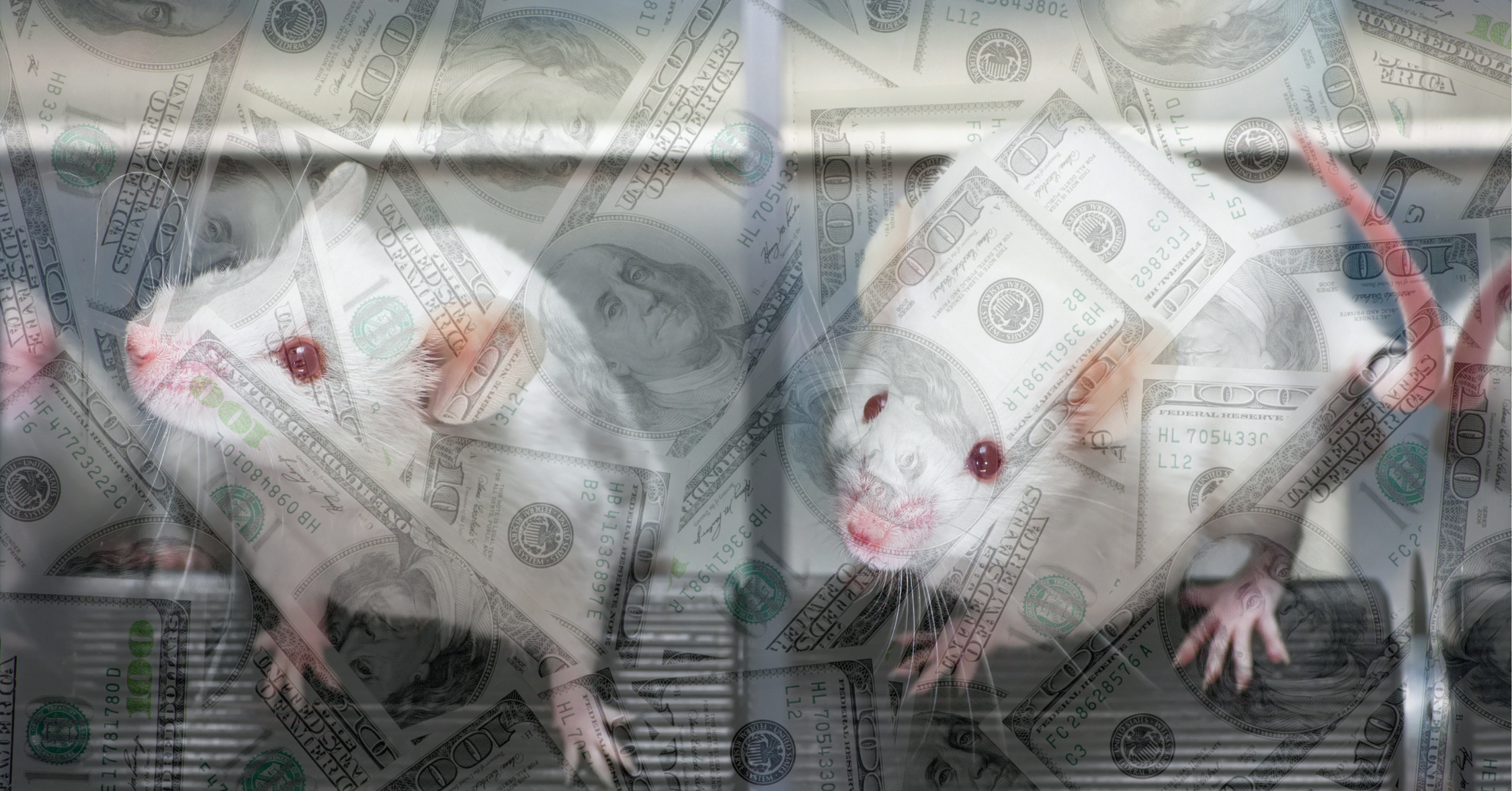
Washington lawmakers are currently considering HB 2542, a bill that would require the use of validated non-animal research methods when available.
Rise for Animals recently joined other advocates in supporting the bill before the House Committee on Consumer Protection and Business, and the message from the public was overwhelmingly clear:
Thirteen of the fourteen people who registered for in-person testimony supported HB 2542.
The lone dissenting voice?
A professional defender of animal research.
Meet the Industry’s Messenger
That speaker was Primo Castro, Director of State Government Affairs for the Western Region at the Biotechnology Innovation Organization (“BIO”)—the world’s largest biotech trade association.
Castro’s job is to represent the interests of BIO’s members, and he acts as a liaison between them and western state governments—advocating for policies favorable to the biotech industry, including those that protect animal research. (Prior to joining BIO, Castro worked for the American Cancer Society, a huge proponent and funder of “animal-model research.”)
So, when Castro testified against HB 2542, he wasn’t offering an independent scientific assessment. He was doing exactly what he’s paid to do.
“We Support Alternatives” . . . In Theory
Castro opened his testimony with a familiar industry script. BIO, he said, appreciates the “intent” behind the bill. BIO, he claimed, supports the “ethical treatment” of animals.
But, then, came the pivot.
Animal research, Castro argued, remains “necessary.” And HB 2542, he warned, could deter biotech companies from developing “life-saving treatments for patients.”
This is one of the animal research industry’s most reliable hypocrisies: praising “alternatives” to animal research, while opposing policies that would actually mobilize them.
BIO itself claims to support a reduction in “the number of animals used for research when it is possible to develop, validate and use alternative methodologies.”
HB 2542 seeks to do exactly that by requiring the use of non-animal methods once developed and validated. So why oppose it?
Because what BIO actually wants—and admits, though only amidst layers of (hollow) ethical posturing—is that the industry’s “ability to conduct” animal research “be preserved.”
And this explains its opposition to HB42: by prohibiting animal use in certain circumstances, HB 2542 threatens that “ability”—it limits the industry’s discretion to choose animal experimentation . . . and that’s where the industry draws the line.

The industry has voiced some tolerance for non-animal methods when they are complements, or add-ons, to animal research—but that tolerance abruptly ends when they are framed as replacements to animal research (and, thereby, threaten animal research’s stranglehold on preclinical research).
Follow the Money
BIO represents over 1,000 biotechnology companies, academic institutions, state biotechnology centers and related organizations. These member entities—which include animal research giants like Charles River Laboratories and Tulane University—fund BIO through membership dues and sponsorships.
They also effectively run the organization: BIO’s Board of Directors is stacked with executives from leading pharmaceutical and technology companies—many heavily invested in animal research—including Bristol Myers Squibb, Novartis, Sanofi, Amgen, Merck, Eli Lilly, and Johnson & Johnson.
Which means that BIO is not *just* adjacent to animal research—it’s governed and funded by entities that profit from it . . . and it acts accordingly.
Beyond aggressively advocating for public and private funding of biomedical research and opposing meaningful regulations of the same, BIO directly shapes the political sphere in which decisions about animal research are made: through its multi-candidate political action committee—BIOPAC—BIO invests directly in political influence, supporting the election of lawmakers who favor the biomedical research enterprise and donating to legislators who oversee controlling agencies like the NIH and FDA.
In other words, BIO helps elect the people who write the rules, fund the labs, and have the power to decide the future of animal research in the U.S.
A Circular Argument—By Design
BIO’s official position is that animal research remains “indispensable” to “biomedical and agricultural research” because it is legally required.
But this is the industry’s sleight of hand—the very same one we’ve previously broken down: the legal requirement that animals be used in preclinical research does not mean, and has never meant, that animals are actually necessary for scientific progress.
Its circular logic, though it does help explain BIO’s opposition to HB 2542:
If the law no longer requires animal use when validated non-animal methods exist, animal research becomes—by BIO’s very own “logic”—dispensable.
That’s the real threat. And, that’s why, despite all its talk of ethics and animal use reductions, BIO showed up to oppose a state bill that would deliver both.
This Is Where We Come In
HB 2542 represented a rare and meaningful opportunity to challenge the animal research industry’s grip on state policy—and the industry clearly knew it. Why else would it send a paid lobbyist to counter overwhelming public demand for better, more ethical science?
Now, with the bill stalled in Committee, the industry is counting on us to fall back in defeat.
We won’t.
As long as federal regulations entrench animal testing in drug development, industry lobbyists like BIO will continue hiding behind “legal” requirements to defend animal exploitation.
That’s why—far from retreat—this moment demands escalation.
We must take this fight from Washington State back to the U.S. Capitol.
Congress can begin dismantling animal testing at the federal level by passing the FDA Modernization Act 3.0. The Senate has already passed this bill. Help get it across the finish line by urging your U.S. Representative to support this bill now. We’ve made it easy with a pre-written letter you can send in 30 seconds: