Over a century ago, two Swedish women ignited “the peak of the antivivisection movement” in Britain by exposing the public torture of a little brown dog.
Liesa Schartau and Lizzy Lind af Hageby enrolled in medical school with a specific interest in “monitoring experiments on animals” and seeking to investigate the “contrast between the accounts of the cruelty of vivisectional experiments given by vivisectors and by the opponents of the system.”
While enrolled at the London School of Medicine for Women, where vivisection was prohibited, the women received permission to attend “some fifty” lectures and demonstrations at other universities.
What they witnessed was horrific—and what they documented changed history.
Though they had not originally intended to “make [their] experiences public in this way,” Schartau and Lind af Hageby chose to co-author a book—The Shambles of Science—after abandoning their medical studies:
The idea of working for a final examination and scientific degree, which we have first held, has been given up, because physiology is at present inseparable from experiments on animals, and nobody objecting to them could have any chance of obtaining a degree. We now think that some of the things we have heard and seen in England may be of interest to England anti-vivisectionists, and we have therefore decided to compile part of our notes and reflections and to publish them.
Vivisectors are extremely anxious to spread their ideas among the young students, and they are not in the least ashamed of their teachings. They ought, therefore, not to object to these comments on their doctrine by two very attentive pupils.

The Shambles of Science contained harrowing accounts of animal suffering—and one chapter in particular sparked a public reckoning.
The Vivisections of the Brown Dog described two “experimental physiologists [Ernest Starling and William Bayliss] in the Claude Bernard mold” violating applicable regulations by vivisecting a single dog multiple times and failing to use any or adequate anesthesia.
The dog was first used in vivisection in December 1902 by Starling, who cut open the dog’s abdomen and ligated the pancreatic duct while fully conscious. For the next two months, the dog lived in a cage until Starling and Bayliss used him again for two procedures on 2 February 1903, the day Lind and Schartau were present. The women alleged that Bayliss illegally dissected the dog while it was awake.
After reading the account, attorney Stephen Coleridge gave “a well-publicized lecture in which he took the two scientists to task.” In response, one of them (Bayliss) sued Coleridge for libel and won damages, even though “by preparing the dog for survival surgery he had in fact broken the law.” Public sentiment sided heavily with Coleridge, and Bayliss, despite his legal victory, was cast a villain.

Following the lawsuit, which received widespread media coverage, the chapter on the Brown Dog appears to have been suppressed and is absent from later editions of the book.
But the story it recorded refused to fade—and sparked a movement.
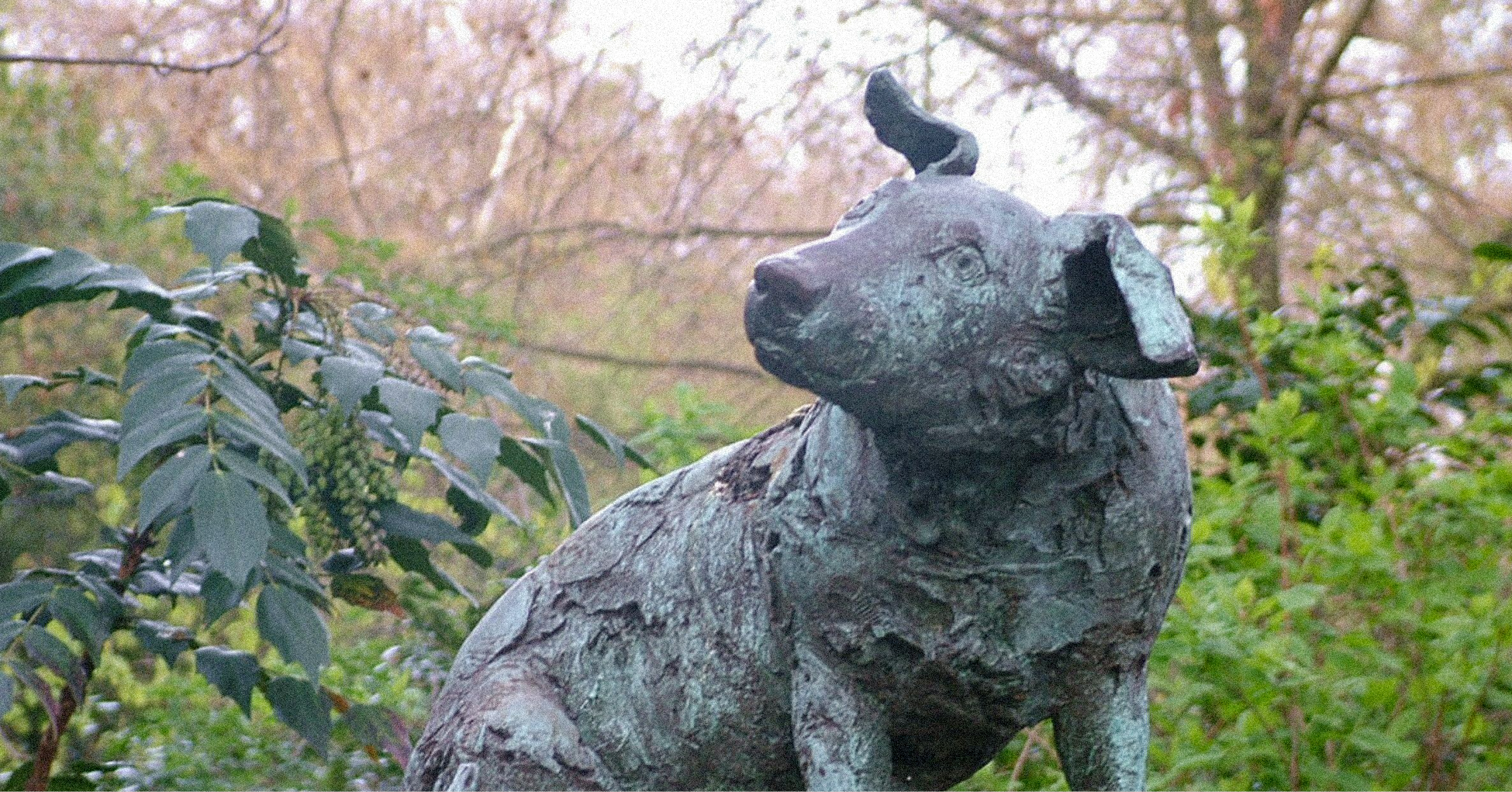
In 1906, advocates funded a memorial statue to the Brown Dog, which was erected in Battersea Park.

Some think the story might have ended there—if not for the statue’s provocative inscription:
In Memory of the Brown Terrier Dog Done to Death in the Laboratories of University College in February, 1903, after having endured Vivisection extending over more than Two Months and having been handed over from one Vivisector to Another Till Death came to his Release. Also in memory of the 232 dogs Vivisected at the same place during the year 1902. Men and Women of England, how long shall these Things be?
The statue became a political flashpoint: “an actual physical symbol of the debate that had set scientists and members of the public at each other’s throats.”
Enraged that their “reputations had been maligned,” medical and veterinary students, along with other pro-vivisectionists—together referred to as “anti-doggers”—launched a campaign to destroy the statute in 1907. But they encountered fierce resistance.
Along with anti-vivisectionists, members of the working class and women—many of whom saw in the Brown Dog’s fate a reflection of their own oppression—turned out to protect the statute. (The Brown Dog Affair is actually credited with “unit[ing] a sector of popular opinion, women suffragists and working class men, who all came together to defend the dog not only due to antivivisection sentiment, but also because the statue had become a symbol of victimhood, oppression by wealthier, established forces, and the casual but deliberate cruelty inflicted on the disenfranchised.”)
Riots broke out. Police were deployed. And then, suddenly, the statue disappeared.

Though theories persist about its fate, commentators surmise that the Battersea Council grew tired of paying to protect the statute and—after a shift in local political power (“from Socialists and Progressive to Moderates in the election of 1908”)—ordered it “removed by four councilmen guarded by 120 police” and destroyed.

But the statue’s disappearance didn’t erase what the Brown Dog had come to represent: “a significant turning point in the conflict between scientific progress and antivivisectionism.”
The Brown Dog became “a martyr to the antivivisectionist cause,” focusing “public attention on what was considered unnecessary cruelty conducted under the auspices of science” and spurring ongoing public outcry—that is, until “the carnage resulting from two world wars” pushed issues of animal welfare to the background.
Decades later, in 1985, advocates erected a new statue in Battersea Park with an inscription pointing both to the past and to the continued relevance of the fight against vivisection:
This monument replaces the original memorial of the Brown Dog erected by public subscriptions in Latchmere Recreation Ground, Battersea in 1906. The sufferings of the Brown Dog at the hands of vivisections generated much protest and mass demonstrations. It represented the revulsion of the people of London to vivisection and animal experimentation. This new monument is dedicated to the continuing struggle to end these practices. After much controversy the former monument was removed in the early hours of 10 March 1910. This was the result of a decision taken by the then Battersea Metropolitan Borough Council, the previous Council having supported the erection of the memorial. Animal experimentation is one of the greatest moral issues of our time and should have no place in a civilized society. In 1903, 19,084 animals suffered and died in British Laboratories. During 1984 3,497,335 experiments were performed on live animals in Great Britain. Today, animals are burned, blinded, irradiated, poisoned and subjected to countless other horrifying cruel experiments in Great Britain.
This new statute’s removal in 1992 provoked another wave of anger and activism, which led to the statue’s reinstatement in 1994 in a “‘more secluded’ spot” where it still stands.

The Brown Dog Affair reminds us that public exposure is the animal research industry’s greatest threat—a truth that remains just as urgent today.
As former vivisector Richard Miller writes:
[The Brown Dog Affair] exhibited all of the elements of the grassroots reaction to animal use by science that we still find today . . . all of the different elements of the modern debate between the animal welfare community and scientists are clearly present. Naturally, the debate had something to do with science, but it wasn’t a scientific debate. By the start of the [20th] century science had become a political issue that concerned all of society, not just scientists.
Though “the array of forces on both sides of the argument has greatly expanded in number” since the Brown Dog Affair, “the immeasurable burden of pain and horror borne by” victims of “science”—just like the little Brown Dog—continues.

In the ever-relevant words of Schartau and Lind af Hageby:
In the stables and cages where various animals await their fate there is misery and half-conscious terror of the things of which they have a presentiment; when we follow them on their weary way up to the rooms where the operation-table, the knives and scissors, the electrical apparatus are ready for them, their mental anguish is soon augmented by bodily pain.
In the pain-tortured bodies, trembling under the sharp steel, bathing in their own blood, and in vain trying to tear the straps that fasten them to their crosses of agony, twitching under the piercing occurrence of artificial electricity, there is no trace left of the normal life in the nerves, in the blood, in the wonderful co-ordinated mechanism of the internal organs….
Vivisection is bankrupt; all the teachings and bloodstained theories which are brought out from these laboratories under the name of physiology make one stupendous fraud. When the day of a true science has reached its zenith they will disappear like the evil smoke which obstructed the dawn of morning after the revelling nights of sacrificial worship of infernal powers.
This National Brown Dog Day, we remember the dog who helped spark a movement.

We remember what was done to him—and what is still being done to countless others.