Meet 264 Victims of Animal Agriculture and Animal Research
Why This Matters: The same animals who are engineered for maximum profit in factory farms are quietly used in federally-funded research, suffering twice over and meaningfully protected by neither law nor transparency. This investigation exposes how animal agriculture and animal experimentation are not separate systems, but one continuous cycle of commodified violence—paid for, in part, by the public.
Farmed Animals Are Research Animals
Farmed animals are common victims of animal research. So it should come as no surprise that “the most intensively farmed animals in the world”—including so-called “broiler chickens”—are routinely used as test subjects.
“Broiler” chickens are named for how their bodies were historically processed: “a preparation and cooking method in which young birds of 5 to 6 weeks old are split open and broiled….” Today, “broiler” has become the industry’s generic shorthand for roughly 9,000,000,000 “birds farmed for meat” every year in the U.S. alone.

How many of these birds are experimented on before they are slaughtered, no one knows. These sentient beings have zero legal protections under federal law and are neither counted nor reported by any federal agency.
Their exploitation almost always happens out of sight, both literally and figuratively.
But now—thanks to Animal Partisan—the stories of 264 victims can finally be told.
The Birds Were “Products” Even Before They Were “Subjects”
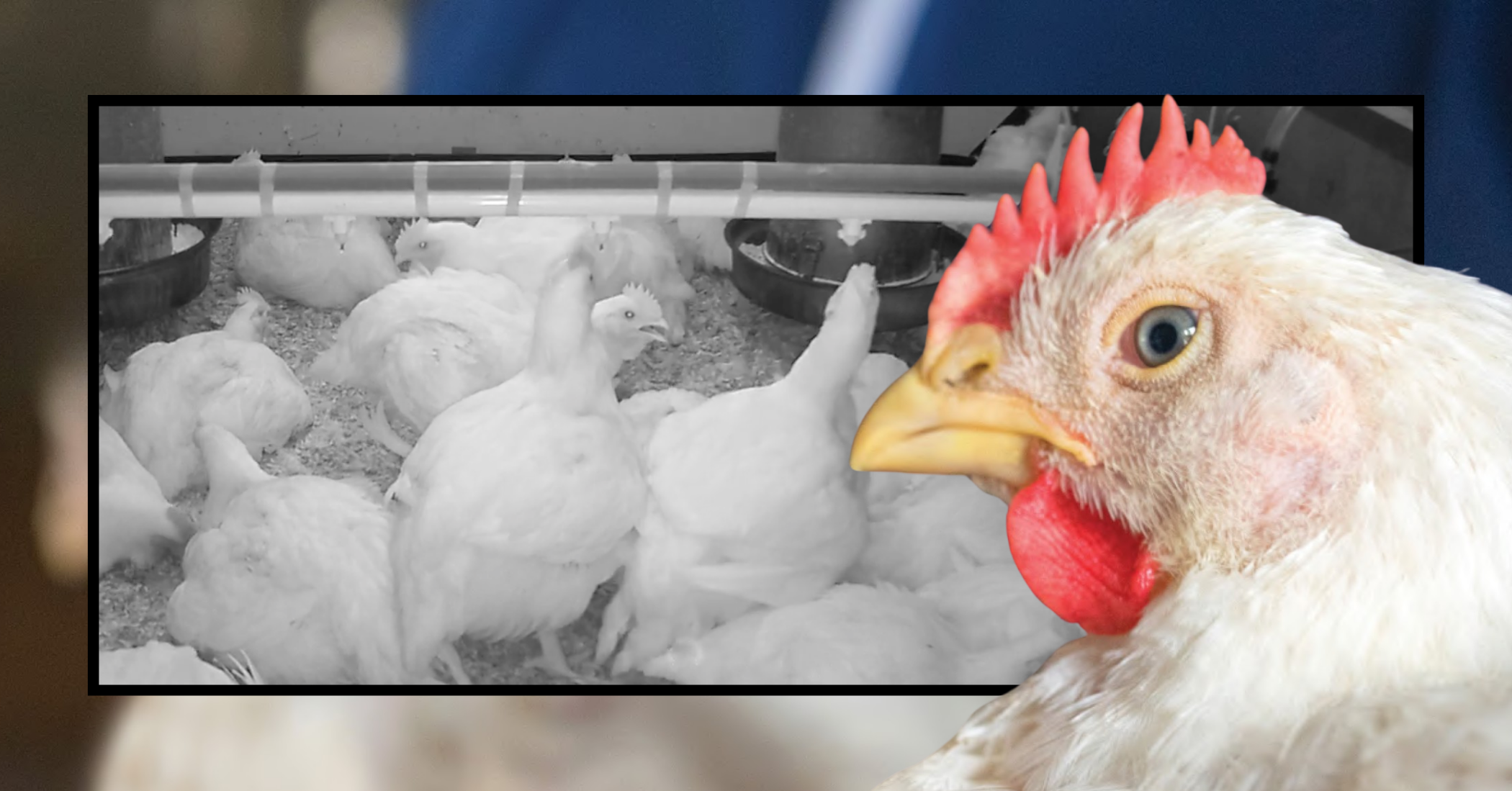
Animal Partisan has obtained video footage of a research protocol using “heavy broiler” chicks—yet, even before these individuals were exploited on camera, their bodies had already been manipulated by humans.
The victims were Cobb500™ broilers, which Cobb-Vantress (a subsidiary of Tyson Foods) markets as trademarked “products.” As of the early 2010s, Cobb-Vantress was one of just three companies owning and controlling the genetics of almost all broilers produced worldwide—selling birds to over 120 countries . . . and, apparently, to an unknown number of laboratories.

Cobb500™ broilers represent one of two dominant commercial chicken “strains,” resulting from “decades of selective breeding aimed at maximizing growth rate and breast muscle yield.”
Their human engineers wanted birds who would grow very quickly “while eating only a small amount of feed.” The consequence has been catastrophic for the animals, who “reach their market size weight” within the first few weeks of life and whose breasts—which now account for one-fifth of their whole bodies—develop far faster than the bones, tendons, organs, and cardiovascular systems meant to support them. Journalist Maryn McKenna captured vividly the imbalance this produces in their bodies:
A fast-growth broiler has the teetering instability of an olive propped up onto toothpicks.
Unsurprisingly, nearly one-in-two “broiler” chickens “suffer from some form of gait impairment, or difficulty walking.” Even in the study at hand, researchers confirmed that heavier birds “were found to be less likely to walk or stand,” “barely made more than two or three steps unless it was required to reach the drinker or feeder,” and spent more time sitting than walking or standing—even when they were not classified as having “leg defects.”

Beyond the immense pain caused by their artificially-induced and accelerated muscle growth, these chickens commonly suffer from cardiovascular dysfunction, bone deformities and skeletal lameness, dead or hardened muscles, fluid accumulations in their abdomens (due to stress on their circulatory systems), abnormal eye conditions (including severe lesions), integument lesions (painful lumps and sores caused by lack of activity and prolonged contact with their own feces), and skin burns.
But none of this is what worries the industry.
The industry worries that these tortured, genetically-distorted animals are more prone to heat stress—which means they eat less, gain less weight, and generate less profit.
Enter North Carolina State University—and Your Federal Tax Dollars
In the study undertaken by North Carolina State University and investigated by Animal Partisan, researchers used federal money to investigate how heat-stressed Cobb500TM “heavy broiler” chickens behaved under different ventilation settings in “poultry growth chambers.”

Researchers hatched 400 chicks, then selected “264 birds without leg defects.” The birds were crammed into chambers where each individual had roughly a single sheet of paper’s worth of space—a density the researchers specifically stated satisfies “animal welfare guidelines.”
The birds remained in the chambers for 33 days (days 28 to 61 of life). After a week of acclimation, experimentation began: researchers manipulated air velocity inside the chambers and recorded behaviors—eating, drinking, standing, walking, sitting, panting, wing flapping, leg stretching—to determine how to keep their bodies most profitable in the face of significant genetic and environmental stressors.
As you watch the video, remember: despite their artificial size, these birds are essentially babies forced into the bodies of adults.
The Groundbreaking Finding? Chickens Eat Less When They’re Too Hot
The researchers concluded that high air velocity “helped more chickens to eat under heat-stressed conditions,” meaning that improved ventilation may “help regulate broiler performance even under faster growth rates and environmental stresses.”
In other words: chickens who are not in fear of or actively overheating are less stressed (and, to the industry’s interest, eat more and grow faster).
Groundbreaking stuff, right?
For this, we can thank the federal government—specifically the USDA—which once again used our tax dollars to subsidize research about how to make animal suffering more profitable.
This is, after all, the same agency responsible for other awe-inspiring research conclusions (think: kill-traps kill animals) and that once proudly compared the “production” of “broiler” chickens to the “production of cars.”
What This Exposes—and the Larger Truth Behind It
Animal Partisan has opened rare windows into otherwise windowless sheds—and, thereby, into a world of routine, industrialized experimentation on birds whose suffering is invisible by design.
The 264 victims whose stories can now be told were not only farmed for human consumption but were also used as experimental tools to help maximize the output and profitability of the very industries exploiting them.
Their lives exemplify the brutal truth that farmed animals are research animals—and that, sometimes, they’re both at the very same time.

This study reminds us that the categories humans assign—”farm animal,” “broiler chicken,” “research subject,” “experimental unit”—are not descriptions of the animals themselves but of how the animal industrial complex commodifies and seeks to extract value from their bodies.
The same birds engineered for human “food” are sold to laboratories, where the “science” that created them feeds back into itself: its victims become the next round of test subjects—many even exploited with public funding from the very federal agency charged with enforcing animal welfare standards against the corporations standing to gain from the research itself.
There is no meaningful separation between the violence of factory farming and the violence of animal research—or between its victims.
The vast majority of whom live, suffer, and die out of view.
But now—at the very least—264 of them have witnesses.
Spread the truths the animal use industrial complex wants to keep quiet.
Share this article now on X, Bluesky, or Facebook.