Here’s a roundup of the latest, biggest news stories related to animal research—all the recent media coverage you need to know right now to be the most effective activist for animals in labs.
The Latest In Non-Animal & Human-Relevant Science
Rise for Animals, 1/8/2026
Explore the latest human-relevant science and alternatives to animal research from December 2025, including the largest dataset of human biology-based models; patient-derived cell assembloids; a new AI brain model; and more. 📰 Full Story →
The Replace Animal Tests Act (H.R. 6660)
Rise for Animals, 1/7/2025
A few weeks ago, Representatives Jared Moskowitz, Jan Schakowsky, and Shri Thanedar introduced the Replace Animal Tests Act of 2025 (Replace Act) (H.R. 6660), landmark legislation designed to modernize U.S. regulatory testing and significantly reduce the use of animals subjected to it.
If enacted, the Replace Act would represent one of the most meaningful federal advances for animals in laboratories in years. 📰 Read More and Take Action→
Congress orders Defense Department to stop painful experiments on dogs and cats
Stephen Dinan, The Washington Times, 12/18/2025
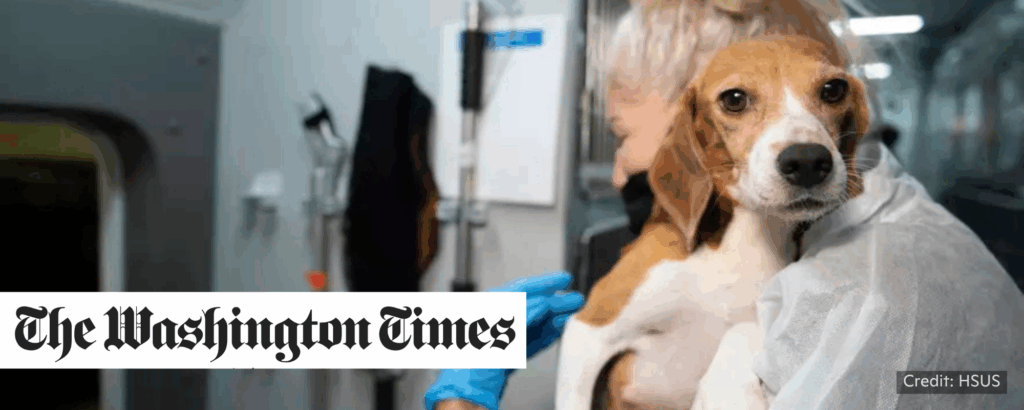
“The Pentagon is now barred from carrying out painful experiments on dogs and cats, thanks to new language in the defense policy bill . . . The change was written by Congress after lawmakers recoiled from reports earlier this year that the Navy was funding experiments that shocked and crippled cats as part of erectile dysfunction and incontinence research. The Navy shut down all dog and cat testing after those revelations, but the new law goes further, directing a halt across the entire Defense Department.”
“The law allows some research as long as it’s not ‘painful.’ The Defense Department secretary can waive the ban if he determines an experiment is “in the national security interests of the United States.’” 📰 Full Story →
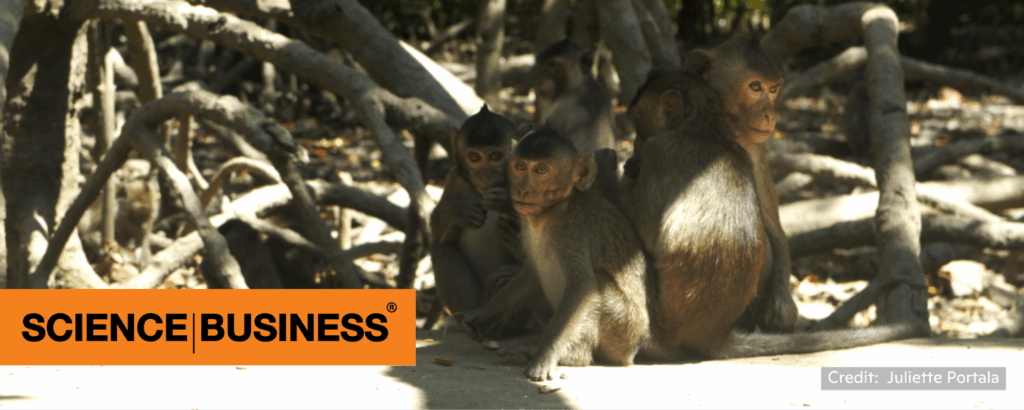
France expands primate breeding centre in name of scientific sovereignty
Julietta Portala, Science | Business, 12/18/2025
“France’s National Centre for Scientific Research (CNRS) plans to triple the capacity of its Provence breeding site for primates used in scientific experiments, in response to evolving regulatory, animal welfare and national sovereignty needs. However, it faces stiff opposition from animal rights groups, which have already taken it to court for failing to release documents on its use of primates.” 📰 Full Story →
US military to stop shooting pigs and goats as a way to train medics for the battlefield
Ben Finley, Associated Press, 12/19/2025
“The U.S. military will stop its practice of shooting pigs and goats to help prepare medics for treating wounded troops in a combat zone, ending an exercise made obsolete by simulators that mimic battlefield injuries. The prohibition on ‘live fire’ training that includes animals is part of this year’s annual defense bill, although other uses of animals for wartime training will continue . . . the Defense Department will continue to allow training that involves stabbing, burning and using blunt instruments on animals, while also allowing ‘weapon wounding,’ which is when the military tests weapons on animals.”
“It’s unclear how often the military uses animals for training.” 📰 Full Story →

Trump Cabinet teams up to end animal abuse
My View with Lara Trump, FOXNews, 12/20/2025
“‘We have this unusual confluence right now at HHS where all the major agency heads, sub-agency heads, are all deeply committed to ending animal experimentation. And what we’ve found, we’ve done internal studies now, that show that the predictivity of animal models is very, very poor for human health outcomes. There’s much more efficient ways of predicting human health outcomes . . . even in their nascent stages, computational modeling and AI were much better.’”
“‘There are 100,000 monkeys . . . nonhuman primates that are in primate labs around the country for research purposes. There are another 20,000 that are imported every year, and we’re very concerned about that. We’re trying to put an end to that completely. And the badge of a really humane nation is the way that it takes care of its animals . . . One of the things that we’re doing is that we’re re-educating researchers, so that they know that there is these other forms of research that are much more predictive of human health outcomes.’”
“‘In September, we changed the rules at NIH to make it so that researchers can use part of their NIH funding to retire their primates to sanctuaries after the experimentation is done. Until now, there was no option like that, no alternative, except for the researcher euthaniz[ing] that animal after they were through. Now, we’re developing sanctuaries across the country.’”
“One of the things that people need to recognize is that there’s a dynamic here like in many other things that is self-sustaining and self-reinforcing, and the primate centers also have a profit motive, and they get locked into the system where the researchers know that they can make a certain amount of money through this kind of research . . . even when it doesn’t make any sense to do these kind of experiments, this kind of research, when there’s better ways, more efficient ways, more predictive models. They don’t really want to switch. And we need to challenge that inertia.’” 📰 Full Story →
20 House Lawmakers Issue Letter in Sync with RFK Jr.’s Plan to Wind Down Use of Primates in Major Facilities Across the Nation
Animal Wellness Action, 12/22/2025
“A group of 10 Republicans and 10 Democrats in the U.S. House of Representatives . . . sent a letter Friday to National Institutes of Health (NIH) Director Dr. Jay Bhattacharya, urging his agency to redirect federal funds currently allocated for non-human primate (NHP) research centers toward more ethical and cost-effective uses. The letter, coming on the heels of Health and Human Services Secretary Robert F. Kennedy, Jr.’s appearance on the Lara Trump Show this weekend announcing the Trump administration’s plan to wind down animal testing, also encouraged NIH to establish a preference for grant proposals that aim to utilize modern animal-free research methods.”
“ . . . the lawmakers recommended these three additional reforms: • Reassessing and reallocating federal funding for the National Primate Research Centers consistent with an animal testing phaseout announced earlier this year by the FDA. • Giving grantmaking preference to proposals using animal-free New Approach Methodologies (NAMS) such as artificial intelligence and advanced cell models. • Reaffirming the NIH’s commitment to the ‘3Rs’ by clarifying that NAMs are intended to replace, not merely to complement, animal use.” 📰 Full Story →
Kennedy ‘deeply committed to ending animal experimentation’
David Grimm, Science, 12/22/2025
“In his strongest condemnation yet of animal research, U.S. Department of Health and Human Services (HHS) Secretary Robert F. Kennedy Jr. said over the weekend that his department, which oversees several science agencies, is “deeply committed to ending animal experimentation.” He also called for an end to the importation of monkeys for scientific studies, claimed the federally funded National Primate Research Centers (NPRCs) are driven by profit, and floated the idea of moving research monkeys to sanctuaries. The remarks, made Saturday on a Fox News program hosted by the daughter-in-law of President Donald Trump, have sent shock waves through the biomedical community.”
“Since last summer, rumors have swirled among researchers that the government is considering closing the NPRCs—which house about 20,000 animals used in academic labs—and converting them into sanctuaries, in part because private sanctuaries have no room. Then, last month the Centers for Disease Control and Prevention moved to phase out all of its monkey studies.”
“An HHS spokesperson did not respond to a request for more details on Kennedy’s remarks. ‘Across the Trump administration, there is a shift to prioritize animal welfare,’ the spokesperson told Science. ‘At HHS, that includes moves to reduce unnecessary animal testing requirements and prioritizing human-based research.’” 📰 Full Story →
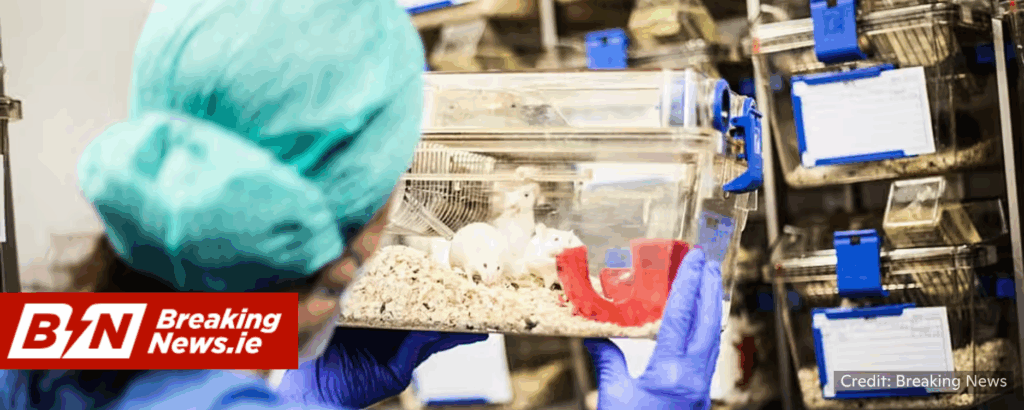
Dogs, horses and goats among 112,000 animals used in Irish lab experiments last year
Darragh Mc Donagh, Breaking News, 12/23/2025
“More than 112,000 animals were used for research and testing purposes in Irish laboratories during 2024, representing a five per cent increase on the previous year, new figures have revealed. Mice were used in almost 86 per cent of the experiments but other species included dogs, guinea pigs, rabbits, horses, goats, and ferrets. Around 1,400 animals were used in more than one experiment. Just over 19,000 of the experiments involved ‘severe’ pain and suffering for the animals….”
“The increase in the use of animals in Irish labs for a second consecutive year has been criticised by the Irish Anti-Vivisection Society (IAVS), which said the rise in ‘severe’ experiments was particularly worrying.”
“The statistics are driven by the fact that Ireland develops and produces around 80 per cent of the world’s Botox-type drugs, each batch of which is typically tested for potency in fatal experiments involving mice . . . The regulatory tests are classified under the highest category of suffering, as the toxin causes paralysis, respiratory distress, and inability to access food or water. The mice ultimately die from suffocation, dehydration or starvation over three or four days.” 📰 Full Story →

South Korea expands ethical oversight of animal testing in national R&D
Jung Min-kyung, The Korea Herald, 12/23/2025
“South Korea has expanded ethical requirements for animal testing conducted as part of national research and development projects, bringing a wider range of institutions under regulatory oversight.”
“Under the revised decree, companies governed by the Commercial Act, small and medium-sized enterprises, and nonprofit organizations that carry out national research and development projects involving animal testing are now classified as animal testing institutions. These entities are required to establish and operate an animal ethics committee and comply with rules governing the humane and ethical treatment of laboratory animals. Previously, only government-funded research institutes were subject to these obligations. The change ensures that all institutions participating in national R&D projects are held to the same ethical standards.” 📰 Full Story →

Rand Paul’s annual Festivus report slams feds for bug buffets, coked-up dogs and $1.6T taxpayer tab
Caitlin Doombos, New York Post, 12/23/2025
“The annual report, released in the spirit of Seinfeld’s famously cranky holiday, accuses federal agencies of blowing taxpayer cash on everything from insect-eating propaganda to drugged dogs, drunken ferrets and monkeys playing a ‘Price Is Right’ knockoff video game. And that’s just the tip of the iceberg.”
“Animal experiments featured prominently in the report’s hall of shame, as they have in years past. Taxpayers paid more than $1 million for a Veterans Affairs study that forced teenage ferrets to binge-drink booze — before killing them. The NIH also spent $5.2 million dosing dogs with cocaine — again — while $13.8 million more went toward controversial beagle experiments tied to previously reported Fauci-era grants, according to the report. Elsewhere, monkeys with metal headposts screwed into their skulls to keep their heads in place as they were forced to play a Plinko-style video game — to the tune of $14.6 million.” 📰 Full Story →
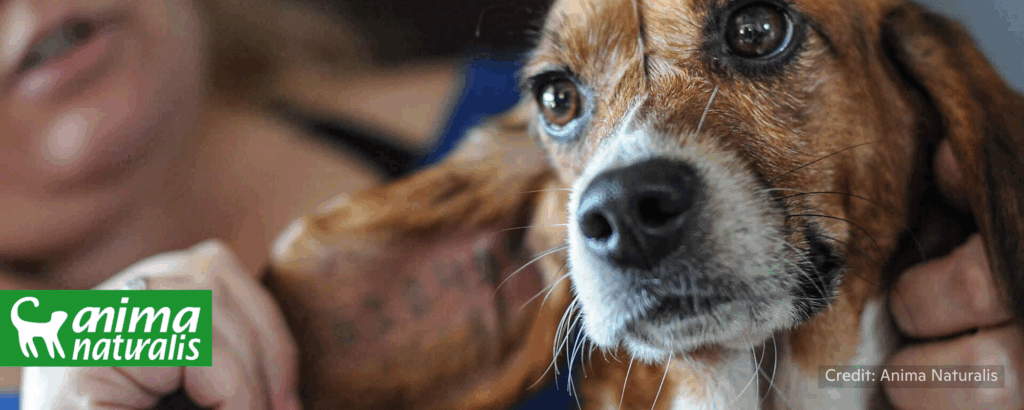
Animal Experimentation in Spain Declines in Numbers But Grows More Severe as Europe Moves Toward Alternatives
AnimaNaturalis, 1/1/2026
“Animal experimentation in Spain presents a troubling paradox: while the total number of animals used in research and education fell to 887,241 in 2014 – a 22.5% decrease compared to the previous year – the severity of the procedures they are subjected to has increased considerably. Procedures classified as ‘mild’ dropped from 66% to 50%, while ‘moderate’ tests jumped from 25% to 40%, and those considered ‘severe’ rose from 5.8% to 7.8%….”
“This trend is particularly concerning because it reveals that, although the absolute number of animals is decreasing, those who continue to be used are experiencing greater physical and psychological harm. ‘This is because in 2023 there was a spike in the use of fish, which has dropped sharply because that peak in experimentation in fish farms has ended,’ explains Aïda Gascón, director of AnimaNaturalis in Spain . . . The drop of 211,629 animals used between 2023 and 2024 is explained almost entirely by the collapse in the use of sea bass, which fell from 337,536 to just 33,558 uses. This 90% reduction does not reflect systematic ethical progress, but simply the completion of a specific project in fish farms that had generated a temporary spike in 2023 . . . In fact, if we exclude the variation in sea bass, the use of mammals increased by 6.52% in 2024.” 📰 Full Story →

Blue Mounds case shows experimenting on dogs is getting hard to defend
F.D. Flam, Wisconsin State Journal, 1/2/2026
“Medical experiments on research dogs could be phased out soon — a change that’s based as much on science as ethics. Pressure is coming from within the scientific community as well as from activists, following a string of scandals involving inhumane living conditions, including in Wisconsin. It follows a similar phase-out in the last decade of the use of captive chimpanzees, which was driven by growing recognition of chimpanzee intelligence and the close evolutionary kinship between our species and theirs.”
“The 2020 report concluded that only a small number of dog experiments might still be necessary for certain research programs. The report also deemed justifications based on historical breakthroughs to represent ‘circular reasoning,’ since we don’t know what’s possible with other methods. The study also noted that some data relevant to human health can be obtained by enrolling sick dogs in clinical trials, which might benefit them.”
“Being pro-science doesn’t have to include a belief in progress at all costs. It can mean accepting — and being guided by — the findings of existing science, including what they tell us about our kinship with other animals.” 📰 Full Story →
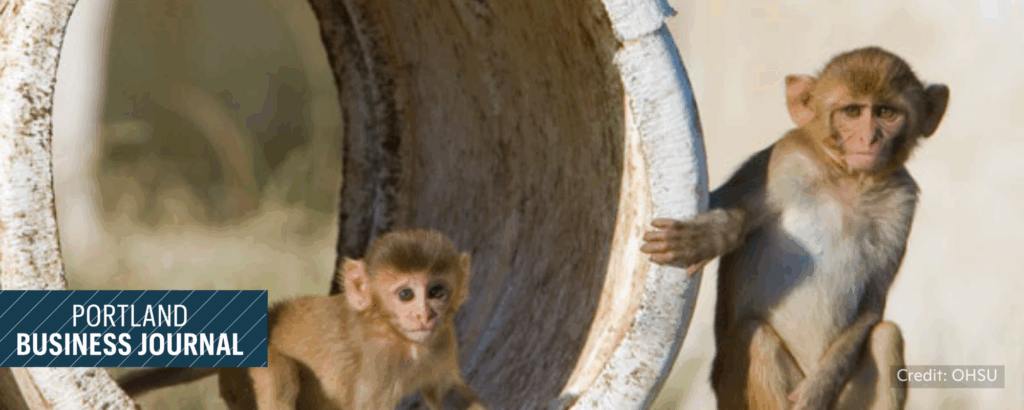
OHSU outlines scenarios for closing primate research center
Elizabeth Hayes, Portland Business Journal, 1/5/2026
“OHSU has outlined a plan and timeline to close the Oregon National Primate Research Center (ONPRC) [which “currently houses nearly 4,800 non-human primates, mostly monkeys and macaques, for research into vaccines for viruses, reproductive health, and more”], in the event that it experiences a 25% drop in funding from the National Institutes of Health. The Oregon Legislature required the plan as part of a budget note passed at the end of the 2025 session . . . The budget note doesn’t require the closure of the primate center, only that OHSU be prepared in the event of a drop in federal funding. Health and Human Services Secretary Robert F. Kennedy Jr. has spoken against animal testing and canceled $28 million in funding for animal labs.”
“‘It looks to me like the future of primate centers is unsustainable, and I want them to have a plan for dealing with that,’ Rep. David Gomberg, who represents Lincoln, Benton and Lane counties and who advocated for the budget note, told the Business Journal in October.” 📰 Full Story →
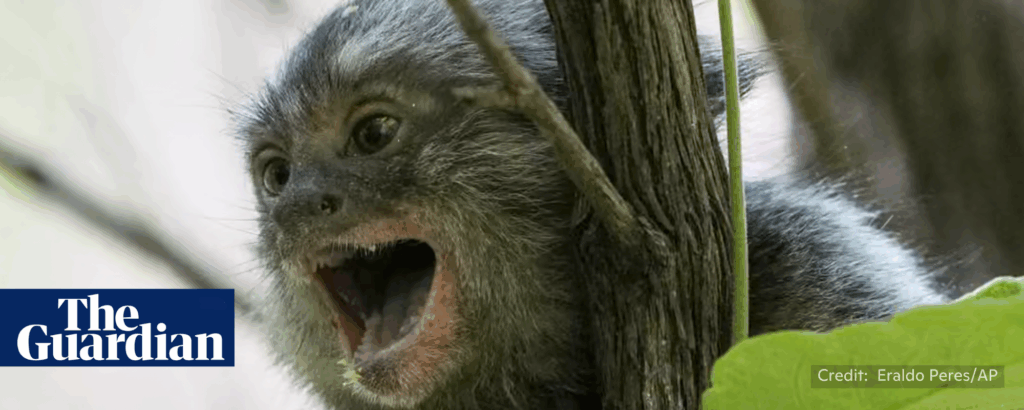
Are crabs animals and should we experiment on monkeys? Major review of Australia’s research code to mull tough questions
Petra Stock, The Guardian, 1/6/2026
“Animal sentience, categorising crustaceans as animals, and rehoming lab animals are all on the table as the Australian code for animal research is scrutinised for the first time in a decade. More than 845,000 animals – including mice, rats, guinea pigs, rabbits and primates – are used in laboratories in Australia each year, based on data from Victoria, New South Wales and Tasmania.”
“The RSPCA was also seeking a greater focus on monitoring and enforcement of laboratory animals – including inspections. ‘In general, government animal welfare officers only inspect research institutions in response to a cruelty complaint. To our knowledge these are rare, mainly due to research activities being behind closed doors and only being witnessed by those involved and so this creates a conflict of interest.’”
“Parker said the code relied heavily on self-regulation by researchers and institutions. ‘There’s no real external enforcement or monitoring and accountability’, an approach that was ‘out of step with how much Australians care about animals’. Animal Free Science Advocacy was seeking clear prohibitions – on experiments involving primates, and “high harm” procedures that caused severe or prolonged distress, including those replicating violent acts. They would like to see an end to the use of animals in teaching, particularly in high schools. Chief executive, Rachel Smith, said the organisation was also seeking more stringent rules for animal care, including a requirement that surgery only be performed by veterinarians – reflecting the standard expected for pet dogs and cats at a vet clinic . . . There should also be a greater onus on researchers seeking approval to explain why they are not using available non-animal alternatives, she said.” 📰 Full Story →
Help spread the word. Share this news compilation on X, Bluesky, or Facebook.