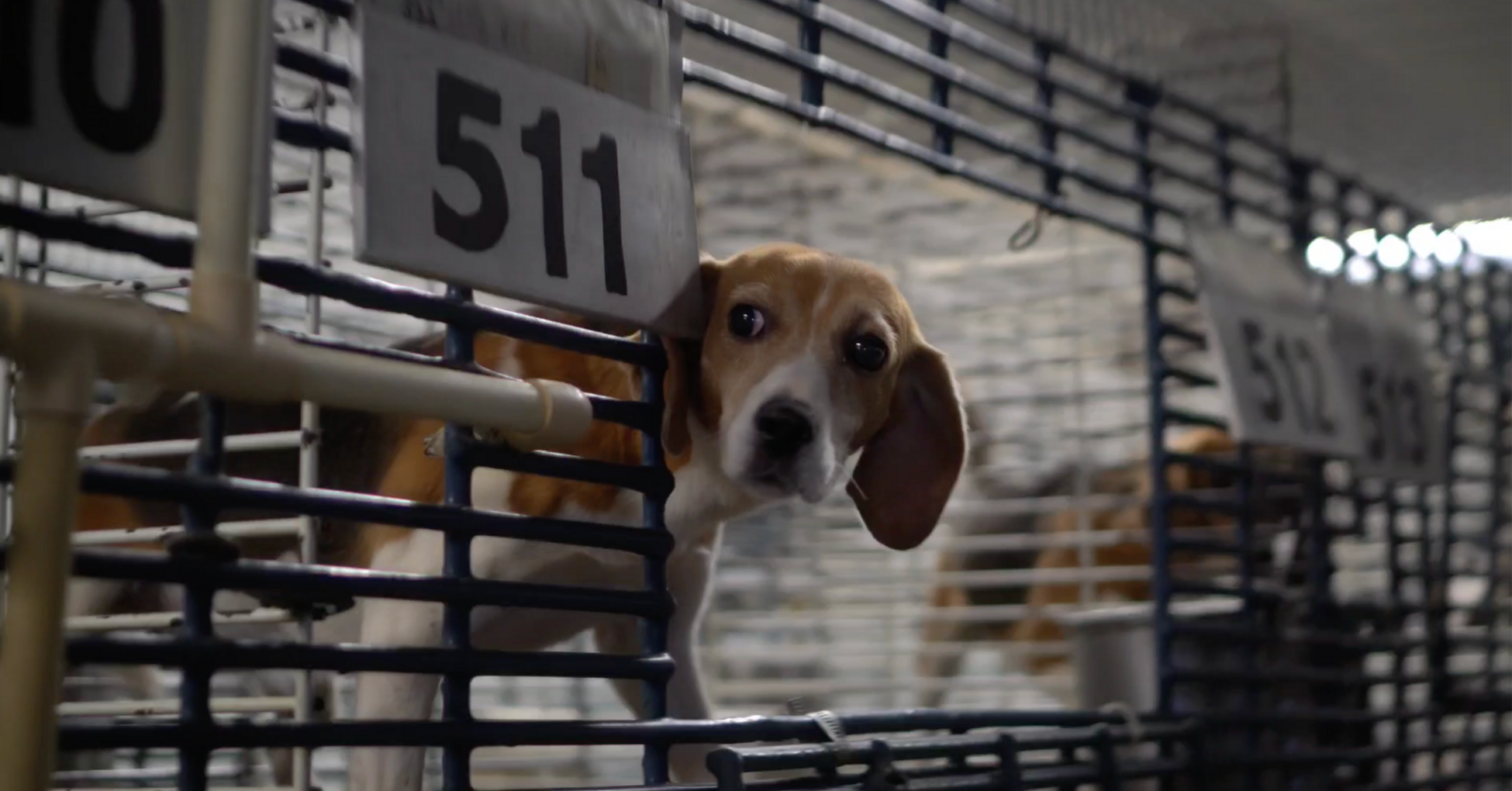
The Moral Illusion of “Helping”
Ridglan Farms wants you to believe it’s helping dogs.
That, somehow, by breeding, confining, brutalizing, and selling off beagles, it’s supporting science that will “help” other dogs.
This is the narrative Ridglan and its animal research allies have been shamelessly and repeatedly peddling—even now as they lament the winding down of Ridglan’s dog-breeding operation.
But, don’t be fooled.
Ridglan’s truth isn’t about helping anyone else. It’s about using dogs to turn a profit.
It’s about selling “retired” “breeders” to the University of Illinois to be enrolled in nutrition protocols so isolating that enrichment and socialization consist of staff collecting fecal samples, filling water bowls, and restraining the dogs for blood draws.
It’s about selling dogs to Colorado State University to be infected with a disease marked by “[m]ild to moderate febrile disease, poor appetite, muscle or joint pain, fever, coughing, abdominal pain, vomiting, diarrhea, swelling of the face or legs, or depression;” to have ticks glued to their bodies; and, then, to be killed.
It’s about selling 6-month-old puppies to the University of Missouri to endure infected ticks feeding on their bodies for days on end, while restrained in e-collars and housed alone.
It’s about selling dogs to the University of California at Davis to “study” dry eye— a condition Ridglan itself creates in dogs by cutting out their eye glands (without medical justification, anesthesia, pain control, or even appropriate personnel).
Sacrificed for the Greater Good?

This isn’t altruism. It’s exploitation. . .
The dogs Ridglan sold into these experiments were never intended to benefit from them. They were meant to suffer for the sake of speculative data, with the best-case scenario being that maybe some other dog will benefit, someday, somewhere.
. . . and, really, it’s dog sacrifice.
The argument that it’s justifiable to harm one being for the supposed benefit of another is ancient—and flawed.
The Manipulation of Language
As Roberta Kalechofsky writes, animal research, like ancient animal sacrifice, “functions as a coda and a symbol of our values, this time vested in the ‘scientific method,’….” Where once animals were killed to please gods, now they’re “sacrificed” to satisfy science—not because it’s just. But because it’s been ritualized . . . partly through language.
Lynda Birke, Arnold Arluke, and Mike Michael help lay this out in their aptly titled work The Sacrifice:
The passive voice is coupled with the use of euphemisms and the frequent omission of details of how animals live in laboratories, which combine to obscure what happens to animals. There are various euphemisms, but the most obvious is the word ‘sacrifice’ rather than ‘kill’ in scientific reports, drawing parallels with ritual sacrifice . . . This gives the killing a symbolic importance, as though the animal were sacrificed for some greater good.
The Ethical Line Crossed
And, that’s the narrative Ridglan and its defenders, like Americans for Medical Progress, are desperate to sell: that some animals must suffer so others can thrive. That harming the few is acceptable—noble, even—if it’s done in the supposed benefit of the many.
But, no matter how many times they repeat it, the argument remains what it’s always been: a betrayal of ethics and a smokescreen for (sacrificial) violence.
The real ethical question isn’t whether animal experimentation might help someone outside the lab. It’s whether it’s ever justifiable to harm an individual without their consent for someone else’s gain.
And, if the answer is “no” when the individual is a human, then it must also be “no” when the individual is a dog. Or a rat. Or any other sentient being.
Exploitation by Design
A growing chorus of ethicists, philosophers, and legal scholars argue that the same basic standards applied to human research—like the Belmont Report principles of respect, beneficence, and justice—should be extended to other animals. Why?
Because they, like humans, can suffer.
Because they, like humans, have interests.
And because they, like humans, matter in their own right.

Ridglan’s dogs didn’t volunteer for the studies that hurt them. They won’t benefit from their findings. And, they weren’t even selected out of scientific necessity.
They were victimized out of convenience—or, in the words of Ridglan customer University of Missouri, because they’re “easy to work with” and “commercially available.”
It is their very vulnerability that makes them attractive victims—and that is exactly what the Belmont Report forbids when applied to humans. Because that’s exploitation.
And, exploitation doesn’t become ethical just because the intended beneficiary changes.
Some argue that harming nonhuman animals to help other nonhuman animals is more ethical than harming them for human gain—undoubtedly the reason Ridglan has pivoted to its “dogs helping dogs” narrative.
But, from the perspective of any dog sold into scientific slavery, it really doesn’t matter whether the disease being studied is canine parvovirus or human cancer—whether their life is being co-opted in the interests of another dog or a human. The consequence and the outcome for them is the same.
Progress Demands Principles
We must reject the framing that some may be harmed for others to live, because others’ lives are neither tools to be used nor offerings to be made.
As Kalechofsky identifies, animal research is the modern equivalent of animal sacrifice: “a ritual intended as a symbolic dramatization of a worldview” that treats animals as offerings—to, in this case, the gods of knowledge and profit.
Only now, the altar is stainless steel. The implements of violence are ordered from a catalogue. And, the priest is a researcher in a white coat.
Neither the violence then nor the violence now serves the greater good. But even if it did, the ethical conclusion wouldn’t change.
Because the greater good cannot be built on the broken bodies and extinguished spirits of the vulnerable.
Not in ancient temples.
Not in modern labs.
Not anywhere.
Not ever.
Share on X or Bluesky to spread the word and expose the truth.
Or copy, paste, and share this link anywhere else:
riseforanimals.org/news/animal-sacrifice