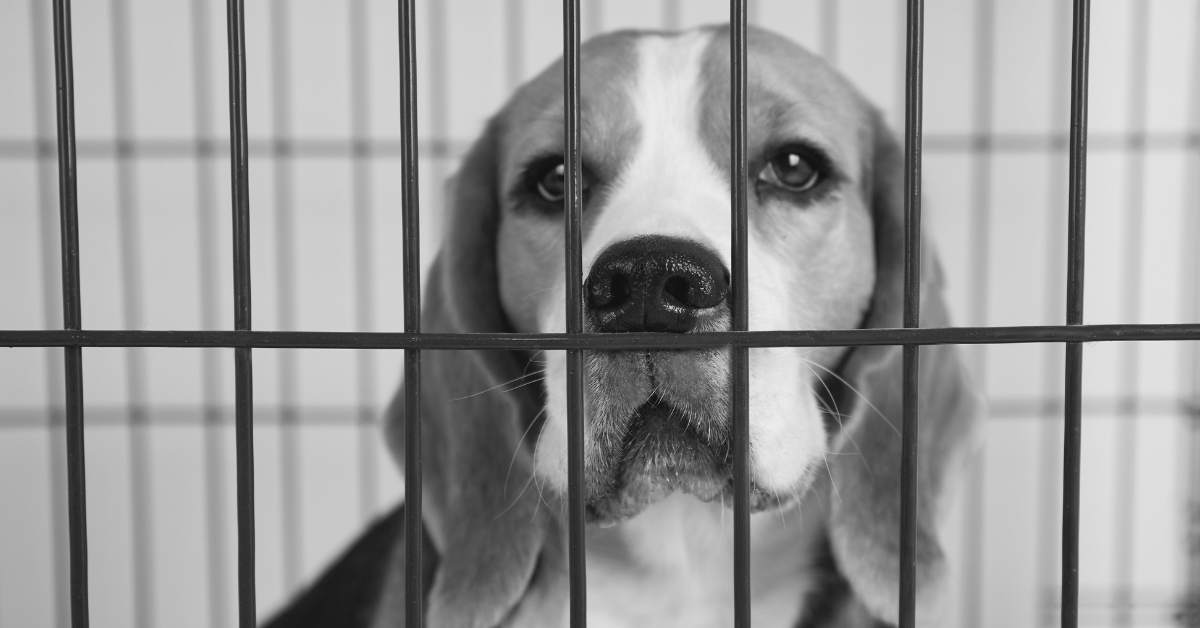
Public records obtained by Rise for Animals expose the fates of 52 beagles purchased by the University of Illinois Chicago (UIC) from Marshall BioResources, the nation’s largest breeder and supplier of dogs for experimentation.
Between November 2025 and March 2026, UIC bought 42 seven- and eight-month-old male and female beagles for toxicity and pharmacokinetics research and 10 male beagles (identified not by age but by “grade”) for cardiac research.
Forty-Two of the Beagles Were Assigned to a Toxicity-Testing Protocol
At UIC, 42 Marshall puppies were assigned to a protocol titled “Toxicity and Pharmacokinetics Studies in Large Animals,” which, according to the protocol itself, was undertaken “to predict potential adverse effects in humans” and “to determine the absorption, distribution, metabolism and elimination (ADME)” of test compounds by measuring how they move through dogs’ bodies.
The protocol belongs to Matthew Lindeblad, animal research veteran and director of UIC’s Toxicology Research Laboratory (TRL).
TRL is not an ordinary academic lab.
TRL describes itself as “combining private enterprise with academic excellence,” touts more than three decades of “successful collaborations with government agencies and industry partners,” and credits itself with helping advance more than 100 compounds toward clinical approval. It specifically offers “preclinical pharmacokinetics” in dogs, as well as mice, rats, rabbits, minipigs, and primates.
Toxicity Tests on Dogs Cannot Prove a Drug is Safe for Humans
The protocol’s premise—that dosing dogs with test compounds predicts how humans will respond to the same compounds—has never been scientifically validated.
Yes, toxicity in animal tests “shares some degree of correlation (above random chance) with the presence of toxicity in humans,” but that correlation is “neither reliable nor consistent” and is “too variable to be regarded as predictive.” This variability appears not only between nonhuman animals and humans but also between different nonhuman species (“mainly due to differences in the pharmacokinetic parameters”) and among individuals of the same species (due to “intrinsic differences”).
Because they cannot reliably or consistently predict safety for humans, animal toxicity tests mislead researchers and “create a false sense of security.”
Worse, they “have essentially no ability to predict the absence of toxicity, the very reason for their use in preclinical testing.”
As Robert Matthews, Visiting Professor in Statistical Science at Aston University, put it (albeit somewhat callously):
‘If Fido goes paws up, that’s bad news, but if he’s wagging his tail, it means nothing.’
The problem runs the other way, too: a drug that harms animals is unlikely to reach human trials, which means promising treatments may be discarded because of effects that would never have appeared in humans. Aspirin, for example, might never have reached humans had it first been toxicity tested in nonhuman animals.
The design of toxicity studies compounds these most fundamental problems.
For one thing, such “tests are designed to demonstrate a negative, which, by definition, cannot be achieved,” and this makes their “scientific basis . . . dubious.”
For another, toxicity tests are almost always carried out on “healthy animals,” whereas the test compounds are intended for sick humans—and illness changes how the body handles drugs. And, even if the same conditions experienced by humans existed in the nonhuman test subject, they would exist “in different forms” and with “different consequences.”
These types of “fundamental constraints” help explain why animal toxicity testing’s tremendous failure rate in predicting human toxicity has “not fallen in the last six decades and in fact has risen in the last two decades.”
Toxicity Testing Is Like Throwing Dogs in the Ocean to Drown
The tragic reality of these experiments is best captured by an analogy Dr. Ray Greek invokes: using animals in human toxicity testing is like throwing dogs into the ocean in an effort to save a drowning human:
Obviously throwing dogs into the ocean will not save the person. The only results of this insane action will be that the dogs too will drown. What the drowning person needs are life jackets….
Yet, the use of dogs and other animals as surrogates for humans in toxicity testing persists for historical and cultural reasons, including their “‘deceptive simplicity,’” and researcher laziness. And each new animal study builds a knowledge base that makes animal testing an “easier option” for the next researcher “even though other methods are available.” The result is that animal toxicity tests continue on a massive scale despite tremendous strides in human-relevant options like multi-organoid systems able to demonstrate toxicity that “animal studies had failed to detect” and computational models able to “predict both the presence and the absence of toxicity….”
Ten Beagles Were Assigned to a Private Contractor’s Protocol at UIC
UIC assigned 10 male “#2 grade” beagles to another protocol, titled “Pacing Induced Atrial Fibrillation in the Dog.” UIC’s approval letter, which named UIC as the only approved performance site, went to Dr. Peter Senese of CorDynamics, a private contract research organization that partners “with pharma and biotech teams” on “cardiovascular preclinical drug discovery and safety studies.”
The protocol’s stated purpose is “to create a model in which atrial fibrillation is inducible by rapid burst pacing following long term atrial pacing,” and then to use that “model” to test compounds’ effects on the condition.
In plain terms, the goal is to give dogs a heart arrhythmia so that experimental drugs can be tested on them.
CorDynamics markets atrial fibrillation “models” of this kind, including one it calls “Telemetry-Based Atrial Tachypacing,” which induces chronic atrial fibrillation in “large animals” through “rapid atrial pacing.” The protocol summary does not say which method was used on these dogs, but published literature describes how studies built on long-term atrial pacing typically work: researchers surgically implant a pacemaker, run its leads into the dog’s heart, and drive the atrium at a relentless rate—commonly 400 to 450 beats per minute, for weeks on end—until the cardiac tissue physically remodels and atrial fibrillation can be readily induced. Then, the drug testing begins.
Animal Researchers Concede That the Dog “Model” Translates Poorly
Atrial fibrillation researchers themselves have been candid about the limits of their methods.
A 2020 review of atrial fibrillation animal “models” in the American Heart Association journal Circulation Research acknowledged that the impediments of animal “models” are “apparent” and “stem largely from the differences in basic physiology as well as the complexities underlying human [atrial fibrillation]”—differences that “have obviated the translation of animal findings.”
That review is not an outlier. A 2024 review in the Journal of Zhejiang University-Science B conceded that animal “models” can only “imitate limited aspects of human [atrial fibrillation]” and “fail to fully reflect its complex pathophysiology.”
And writing about chronic tachypacing specifically—one of the very techniques advertised by CorDynamics—researcher Patrick M. Boyle acknowledged in an editorial published by Cardiovascular Research that animal “models[’]” “translational relevance is inherently limited by differences from human physiology.”
Those differences, it turns out, matter precisely where CorDynamics does business: testing drugs.
In an August 2026 study published in EP Europace, researchers at the University Heart and Vascular Centre Hamburg described large animal “models” of atrial fibrillation as “expensive and often ethically controversial,” and noted that even large animals can differ from humans in their atrial electrophysiology—to the point of responding in opposite ways to investigational drugs designed to act on the atria. Their answer was to build atrial heart tissue from human stem cells, pace it, and trigger a self-sustaining, fibrillation-like state in the lab, which they describe as the first in vitro “model” of its kind (alongside characterizations of other in vitro models as both “cost-effective and ethically sound”).
UIC Is Only One of Marshall’s Buyers
The records from UIC tell us the fates of 52 specific Marshall beagles, though their tragic stories are not unique.
They are illustrative of a corporate supply chain that moves “purpose-bred” beagles from sheds in North Rose, New York, to laboratories all across the country—where they are dosed, instrumented, and used as experimental bodies for unethical and scientifically debunked research.
We must work together to write different stories for all those beings whose fates have not yet been determined.